How does electricity turn on a light?
Build circuits with batteries, wires, switches and bulbs, find the breaks and compare series and parallel.
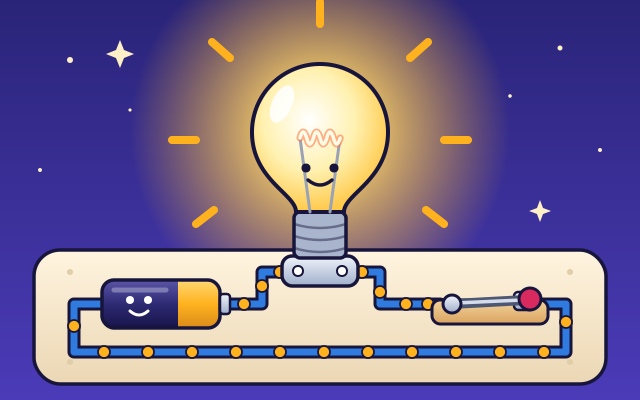
The big idea: A bulb lights when there is a complete loop, called a circuit, from the battery, through the bulb and back. The battery pushes electric charge around the loop. A gap anywhere stops it everywhere.
It's like
The interactive parts didn't load. The explanations below still work; try reloading the page.
The secret loop inside a flashlight
- It's bedtime and the room is dark. Click! A flashlight shines. But how does a battery make a bulb light up? Let's find out.
- Electricity flows only when there is a complete loop: out of the battery, along a wire, through the bulb and back to the battery. This loop is called a circuit.
- The wires are already full of tiny charged particles. The battery pushes on all of them at once, so the whole loop starts flowing together, like marbles in a tube.
- Inside an old-style bulb is a very thin wire called a filament. Pushing the current through it makes it hot, so hot that it glows with bright light.
- A switch is like a drawbridge. When it's open there's a gap in the loop, so everything stops. Close it and the bulb lights again, right away.
- Two bulbs in one loop, called series, share the battery's push and glow dimmer. In parallel, each bulb has its own path to the battery, so both glow brightly.
Inside a flashlight
A flashlight is a complete circuit in a tube. Tap each part to see its job.
- Batteries. Two batteries sit end to end, the bump of one touching the flat end of the next. Together they push twice as hard as one.
- Spring contact. The metal spring presses the batteries together so every part touches. It also carries the current from the battery's flat end.
- Metal strip. A metal strip runs along the inside of the case. It is the flashlight's wire, carrying the current from the bulb back to the battery.
- Switch. The switch slides a piece of metal into the gap in the strip. On closes the loop. Off opens a gap, and the light goes out.
- Bulb. The bulb has two metal contacts: one on its tip and one on its side. Current goes in one, through the filament and out the other.
- Filament. The filament is a very thin, coiled wire. It is hard for the current to get through, so it heats up and glows white-hot.
- Reflector. The shiny curved cup around the bulb bounces light forward, so it shines in a strong beam instead of spreading everywhere.
- Lens. The clear plastic front protects the bulb and lets the light out.
- Case. The plastic case holds all the parts in place. Plastic doesn't carry electricity, so the current stays inside the circuit.
Circuit builder: series or parallel?
Pick a part from the box, then tap a gap on the board to put it there (or drag it). Build a loop to light a bulb, then try two bulbs in series and in parallel.
Experiment: You have two bulbs. Are they brighter in one loop (series) or on two separate paths (parallel)?
- Press Series to make two bulbs in one loop. How bright are they?
- Press Parallel to give each bulb its own path. Compare!
- Use the eraser to take away one bulb in each circuit. What happens to the other one?
What we found: In series, the two bulbs share one path and the battery's push, so each glows dimmer, and if one goes out they both do. In parallel, each bulb has its own path, so both glow brightly and one keeps working if the other is removed. But the battery has to work harder, so it runs down faster.
Turn on JavaScript to try it yourself.
Circuit detective
Each circuit has one fault. Find it and tap it to fix it. Then build a circuit where both bulbs glow brightly.
Circuits, current and switches
Everything is made of tiny particles, and some of them carry electric charge. In metals, some of those charged particles, called electrons, can move around freely. When a battery is connected in a complete loop, it pushes them along the wire. This flow of charge is called an electric current.
The flow needs a closed path, called a circuit. If there is a gap anywhere, the current stops everywhere, all at once. That's why a switch works: it opens a gap in the loop to turn things off, and closes it to turn them on again.
A bulb lights because its thin filament is hard for the current to push through. The moving charge transfers energy to the filament, which gets so hot that it glows. The battery isn't filled with electricity that gets used up. It is a store of energy that keeps the charges moving.
Bulbs can be wired in series (one after another in one loop) or in parallel (each on its own branch). In series, they share the battery's push and glow dimmer, and if one breaks they all go out. In parallel, each bulb gets the full push and stays bright, which is why the lights in a house are wired in parallel.
Key words
- Circuit
- A complete loop that electricity can flow around.
- Current
- The flow of electric charge around a circuit.
- Voltage
- The push that a battery gives the electricity, measured in volts.
- Resistance
- How hard it is for current to flow through something.
- Series and parallel
- Series: parts in one single loop. Parallel: parts on separate branches.
- Short circuit
- A path with almost no resistance that lets a dangerously large current flow.
Check your thinking
-
Why does the bulb light only when the loop is complete?
Show the answer
Current can only flow around a complete path. A gap anywhere stops the flow everywhere, so the loop must be complete.
-
What does an open switch do?
Show the answer
Makes a gap so current can't flow. An open switch breaks the loop, so the current stops and the bulb goes out.
-
Two bulbs are in series. One breaks. What happens to the other?
Show the answer
It goes out too. In series there is only one loop. A break anywhere stops the current for every bulb.
-
A bulb has 6 V across it and 0.5 A flowing through it. What is its resistance?
Show the answer
12 Ω. R = V ÷ I = 6 ÷ 0.5 = 12 Ω.
-
Why is a short circuit dangerous?
Show the answer
A huge current flows and things get hot. The current skips the bulb and rushes through the wire, which can make wires and batteries dangerously hot.
-
Two bulbs in series are dim. How could you make both brighter with the same battery?
Show the answer
Rewire them in parallel. In parallel each bulb gets the full battery voltage, so each glows as brightly as a single bulb.
You're a Electricity & energy expert!
You watched, looked inside, tried it, solved the challenge and went deeper. Pick another question below, or switch the age at the top to see this topic another way.
More about electricity & energy
 #42
Electricity & energy
How do batteries power things?
Look inside a simplified battery and explore chemical energy becoming electrical energy. Connect different devices and compare how quickly they use its stored energy.
#42
Electricity & energy
How do batteries power things?
Look inside a simplified battery and explore chemical energy becoming electrical energy. Connect different devices and compare how quickly they use its stored energy.
 #43
Electricity & energy
How do solar panels make electricity?
Explore a solar cell and follow sunlight becoming electrical energy. Adjust shade, panel direction, and time of day while watching output change.
#43
Electricity & energy
How do solar panels make electricity?
Explore a solar cell and follow sunlight becoming electrical energy. Adjust shade, panel direction, and time of day while watching output change.
 #44
Electricity & energy
How do wind turbines make electricity?
Follow wind turning the blades and driving a generator. Explore the inside of a turbine and power a model village under different wind conditions.
#44
Electricity & energy
How do wind turbines make electricity?
Follow wind turning the blades and driving a generator. Explore the inside of a turbine and power a model village under different wind conditions.
 #45
Electricity & energy
How do electric motors make things move?
Explore magnets, coils, and a turning shaft in a simplified motor. Use it to drive a fan, toy car, or conveyor belt.
#45
Electricity & energy
How do electric motors make things move?
Explore magnets, coils, and a turning shaft in a simplified motor. Use it to drive a fan, toy car, or conveyor belt.
Keep exploring
Games to play next
- Circuit Workshop 3DWire up batteries, bulbs and switches on a 3D workbench.
- SwitchworksFlip switches to light the lamps in the target pattern — in as few presses as you can.
- Machine RepairFix levers, pulleys, gears and ramps so every contraption works.
Guide for grown-ups
- How to start homeschooling: a step-by-step guide for familiesA guide for parents · 7 min read
Science games by grade
Science worksheets by grade
- Preschool Science Worksheets
- Pre-K Science Worksheets
- Kindergarten Science Worksheets
- 1st Grade Science Worksheets
- 2nd Grade Science Worksheets
- 3rd Grade Science Worksheets
- 4th Grade Science Worksheets
- 5th Grade Science Worksheets
- 6th Grade Science Worksheets
- 7th Grade Science Worksheets
- 8th Grade Science Worksheets