How does wireless charging recharge a device?
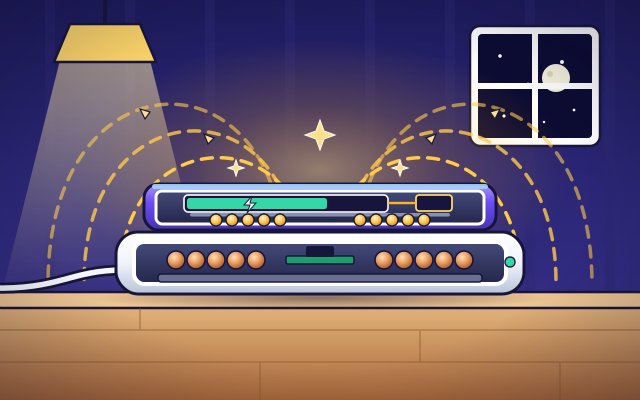
A coil of wire in the pad makes a changing magnetic field. A coil in the phone catches it and turns it back into electricity for the battery.
The big idea: Electricity in the pad's coil makes a magnet that flips back and forth very fast. That flipping magnet pushes electricity around the coil in the phone, but only when the two coils sit close together and line up.
It's like a magnet under a table moving a paper clip on top. Here the magnet flips back and forth very fast, and that pushes electricity around a coil.
The interactive parts didn't load. The explanations below still work; try reloading the page.
Charging without a wire
- Lay a phone on a charging pad and its battery starts to fill. The pad has a cable, but nothing plugs into the phone. So how does the energy get in?
- Look inside. The pad holds a flat coil of copper wire. Hidden in the back of the phone is another coil, just like it.
- Electricity running around a coil turns it into a magnet. The pad switches its current back and forth very quickly, so its magnetic field grows, shrinks and flips again and again.
- That changing field reaches through the phone's coil and pushes electricity around it. The phone tidies this electricity up and feeds it to the battery.
- The coils must line up. Slide the phone off to one side and most of the field misses its coil, so it charges slowly or not at all. Centered, it charges fast.
- The pad is careful. It first checks that a real phone is there, so a coin or a key gets no power. When the battery is full, the phone tells the pad to stop.
Look inside a wireless charger
The pad and the phone are cut through the middle. Tap each part to see its job.
- Power cable. The cable brings electricity from a wall adapter to the pad. Only the pad is plugged in.
- Pad circuit. A little circuit that switches the electricity back and forth very quickly, because only a changing magnet can push electricity in the phone's coil.
- Pad coil. A flat spiral of copper wire. When the flipping current runs around it, it makes a magnetic field that reaches up out of the pad.
- Magnetic shield. A dark sheet behind each coil. It guides the magnetic field toward the other coil and keeps it away from the other parts.
- Phone coil. A thin spiral of wire in the back of the phone. The changing field from the pad pushes electricity around it.
- Charging chip. The electricity from the coil flips back and forth, but a battery needs it to flow one way. This chip straightens it out and controls the charging.
- Battery. The battery stores the energy as it arrives, ready to run the phone later.
Line up the coils
Drag the phone over the pad. Watch the two coils, the field in the side view and the charging speed. What happens off-center?
Experiment: The phone is charging in the middle of the pad. What happens if you slide it partly off to one side?
- Drag the phone until its coil sits right over the pad's coil.
- Slide it a little to one side and watch the charging speed.
- Slide it further until the pad gives up.
What we found: The further the coils are from lining up, the less of the pad's field passes through the phone's coil. Charging slows down, more energy is wasted as heat, and at last the pad stops.
Turn on JavaScript to try it yourself.
Find the hidden coil
Three phones, and each hides its coil in a different place. Move each one until it charges at full speed.
How energy crosses without a wire
Electricity and magnetism are two sides of one thing. When electricity flows around a coil of wire, the coil becomes a magnet. And it works the other way too: when a magnet's field changes near a coil of wire, it pushes electricity around the coil. That second effect is called induction.
A charging pad uses both. Inside the pad is a flat coil of copper wire. The pad sends electricity around it, switching direction many thousands of times every second. So the coil is a magnet whose field keeps growing, shrinking and flipping over.
The phone has its own flat coil, tucked in its back. When the phone lies on the pad, the pad's changing field reaches through the phone's coil and pushes electricity around it. A chip in the phone straightens that electricity out and feeds it to the battery. Energy has crossed the gap with no wire, carried by the magnetic field.
The trick only works up close. The field spreads out and fades fast, so the two coils must be near each other and lined up. A thick case or a phone that is off-center means less field is caught, slower charging and more wasted heat. Electric toothbrushes charge the same way, which keeps their bases sealed against water. The magnet under the table is a good picture, but remember that a steady magnet would do nothing here: the field has to keep changing.
Key words
- Coil
- Wire wound round and round. A charging pad and a phone each have a flat one.
- Magnetic field
- The invisible push and pull around a magnet or around a wire carrying electricity.
- Induction
- A changing magnetic field pushing electricity around a nearby coil.
- Alternating current
- Electricity that keeps switching direction, back and forth, many times a second.
- Coupling
- How well the two coils are linked: how much of the pad's field the phone's coil catches.
- Efficiency
- The share of the energy put in that arrives where it is wanted. The rest is wasted, mostly as heat.
Check your thinking
-
What carries the energy from the pad to the phone?
Show the answer
A changing magnetic field. The pad's coil makes a magnetic field that keeps changing, and that pushes electricity around the phone's coil.
-
Where does a phone charge fastest on a pad?
Show the answer
With its coil directly over the pad's coil. When the coils line up, most of the pad's field passes through the phone's coil.
-
Why does the pad switch its electricity back and forth so quickly?
Show the answer
Only a changing magnetic field pushes electricity in the phone's coil. A steady magnet does nothing to a coil sitting still. The field has to keep changing.
-
You put a very thick case on your phone. What will probably happen on the pad?
Show the answer
It charges more slowly, because the coils are further apart. The field fades quickly with distance, so less of it reaches the phone's coil.
-
Why does a charging pad check for a phone before it sends full power?
Show the answer
So that a metal object such as a coin is not heated by mistake. A changing field induces currents in any metal. The pad transmits only when a receiver answers, and stops if energy goes missing.
You're a Electricity & energy expert!
You watched, looked inside, tried it, solved the challenge and went deeper. Pick another question below, or switch the age at the top to see this topic another way.
More about electricity & energy
 #41
Electricity & energy
How does electricity turn on a light?
Build virtual circuits using batteries, wires, switches, and bulbs. Find breaks in a circuit and compare simple series and parallel arrangements.
#41
Electricity & energy
How does electricity turn on a light?
Build virtual circuits using batteries, wires, switches, and bulbs. Find breaks in a circuit and compare simple series and parallel arrangements.
 #42
Electricity & energy
How do batteries power things?
Look inside a simplified battery and explore chemical energy becoming electrical energy. Connect different devices and compare how quickly they use its stored energy.
#42
Electricity & energy
How do batteries power things?
Look inside a simplified battery and explore chemical energy becoming electrical energy. Connect different devices and compare how quickly they use its stored energy.
 #43
Electricity & energy
How do solar panels make electricity?
Explore a solar cell and follow sunlight becoming electrical energy. Adjust shade, panel direction, and time of day while watching output change.
#43
Electricity & energy
How do solar panels make electricity?
Explore a solar cell and follow sunlight becoming electrical energy. Adjust shade, panel direction, and time of day while watching output change.
 #44
Electricity & energy
How do wind turbines make electricity?
Follow wind turning the blades and driving a generator. Explore the inside of a turbine and power a model village under different wind conditions.
#44
Electricity & energy
How do wind turbines make electricity?
Follow wind turning the blades and driving a generator. Explore the inside of a turbine and power a model village under different wind conditions.
Keep exploring
Games to play next
- Circuit Workshop 3DWire up batteries, bulbs and switches on a 3D workbench.
- SwitchworksFlip switches to light the lamps in the target pattern — in as few presses as you can.
- Machine RepairFix levers, pulleys, gears and ramps so every contraption works.
Guide for grown-ups
- How to start homeschooling: a step-by-step guide for familiesA guide for parents · 7 min read
Science games by grade
Science worksheets by grade
- Preschool Science Worksheets
- Pre-K Science Worksheets
- Kindergarten Science Worksheets
- 1st Grade Science Worksheets
- 2nd Grade Science Worksheets
- 3rd Grade Science Worksheets
- 4th Grade Science Worksheets
- 5th Grade Science Worksheets
- 6th Grade Science Worksheets
- 7th Grade Science Worksheets
- 8th Grade Science Worksheets