How do waves change coastlines?
Every wave carries energy. Waves wear away cliffs and headlands, carry sand along the shore and build beaches where the water is calm.
The big idea: Waves hit hardest on rocky points that stick out, and wear them away. They carry the sand along the shore and drop it in quiet bays, making beaches.
It's like sweeping a floor with a broom. Each sweep, like each wave, moves the grit a little way along, and it piles up wherever something blocks it.
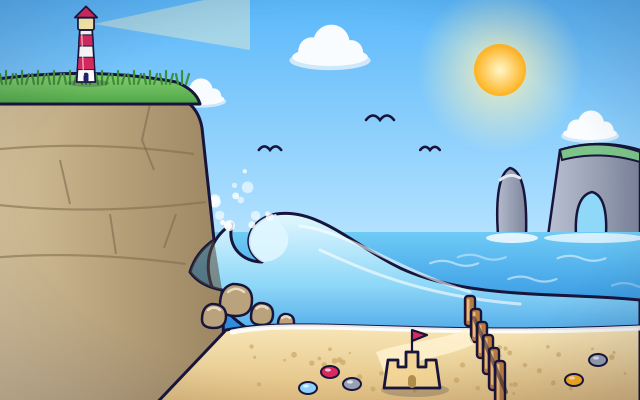
The interactive parts didn't load. The explanations below still work; try reloading the page.
How waves shape a coast
- A beach looks like it stays the same, but it does not. Thousands of waves arrive every day, and each one moves a little sand or chips a little rock.
- Wind blowing over the sea makes waves. Stronger wind blowing farther makes bigger waves. When a wave breaks on the shore, all that energy hits the land.
- Waves pound the foot of a cliff and hurl sand and pebbles at it. They cut a notch. When the rock above has nothing holding it up, it falls, and the cliff steps back.
- Seen from above, waves bend around a headland, the rocky point that sticks out. They crash hardest there. In the sheltered bay the waves are weaker, so they drop their sand and build a beach.
- When waves arrive at a slant, each one pushes sand up the beach at an angle. The water then runs straight back down. Zigzag by zigzag, the sand travels along the shore.
- People who look after coasts use what they know. Low fences called groynes catch drifting sand, and dune grass holds it in place. But sand caught here cannot reach the next beach.
A coast seen from above
This is a coast seen from high above. Tap each place to see how the waves shaped it.
- Waves. Waves bring the energy that shapes the coast. They bend as they reach shallow water, so they nearly match the shape of the shore.
- Headland. A headland is a point of harder rock that sticks out into the sea. Waves bend toward it and hit it from three sides.
- Cliff. Waves cut a notch into the bottom of the cliff. When the notch is deep enough, the rock above it falls and the cliff moves back.
- Arch and stack. Waves widen a crack into a cave. The cave breaks through to make an arch. When the roof of the arch falls, a tower called a stack is left.
- Bay beach. In the sheltered bay the waves are gentler. They cannot carry their sand any more, so they drop it and a beach builds up.
- Groyne. A groyne is a low wall built across the beach. Drifting sand piles up on the side the waves come from. The other side gets less.
- Spit. Where the coast bends, drifting sand keeps going straight and builds a long finger of sand called a spit.
- Sand dunes. Wind blows dry sand up the beach into dunes. Tough grasses trap the sand with their roots. Dunes protect the land behind them from storms.
Wave tank: which way does the sand go?
Drag the wind cloud to change where the waves come from, and change their size. Which way does the red pebble travel, and where does the beach grow?
Experiment: The waves come from the left side at a slant. What happens to the sand on the beach?
- Drag the wind cloud to the left. Watch the red pebble.
- Now drag the cloud to the right. What changes?
- Put the cloud in the middle. Does the pebble still travel?
What we found: Slanted waves push sand up the beach sideways, and the water runs straight back. So the sand zigzags away from where the waves come from. Straight-on waves just move it up and down.
Turn on JavaScript to try it yourself.
Save the village beach
Winter storms will narrow this beach. Place up to two groynes, then run the season. Keep the village beach wide.
How waves build and break a coast
Waves are made by wind. As wind blows across the sea it pushes the surface into ripples, and the ripples grow into waves. A storm far out at sea can send waves across a whole ocean. When a wave reaches the shore it breaks, and the energy it carried has to go somewhere. It goes into moving sand and breaking rock.
Waves break rock in a few ways. They slam water into cracks. They throw sand and pebbles at the cliff like sandpaper. Some rocks slowly dissolve in seawater. The pebbles also knock against each other, which is why beach pebbles are smooth and round.
A coast is rarely made of one kind of rock. Soft rock wears away quickly and leaves curved bays. Hard rock is left sticking out as headlands. Waves bend toward the headlands and hit them hardest, carving caves, arches and stacks. In the bays the water is calmer, so sand settles and beaches form.
Sand does not stay put. Slanted waves carry it along the shore in a zigzag, called longshore drift. People build groynes and plant dune grass to keep sand where they need it. That works, but the sand they catch is sand the next beach does not get. Today many coastal teams add extra sand or leave room for the shore to move.
Key words
- Erosion
- Wearing away rock or sand and carrying it off.
- Deposition
- When water slows down and drops the sand it was carrying.
- Headland
- A point of hard rock that sticks out into the sea.
- Longshore drift
- The zigzag journey of sand along a beach when waves arrive at a slant.
- Groyne
- A low wall or fence built across a beach to catch drifting sand.
- Swash and backwash
- Swash is water rushing up the beach after a wave breaks. Backwash is the water running back down.
Check your thinking
-
Where do waves get their energy?
Show the answer
From wind blowing over the sea. Wind pushes the sea surface into waves. Stronger wind over more open water makes bigger waves.
-
Why do beaches form in bays but not on headlands?
Show the answer
Waves are weaker in bays, so they drop their sand there. Calm water cannot carry sand, so the sand settles. On the headland the strong waves carry everything away.
-
Waves reach a beach at a slant from the left. Which way does the sand move?
Show the answer
Along the beach to the right. Each wave pushes the sand up and to the right; the water runs straight back. The zigzag heads right.
-
A town builds groynes and its beach grows. What might happen to the next beach along the coast?
Show the answer
It may get thinner, because less sand reaches it. The groynes keep sand that would have drifted on. The next beach gets less, so the waves wear it down.
-
How do waves make a cliff fall?
Show the answer
They cut a notch at the bottom until the top has no support. Waves attack the foot of the cliff. Once the notch is deep, the overhanging rock breaks off.
You're a Earth & weather expert!
You watched, looked inside, tried it, solved the challenge and went deeper. Pick another question below, or switch the age at the top to see this topic another way.
More about earth & weather
 #468
Earth & weather
How does air pollution form and spread?
Trace model emissions, particles, wind, and atmospheric reactions across a town.
#468
Earth & weather
How does air pollution form and spread?
Trace model emissions, particles, wind, and atmospheric reactions across a town.
 #469
Earth & weather
How do greenhouse gases warm the planet?
Compare incoming sunlight and outgoing heat in a simplified atmospheric model.
#469
Earth & weather
How do greenhouse gases warm the planet?
Compare incoming sunlight and outgoing heat in a simplified atmospheric model.
 #470
Earth & weather
How does carbon move through the environment?
Follow carbon between air, plants, animals, soil, oceans, and fuels.
#470
Earth & weather
How does carbon move through the environment?
Follow carbon between air, plants, animals, soil, oceans, and fuels.
 #69
Earth & weather
How do clouds form, and why does it rain?
Follow a water droplet through evaporation, condensation, rainfall, and its return to rivers or oceans. Change conditions in a simple water-cycle simulation.
#69
Earth & weather
How do clouds form, and why does it rain?
Follow a water droplet through evaporation, condensation, rainfall, and its return to rivers or oceans. Change conditions in a simple water-cycle simulation.
Keep exploring
Games to play next
- Landform ExplorerMountains, valleys, peninsulas and deltas — learn the shapes of the land and find them on Earth.
- Weather LabPredict the weather in a box, then run a fair test to find out why.
- River MysterySomething changed the river. Sample sites with a limited budget, follow the evidence and find where the change begins.
Guide for grown-ups
- How to start homeschooling: a step-by-step guide for familiesA guide for parents · 7 min read
Science games by grade
Science worksheets by grade
- Preschool Science Worksheets
- Pre-K Science Worksheets
- Kindergarten Science Worksheets
- 1st Grade Science Worksheets
- 2nd Grade Science Worksheets
- 3rd Grade Science Worksheets
- 4th Grade Science Worksheets
- 5th Grade Science Worksheets
- 6th Grade Science Worksheets
- 7th Grade Science Worksheets
- 8th Grade Science Worksheets