How do greenhouse gases warm the planet?
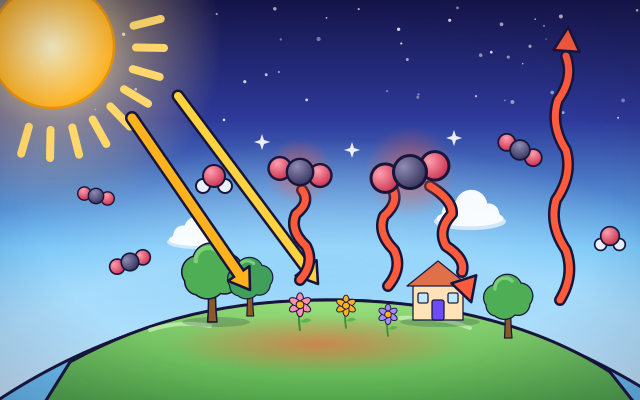
Sunlight comes in and heat goes out. Greenhouse gases catch some of the outgoing heat and send it back, which keeps Earth warm enough to live on.
The big idea: Earth takes in sunlight and gives off heat. Greenhouse gases catch part of that heat before it reaches space. A little keeps us cozy; more makes the planet warmer.
It's like a blanket: it makes no heat of its own, it just slows your warmth from escaping. A thicker blanket keeps you warmer.
The interactive parts didn't load. The explanations below still work; try reloading the page.
How greenhouse gases keep Earth warm
- Energy reaches Earth as sunlight. Most of it passes straight through the clear air and warms the land and sea. Some bounces off clouds and ice, back to space.
- Everything warm gives off heat as invisible light called infrared. The warm ground shines infrared upward, day and night. That is how Earth cools down.
- A few gases in the air, such as carbon dioxide, water vapor and methane, catch infrared. Each molecule shakes, then sends the heat out again in any direction. Some of it heads back down.
- This is the natural greenhouse effect, and it is a good thing. Without it Earth would average about 18 degrees below zero Celsius. With it, the average is about 15 degrees: just right for life.
- Burning coal, oil and gas adds extra carbon dioxide. More heat is caught, so the balance shifts and the planet warms. Earth is already more than 1 degree Celsius warmer than in the 1800s.
- The good news: we know the cause, so we know the fix. Solar panels, wind turbines and electric travel make energy without adding carbon dioxide, and forests take some back out of the air.
Energy in, energy out
Tap each arrow and each gas to see where the energy goes.
- Incoming sunlight. Sunlight travels through space and passes through the air almost as if it were not there.
- Reflected sunlight. Bright things such as clouds, snow and ice bounce some sunlight straight back to space. That light never warms the ground.
- Warm ground and sea. Land and sea soak up the sunlight that reaches them and warm up. Then they give that energy off again as heat.
- Outgoing heat. The warm ground shines invisible infrared light upward. The warmer the ground, the more it gives off.
- Carbon dioxide. Carbon dioxide is made of one carbon atom and two oxygen atoms. It catches infrared and sends it out again in all directions. It stays in the air for a very long time.
- Water vapor. Water vapor is water as an invisible gas. It catches the most heat of all. Warmer air holds more of it.
- Methane. Methane comes from swamps, cows, rice fields and leaks of natural gas. Each molecule catches much more heat than carbon dioxide, but it breaks down after about ten years.
- Heat escaping to space. Some heat slips between the gas molecules and escapes to space. When the heat going out matches the sunlight coming in, the temperature stays steady.
Energy model: sunlight in, heat out
Add or remove greenhouse gas with the plus and minus buttons. Watch the red heat arrows and the thermometer. What happens with no gas at all? With a lot?
Experiment: You add more greenhouse gas and wait. What does the ground temperature do?
- Take all the gas away and wait. Read the thermometer.
- Add gas a step at a time. Watch how many heat arrows turn back.
- Does the temperature keep climbing, or settle?
What we found: More greenhouse gas turns more heat arrows back, so the ground warms. But warm ground gives off more heat, so soon as much escapes as arrives, and the temperature settles at a new, higher level. No gas at all means a frozen planet.
Turn on JavaScript to try it yourself.
The just-right planet
Choose how much greenhouse gas to give this planet, then let the Sun shine. Land the temperature in the green band, 12 to 18 degrees.
Why greenhouse gases matter
Earth is always doing two things at once: soaking up sunlight and giving off heat. If more energy comes in than goes out, the planet warms. If more goes out than comes in, it cools. The temperature stays steady only when the two are equal.
Sunlight passes through air easily. The heat that Earth gives off is a different kind of light, called infrared, and some gases catch it. Carbon dioxide, water vapor and methane are the main ones. When a molecule catches infrared it shakes, then sends the heat off in a random direction, sometimes back toward the ground. So the ground ends up warmer than it would otherwise be.
That is the natural greenhouse effect, and we need it. Without it, Earth would be a frozen world at about 18 degrees below zero Celsius. But for about 200 years people have burned coal, oil and gas, which adds carbon dioxide to the air faster than plants and oceans can take it up. The blanket has thickened, and Earth has warmed by more than 1 degree Celsius.
The hopeful part is that the cause is well understood. Electricity from sunshine and wind adds no carbon dioxide, and it has become much cheaper. Electric buses, trains and cars, homes that waste less heat, and healthy forests all help too. People all over the world, including many young people, are working on these.
Key words
- Greenhouse gas
- A gas in the air that catches heat, such as carbon dioxide, water vapor or methane.
- Infrared
- Invisible light that warm things give off. You feel it as warmth.
- Energy balance
- The state in which a planet gives off exactly as much energy as it takes in, so its temperature holds steady.
- Albedo
- How much sunlight a surface bounces back. Snow has a high albedo; dark sea has a low one.
- Carbon dioxide
- A gas made of one carbon atom and two oxygen atoms. Burning fuel makes it, and plants take it in.
- Emissions
- Gases put into the air by human activity, such as carbon dioxide from burning fuel.
Check your thinking
-
What do greenhouse gases do to the heat leaving the ground?
Show the answer
They catch some of it and send part back down. The gases do not make heat. They catch outgoing infrared and re-send it in all directions, including downward.
-
Is the natural greenhouse effect good or bad for life?
Show the answer
Good: without it Earth would be frozen. The natural effect keeps Earth about 33 degrees warmer than it would be. The problem is adding too much extra.
-
More greenhouse gas is added. Why does the temperature not rise forever?
Show the answer
Warmer ground gives off more heat, until heat out matches sunlight in. A warmer surface shines more infrared. The warming stops when the amount escaping equals the amount arriving.
-
Which of these adds carbon dioxide to the air?
Show the answer
Burning coal, oil or gas. Fossil fuels are made of carbon. Burning them joins that carbon to oxygen and releases carbon dioxide.
-
Arctic sea ice melts and leaves dark open water. What does this do to Earth's energy budget?
Show the answer
Albedo falls, so more sunlight is absorbed. Ice reflects most sunlight and water absorbs most of it, so losing ice adds to warming: a feedback.
You're a Earth & weather expert!
You watched, looked inside, tried it, solved the challenge and went deeper. Pick another question below, or switch the age at the top to see this topic another way.
More about earth & weather
 #470
Earth & weather
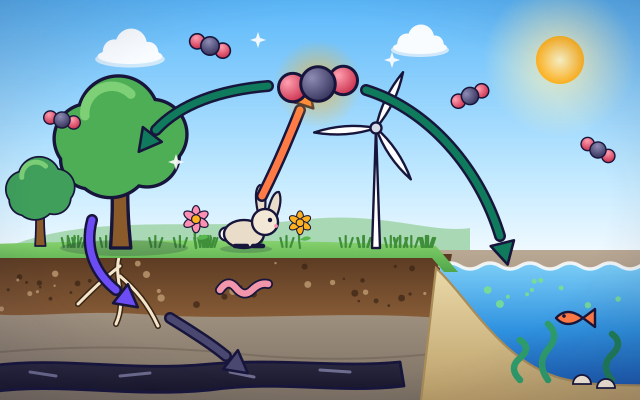
How does carbon move through the environment?
Follow carbon between air, plants, animals, soil, oceans, and fuels.
#470
Earth & weather
How does carbon move through the environment?
Follow carbon between air, plants, animals, soil, oceans, and fuels.
 #69
Earth & weather
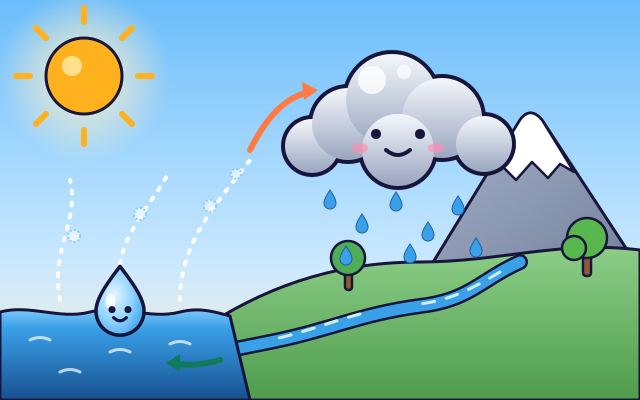
How do clouds form, and why does it rain?
Follow a water droplet through evaporation, condensation, rainfall, and its return to rivers or oceans. Change conditions in a simple water-cycle simulation.
#69
Earth & weather
How do clouds form, and why does it rain?
Follow a water droplet through evaporation, condensation, rainfall, and its return to rivers or oceans. Change conditions in a simple water-cycle simulation.
 #70
Earth & weather
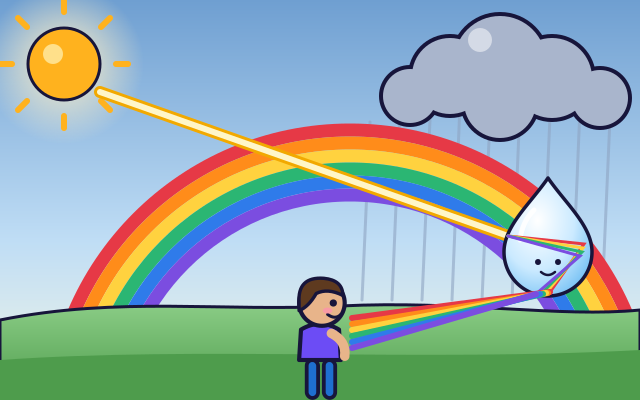
How do rainbows form?
Position sunlight, water droplets, and an observer. Follow light as it bends and reflects, and explore why different colors appear at different angles.
#70
Earth & weather
How do rainbows form?
Position sunlight, water droplets, and an observer. Follow light as it bends and reflects, and explore why different colors appear at different angles.
 #71
Earth & weather
How do lightning and thunder happen?
Explore a simplified storm cloud and the buildup of electrical charge. Compare when a flash is seen and its thunder is heard at different distances.
#71
Earth & weather
How do lightning and thunder happen?
Explore a simplified storm cloud and the buildup of electrical charge. Compare when a flash is seen and its thunder is heard at different distances.
Keep exploring
Games to play next
- Weather LabPredict the weather in a box, then run a fair test to find out why.
- Landform ExplorerMountains, valleys, peninsulas and deltas — learn the shapes of the land and find them on Earth.
- River MysterySomething changed the river. Sample sites with a limited budget, follow the evidence and find where the change begins.
Guide for grown-ups
- How to start homeschooling: a step-by-step guide for familiesA guide for parents · 7 min read
Science games by grade
Science worksheets by grade
- Preschool Science Worksheets
- Pre-K Science Worksheets
- Kindergarten Science Worksheets
- 1st Grade Science Worksheets
- 2nd Grade Science Worksheets
- 3rd Grade Science Worksheets
- 4th Grade Science Worksheets
- 5th Grade Science Worksheets
- 6th Grade Science Worksheets
- 7th Grade Science Worksheets
- 8th Grade Science Worksheets