How does convection move heat through air and water?
Heat one part of a tank of water and watch the currents begin: warm fluid rises, cool fluid sinks, and the loop carries heat everywhere.
The big idea: When part of a liquid or a gas is warmed, it spreads out and becomes lighter, so it floats up. Cooler, heavier fluid sinks to take its place and gets warmed in turn. This moving loop is a convection current, and it carries heat with it.
It's like a Ferris wheel for heat: warm water rides up one side, gives away its heat at the top, and rides back down the other side to be warmed again.
The interactive parts didn't load. The explanations below still work; try reloading the page.
Warm rises, cool sinks
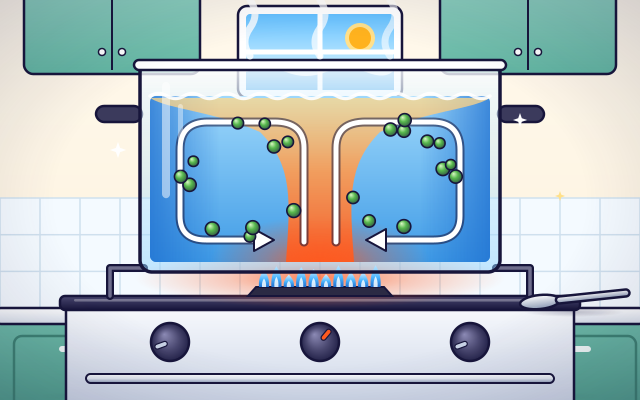
- A pot of soup warms on the stove. The peas travel up in the middle and down at the sides, round and round. But the spoon is on the counter. Who is stirring?
- Water is made of tiny molecules. At the bottom of the pot they are heated, so they move faster and spread a little farther apart. The same water now takes up more room, which makes it lighter than the cool water around it.
- Lighter things float on heavier things. So the warm water floats up through the pot, and the cooler, heavier water sinks down to take its place.
- At the top, the warm water gives some heat to the air and cools down. It gets heavier and sinks, is warmed again at the bottom, and rises again. This loop is called a convection current.
- Air works the same way. A heater warms the air next to it. The warm air rises to the ceiling, spreads across the room, cools and sinks. One small heater can warm a whole room.
- The biggest loops are outdoors. On a sunny day the land warms up faster than the sea. Air rises over the warm land, and cooler air blows in from the sea to replace it. That wind is a sea breeze.
Follow one blob of water
A heater sits under one end of this tank. Follow one blob of water all the way around the loop.
- Heat goes in. The blob of water is resting just above the heater. Heat passes into it through the glass, and its temperature goes up.
- It spreads out. The warm blob expands: its molecules move faster and spread apart. It still has the same amount of water in it, but it is bigger, so it is lighter for its size.
- It floats up. Because it is lighter than the water around it, the blob floats upward. Heavier water slides in underneath and pushes it up.
- It cools at the top. At the surface the blob cannot rise any farther, so it spreads sideways. It gives heat to the cooler air above and slowly cools down.
- It sinks. The cooled blob has shrunk back and is heavier for its size than the warm water rising behind it. So it sinks down the far side of the tank.
- Back to the heater. At the bottom the blob is pulled back toward the heater, where rising water has left a space. It warms up, and the loop starts again.
Tank test: where does the heater go?
Drag the heater along the tank and follow the dots. Then try it on top, and try the ice pack. When does a current start, and when does the water stay still?
Experiment: The heater is under the tank and the water is going round. What will happen if you put the heater on top of the water instead?
- Leave the heater under the tank until the dots are going round.
- Choose On top and watch for a few seconds.
- Switch to the ice pack and try it on top and underneath.
What we found: Heating from below starts a current, because the warm water is light and has to rise through the cool water. Heating from the top does not: the warm water is already on top, so it just stays there. Ice works the other way around, because cold water sinks.
Turn on JavaScript to try it yourself.
Cozy in winter, cool in summer
Winter: put the heater where it will warm both nose and toes, then turn it on. When summer comes, do the same with the cooler.
How convection carries heat
Liquids and gases are called fluids, because they can flow. When you warm part of a fluid, its molecules move faster and spread out a little. The warm part takes up more room but has the same amount of stuff in it, so it is lighter for its size. In a pot of soup, the light, warm soup at the bottom floats up, and the heavier, cooler soup sinks down to take its place.
This makes a loop. Warm fluid rises, gives away some heat at the top, cools, sinks and comes back to be warmed again. The loop is called a convection current. It carries heat from place to place much faster than heat could creep through still water or still air.
Where you put the heat matters. A heater at the bottom of a tank starts a current. A heater at the top does not, because the warm water is already where it wants to be. That is why room heaters sit near the floor and air conditioners sit near the ceiling: warm air has to rise through the room, and cool air has to sink through it.
Convection is at work all around you. Warm air rising from sunny land pulls in cooler air from the sea, which makes a sea breeze. Rising warm, damp air builds tall clouds. Deep inside the Earth, hot rock creeps around in slow loops that take millions of years. The Ferris wheel comparison only goes so far: a real current has no fixed seats, and the water mixes as it goes.
Key words
- Convection
- Heat being carried along by moving water or air.
- Fluid
- Anything that can flow: a liquid or a gas.
- Density
- How heavy something is for its size.
- Convection current
- A loop of moving fluid: warm fluid rising, cool fluid sinking.
- Buoyancy
- The upward push that makes light things float in a fluid.
- Viscosity
- How thick a fluid is, or how strongly it resists flowing. Syrup is more viscous than water.
Check your thinking
-
Why does warm water rise in a pot?
Show the answer
It spreads out and becomes lighter than the cool water around it. Warm water expands, so it is lighter for its size and floats up through the cooler water.
-
Where is the best place for a room heater, and why?
Show the answer
Low down, because warm air rises and then circles the room. Warm air from a low heater rises through the room and starts a current. From the ceiling it would just stay up there.
-
A heater is put at the top of a tank of water instead of the bottom. What happens?
Show the answer
The warm water stays at the top and there is almost no current. Warm water is light. If it is already on top, nothing pushes it down, so no loop forms.
-
On a sunny day at the beach, the wind often blows from the sea toward the land. Why?
Show the answer
The land warms faster, the air above it rises, and cooler sea air flows in. Rising warm air over the land leaves room that cooler air from the sea moves into. That moving air is the sea breeze.
-
In a spacecraft in orbit, a candle flame is a small, round ball and hot air does not rise from it. Why?
Show the answer
Everything is in free fall, so there is no buoyancy to lift the lighter gas. Buoyancy needs weight. In free fall, dense and light gas fall together, so nothing pushes the hot gas up.
You're a Everyday chemistry & materials expert!
You watched, looked inside, tried it, solved the challenge and went deeper. Pick another question below, or switch the age at the top to see this topic another way.
More about everyday chemistry & materials
 #418
Everyday chemistry & materials
How do emulsions keep oil and water mixed?
Build model droplets and explore how emulsifiers help stabilize salad dressing or mayonnaise.
#418
Everyday chemistry & materials
How do emulsions keep oil and water mixed?
Build model droplets and explore how emulsifiers help stabilize salad dressing or mayonnaise.
 #419
Everyday chemistry & materials
How does baking powder help cakes rise?
Follow gas bubbles forming in batter and expanding during a baking simulation.
#419
Everyday chemistry & materials
How does baking powder help cakes rise?
Follow gas bubbles forming in batter and expanding during a baking simulation.
 #420
Everyday chemistry & materials
How does sugar turn into caramel?
Follow changes in color, aroma, and structure as virtual sugar heats.
#420
Everyday chemistry & materials
How does sugar turn into caramel?
Follow changes in color, aroma, and structure as virtual sugar heats.
 #421
Everyday chemistry & materials
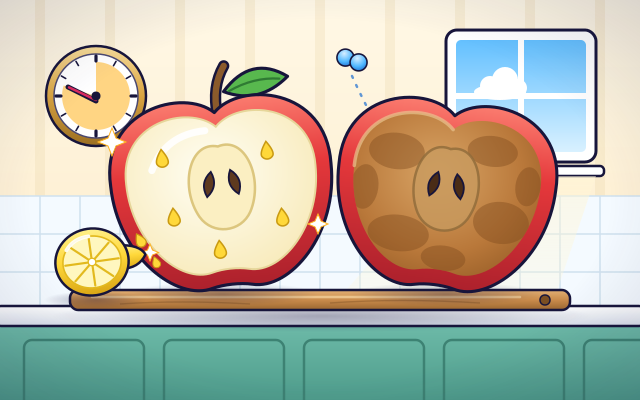
Why do cut apples turn brown?
Explore exposed fruit surfaces, oxygen, and enzymes in a simplified browning animation.
#421
Everyday chemistry & materials
Why do cut apples turn brown?
Explore exposed fruit surfaces, oxygen, and enzymes in a simplified browning animation.
Keep exploring
Games to play next
- Weather LabPredict the weather in a box, then run a fair test to find out why.
- Science QuizzesOlly's Science Quiz Show: plants, animals, the body, weather, space and more, for every grade.
- Ratio KitchenScale recipes, fill ratio tables and find the better buy.
Guide for grown-ups
- How to start homeschooling: a step-by-step guide for familiesA guide for parents · 7 min read
Science games by grade
Science worksheets by grade
- Preschool Science Worksheets
- Pre-K Science Worksheets
- Kindergarten Science Worksheets
- 1st Grade Science Worksheets
- 2nd Grade Science Worksheets
- 3rd Grade Science Worksheets
- 4th Grade Science Worksheets
- 5th Grade Science Worksheets
- 6th Grade Science Worksheets
- 7th Grade Science Worksheets
- 8th Grade Science Worksheets