How do emulsions keep oil and water mixed?
Shake oil and vinegar and they soon separate. Add an emulsifier, and its molecules coat every droplet so the mixture stays creamy.
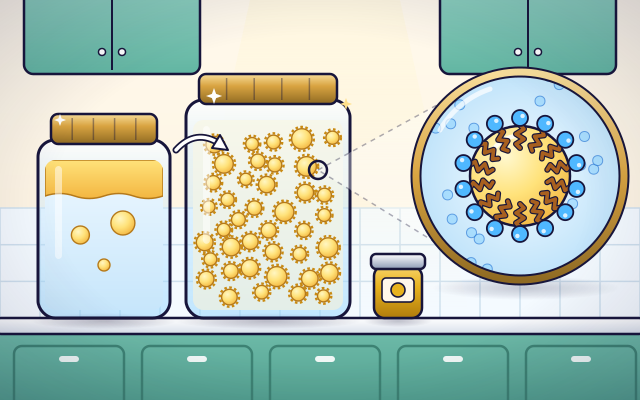
The big idea: An emulsion is tiny droplets of one liquid spread through another, like oil in vinegar. The droplets would soon join up and float to the top. An emulsifier has molecules that hold oil with one end and water with the other. They coat each droplet and keep the droplets apart.
It's like a friend holding hands with two children who will not play together. An emulsifier molecule holds oil with one end and water with the other.
The interactive parts didn't load. The explanations below still work; try reloading the page.
Why salad dressing separates
- A jar of homemade salad dressing has two layers. Golden oil floats on top and watery vinegar sits underneath. Why do they not mix?
- Look very, very close. Water molecules pull strongly on each other and hold together. An oil molecule cannot break in between them, so the water squeezes the oil out.
- Shaking breaks the oil into droplets and spreads them through the vinegar. But whenever two droplets touch, they join into a bigger one. Big droplets float up fast, and soon the oil is back on top.
- Now a spoon of mustard goes in. Mustard contains emulsifiers. An emulsifier molecule has two different ends: a head that loves water and a tail that loves oil.
- Shake again. The emulsifier molecules gather around each droplet, with their tails in the oil and their heads in the water. They make a coat. Coated droplets cannot join up: they just bounce apart.
- Now the dressing stays mixed and looks creamy. This kind of mixture is called an emulsion. Mayonnaise is one too: its emulsifier comes from egg yolk.
Look inside an emulsion
This is a creamy dressing, magnified many thousands of times. Tap each part to see what it does.
- Water. The watery part of the dressing: vinegar or lemon juice. Its molecules hold tightly to each other, which is why they push oil out.
- Oil droplet. A droplet of oil. It is round because a ball has the smallest surface, and oil tries to touch as little water as it can.
- Emulsifier molecule. One emulsifier molecule. Mustard and egg yolk both contain emulsifiers. Each molecule has two ends that behave very differently.
- Water-loving head. The head of the molecule is attracted to water, so it always faces outward into the watery part.
- Oil-loving tail. The tail of the molecule is attracted to oil, so it buries itself in the droplet.
- The coat. Thousands of emulsifier molecules crowd around the droplet, tails in and heads out. Together they make a coat that covers the oil.
- Bounce, not join. When two coated droplets bump, their coats touch but their oil does not. They bounce apart instead of joining, so the dressing stays mixed.
Two jars: with and without a helper
Shake both jars and watch the model droplets. The right jar has mustard. What happens in each jar after a few seconds? Try less mustard, and more shakes.
Experiment: You shake two jars of oil and vinegar. One of them has a spoonful of mustard in it. What will they look like a few seconds later?
- Press Shake both jars twice.
- Watch both jars for about five seconds.
- Change the mustard to A little, shake again and compare.
What we found: The plain jar separates within seconds, because bare droplets join up whenever they touch and big droplets float up fast. In the mustard jar every droplet has a coat of emulsifier, so the droplets bounce apart and the dressing stays mixed. With too little mustard, some droplets join up until there is enough to coat the rest.
Turn on JavaScript to try it yourself.
Creamy until the timer rings
Make a creamy dressing: small droplets that are still mixed when the 8-second timer ends. Tap ingredients to add them, shake the jar, then start the timer.
How emulsions work
Oil and water do not mix. Water molecules pull strongly on each other and stick together, a bit like tiny magnets. Oil molecules do not have that pull, so the water squeezes them out. Oil is also lighter than water, so it ends up floating on top.
If you shake oil and water, the oil breaks into droplets. For a moment the liquid looks cloudy and mixed. But every time two droplets touch, they join into a bigger droplet. Bigger droplets float upward faster, so in a few seconds the oil is back on top.
An emulsifier changes this. Its molecules have two different ends: a head that is attracted to water and a tail that is attracted to oil. They crowd around each droplet with their tails in the oil and their heads in the water. Now each droplet wears a coat. When coated droplets bump into each other, they bounce apart. A mixture of droplets that stays mixed is called an emulsion.
Mustard and egg yolk are kitchen emulsifiers. Mayonnaise is oil, lemon juice and egg yolk whisked into an emulsion so thick you can spread it. Milk is an emulsion of tiny drops of fat in water. Soap is an emulsifier too: it coats grease so water can wash it away. The friend-holding-hands comparison only goes so far: a real droplet is surrounded by a huge number of emulsifier molecules, not just one.
Key words
- Emulsion
- Tiny droplets of one liquid spread through another liquid that it does not normally mix with.
- Emulsifier
- A helper whose molecules hold oil with one end and water with the other.
- Droplet
- A very small drop of liquid.
- Hydrophilic
- Attracted to water. The word means water-loving.
- Hydrophobic
- Not attracted to water. The word means water-fearing. Oil is hydrophobic.
- Coalescence
- Two droplets merging into one bigger droplet.
Check your thinking
-
Why does the oil float back to the top after you shake oil and vinegar?
Show the answer
The droplets join up, and oil is lighter than water. Bare droplets merge when they touch. Big droplets of light oil float up quickly.
-
What is special about an emulsifier molecule?
Show the answer
One end holds on to water and the other end holds on to oil. Its two different ends let it sit at the surface of a droplet and coat it.
-
Which of these is an emulsion?
Show the answer
Mayonnaise. Mayonnaise is tiny oil droplets spread through lemon juice, held by emulsifier from egg yolk.
-
You shake a dressing very hard, but you added only a tiny bit of mustard. Why might it still separate?
Show the answer
There is not enough mustard to coat all the small droplets. Lots of small droplets have a lot of surface. Droplets without a coat join up again.
-
Soap helps water wash grease off a plate. Which explanation fits what you have learned?
Show the answer
Soap is an emulsifier: its molecules coat grease droplets so water can carry them away. Soap molecules have an oil-loving tail and a water-loving head, exactly like the emulsifiers in mustard and egg yolk.
You're a Everyday chemistry & materials expert!
You watched, looked inside, tried it, solved the challenge and went deeper. Pick another question below, or switch the age at the top to see this topic another way.
More about everyday chemistry & materials
 #419
Everyday chemistry & materials
How does baking powder help cakes rise?
Follow gas bubbles forming in batter and expanding during a baking simulation.
#419
Everyday chemistry & materials
How does baking powder help cakes rise?
Follow gas bubbles forming in batter and expanding during a baking simulation.
 #420
Everyday chemistry & materials
How does sugar turn into caramel?
Follow changes in color, aroma, and structure as virtual sugar heats.
#420
Everyday chemistry & materials
How does sugar turn into caramel?
Follow changes in color, aroma, and structure as virtual sugar heats.
 #421
Everyday chemistry & materials
Why do cut apples turn brown?
Explore exposed fruit surfaces, oxygen, and enzymes in a simplified browning animation.
#421
Everyday chemistry & materials
Why do cut apples turn brown?
Explore exposed fruit surfaces, oxygen, and enzymes in a simplified browning animation.
 #422
Everyday chemistry & materials
How do acids and bases behave?
Test fictional household samples with virtual indicators and explore neutralization.
#422
Everyday chemistry & materials
How do acids and bases behave?
Test fictional household samples with virtual indicators and explore neutralization.
Keep exploring
Games to play next
- Weather LabPredict the weather in a box, then run a fair test to find out why.
- Science QuizzesOlly's Science Quiz Show: plants, animals, the body, weather, space and more, for every grade.
- Ratio KitchenScale recipes, fill ratio tables and find the better buy.
Guide for grown-ups
- How to start homeschooling: a step-by-step guide for familiesA guide for parents · 7 min read
Science games by grade
Science worksheets by grade
- Preschool Science Worksheets
- Pre-K Science Worksheets
- Kindergarten Science Worksheets
- 1st Grade Science Worksheets
- 2nd Grade Science Worksheets
- 3rd Grade Science Worksheets
- 4th Grade Science Worksheets
- 5th Grade Science Worksheets
- 6th Grade Science Worksheets
- 7th Grade Science Worksheets
- 8th Grade Science Worksheets