How do cooking pans transfer heat?
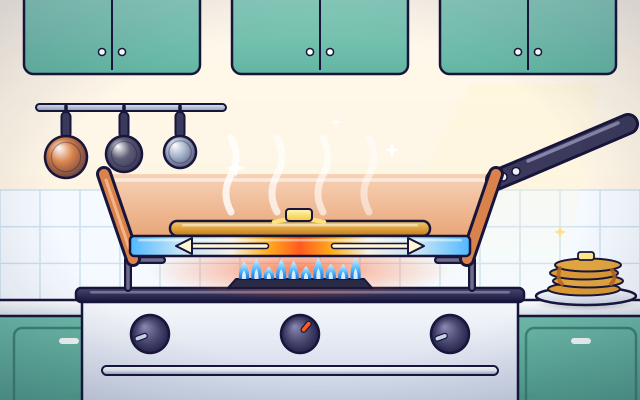
A flame touches only the middle of a pan. See how the metal carries the heat sideways, and why some metals do it much faster.
The big idea: Heat moves through a pan by conduction: hot, jiggling atoms bump their neighbors and pass the heat along. Copper and aluminum pass it quickly, so the whole pan gets evenly hot. Steel passes it slowly, so it gets a hot spot.
It's like a line of friends holding hands: when the first one wiggles, the wiggle passes down the whole line. Hot atoms pass their jiggle along the metal the same way.
The interactive parts didn't load. The explanations below still work; try reloading the page.
From flame to pancake
- A pan goes on the stove and the batter goes in. Look closely: the flame only touches the middle of the pan. So how does the edge of the pancake get cooked?
- Here is the pan cut in half, with colors that show its temperature. The flame pours heat into the bottom of the pan, and the middle gets hot first.
- Metal is made of tiny atoms packed tightly together. Heat makes them jiggle faster. Each jiggling atom bumps its neighbors and makes them jiggle too, so the heat is passed along.
- Atom by atom, the heat travels sideways from the hot middle to the cooler edge. This way of moving heat through a solid is called conduction.
- Different metals pass heat at different speeds. Copper passes it quickly, so the whole pan warms up together. Stainless steel passes it slowly, so the middle gets very hot while the edge stays cool.
- When a pan spreads its heat evenly, every part of the pancake cooks at the same speed. Golden all over, with no burnt middle and no pale edge!
Look inside a layered pan
This steel pan is cut in half. Tap each part to see how it handles heat.
- Burner flame. The burner's ring of flame heats the bottom of the pan, but only in the middle. The rest of the pan has to get its heat through the metal.
- Heat-spreading core. Hidden inside the base is a thick layer of aluminum. It passes heat along quickly, so the heat spreads sideways before the middle gets too hot.
- Steel cooking surface. The cooking surface is a thin sheet of stainless steel. It is hard, it does not rust and it does not change the taste of food. It is thin, so heat crosses it easily.
- Sloping walls. The sloping walls keep food and sauce in the pan and make it easy to slide a pancake out. Heat creeps up them from the base, so they are cooler than the middle.
- Handle. The handle is long and made of steel, which passes heat slowly. By the time any heat has crept along it, most has escaped into the air. Pans are still for grown-ups to move.
- Rivets. Rivets are short metal pins squashed flat at both ends. They clamp the handle to the wall of the pan so it can never wobble loose.
- The food. Where the food touches the pan, heat passes straight into it by conduction. That is why the bottom of the egg cooks first.
Butter test: two pans, two metals
Light the burners and watch the heat colors spread through each pan. Which butter melts, and which never does? Tap a pan to change its metal.
Experiment: A copper pan and a stainless steel pan sit on flames of the same size. What will happen to the butter at the edges?
- Keep copper on the left and stainless steel on the right.
- Tap the knob to light both burners.
- Watch the heat colors and the five pats of butter in each pan.
What we found: Copper passes heat along so quickly that the whole pan warms up and all the butter melts. Stainless steel passes heat slowly: its middle becomes scorching hot while the butter at the edge stays hard. That is a hot spot.
Turn on JavaScript to try it yourself.
The evenly golden pancake
Choose a pan and a burner ring, light the burner, and pour the batter when the whole pan is hot. Make a pancake with no burnt middle and no pale edge.
How heat moves through a pan
Everything is made of tiny atoms, and the atoms are always jiggling. The hotter something is, the faster its atoms jiggle. When a flame heats the bottom of a pan, the atoms there start to jiggle hard. They bump the atoms beside them, which bump the next ones, and so the heat is passed along. Nothing travels through the pan except the jiggling. This is called conduction.
Materials that pass heat along quickly are called conductors. Metals are the best conductors we use every day, and copper and aluminum are two of the fastest. Materials that pass heat slowly are called insulators. Wood, plastic and air are insulators, which is why a wooden spoon in a hot pot stays cool enough to hold.
Not all metals are equally quick. Stainless steel is strong and never rusts, but it passes heat about 25 times more slowly than copper. A thin steel pan over a small flame gets a hot spot: the middle is scorching while the edge is barely warm. Pan makers solve this by hiding a thick layer of aluminum or copper inside the steel base to spread the heat.
Cast iron is different again. It is a slow conductor, but a cast iron pan is thick and heavy, so it stores a lot of heat. Once it is hot, it stays hot even when cold food lands on it. The comparison with friends holding hands only goes so far: in a real metal, tiny particles called electrons also race between the atoms and carry heat with them.
Key words
- Conduction
- Heat passing through a solid as jiggling atoms bump their neighbors.
- Conductor
- A material that passes heat along quickly, such as copper or aluminum.
- Insulator
- A material that passes heat along slowly, such as wood, plastic or air.
- Thermal conductivity
- A number that tells how quickly a material passes heat along.
- Hot spot
- A part of a pan that is much hotter than the rest, usually right above the flame.
- Heat capacity
- How much heat something can store. A heavy pan stores more than a light one.
Check your thinking
-
What is it called when heat passes through a solid from atom to atom?
Show the answer
Conduction. In conduction, jiggling atoms bump their neighbors and pass the heat along.
-
A thin stainless steel pan sits on a small flame. What will a pancake cooked in it look like?
Show the answer
Dark in the middle and pale at the edge. Steel passes heat slowly, so the heat piles up over the flame and little of it reaches the edge.
-
Why do many steel pans have a layer of aluminum or copper hidden in the base?
Show the answer
To spread the heat sideways so there is no hot spot. Aluminum and copper pass heat much faster than steel, so they carry it out to the edge.
-
Why does a wooden spoon left in a hot pot stay cool enough to hold?
Show the answer
Wood is an insulator: it passes heat very slowly. Insulators such as wood pass heat so slowly that the handle end hardly warms up.
-
A cold steak is dropped into two pans at the same temperature: thin aluminum and thick cast iron. Which pan's temperature drops less, and why?
Show the answer
The cast iron, because its large heat capacity stores more energy. A heavy pan stores much more energy per degree, so giving some to the steak cools it only a little.
You're a Everyday chemistry & materials expert!
You watched, looked inside, tried it, solved the challenge and went deeper. Pick another question below, or switch the age at the top to see this topic another way.
More about everyday chemistry & materials
 #417
Everyday chemistry & materials
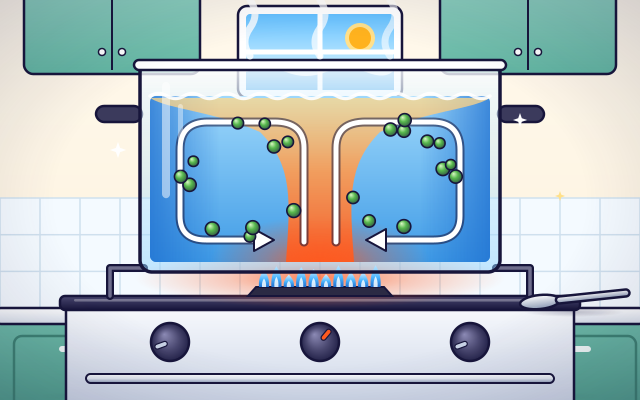
How does convection move heat through air and water?
Warm one region of a fluid and follow circulating currents.
#417
Everyday chemistry & materials
How does convection move heat through air and water?
Warm one region of a fluid and follow circulating currents.
 #418
Everyday chemistry & materials
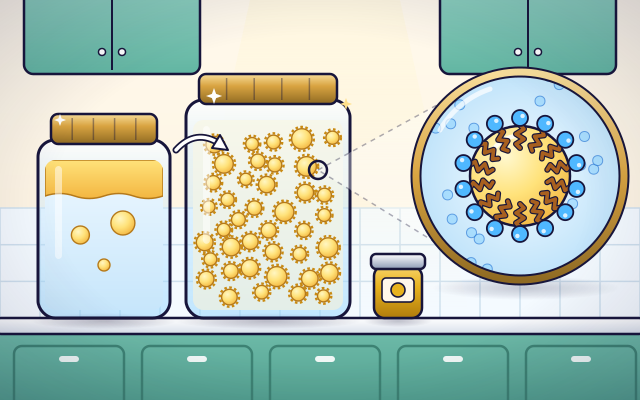
How do emulsions keep oil and water mixed?
Build model droplets and explore how emulsifiers help stabilize salad dressing or mayonnaise.
#418
Everyday chemistry & materials
How do emulsions keep oil and water mixed?
Build model droplets and explore how emulsifiers help stabilize salad dressing or mayonnaise.
 #419
Everyday chemistry & materials
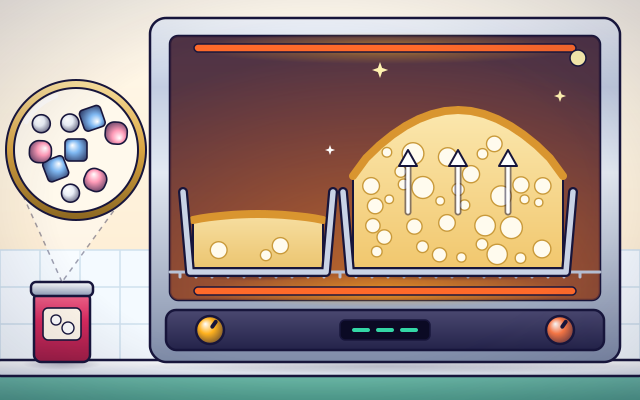
How does baking powder help cakes rise?
Follow gas bubbles forming in batter and expanding during a baking simulation.
#419
Everyday chemistry & materials
How does baking powder help cakes rise?
Follow gas bubbles forming in batter and expanding during a baking simulation.
 #420
Everyday chemistry & materials
How does sugar turn into caramel?
Follow changes in color, aroma, and structure as virtual sugar heats.
#420
Everyday chemistry & materials
How does sugar turn into caramel?
Follow changes in color, aroma, and structure as virtual sugar heats.
Keep exploring
Games to play next
- Weather LabPredict the weather in a box, then run a fair test to find out why.
- Science QuizzesOlly's Science Quiz Show: plants, animals, the body, weather, space and more, for every grade.
- Ratio KitchenScale recipes, fill ratio tables and find the better buy.
Guide for grown-ups
- How to start homeschooling: a step-by-step guide for familiesA guide for parents · 7 min read
Science games by grade
Science worksheets by grade
- Preschool Science Worksheets
- Pre-K Science Worksheets
- Kindergarten Science Worksheets
- 1st Grade Science Worksheets
- 2nd Grade Science Worksheets
- 3rd Grade Science Worksheets
- 4th Grade Science Worksheets
- 5th Grade Science Worksheets
- 6th Grade Science Worksheets
- 7th Grade Science Worksheets
- 8th Grade Science Worksheets