How do cows produce milk?
Food and water travel in the cow's blood to her udder, where millions of tiny sacs turn them into milk.
The big idea: A cow does not store milk she has eaten. Her blood carries nutrients to the udder, and tiny cells there build milk from them, drop by drop.
It's like a kitchen with millions of tiny cooks: delivery trucks (the blood) bring ingredients, the cooks mix them into milk, and pipes carry it out.
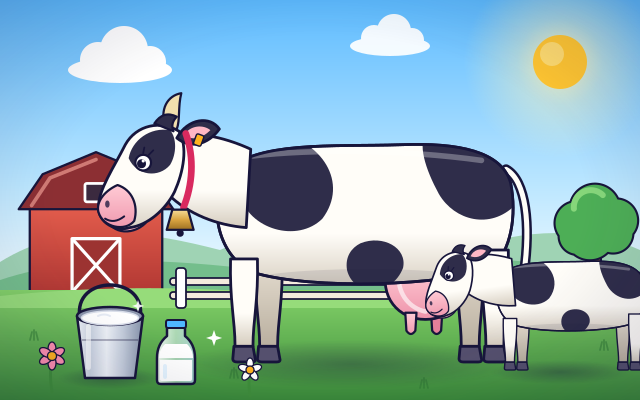
The interactive parts didn't load. The explanations below still work; try reloading the page.
From grass to a glass of milk
- Daisy has a new calf, so her body has started making milk to feed it. But she only eats grass and drinks water. So where does the milk come from?
- First Daisy eats and drinks. In her stomachs and gut, the grass is broken down into tiny bits called nutrients. They are small enough to pass into her blood.
- The heart pumps the blood around her body. A big blood vessel carries the nutrients and water down to the udder, the soft pink bag under her belly.
- Inside the udder are millions of tiny hollow sacs. The cells in their walls take nutrients and water from the blood and build milk, which collects in the middle of each sac.
- When the calf nuzzles, a signal tells tiny muscles around each sac to squeeze. The milk is pushed out into small tubes called ducts, which join and lead down to the teat.
- The calf drinks, and the farmer collects milk too. As soon as the sacs are emptied, the cells get busy filling them again. Grass and water in, milk out.
Look inside an udder
This is one quarter of the udder, cut open. Tap each part, then look in the round window to see one milk sac up close.
- Blood vessels. Arteries (red) bring blood carrying nutrients and water into the udder. Veins (blue) carry the blood back to the heart to pick up more.
- Milk sacs. Bunches of tiny hollow sacs fill the upper udder, like grapes on a stem. Each sac makes milk and holds it until it is squeezed out.
- Milk-making cells. The wall of each sac is one layer of cells. They pull nutrients and water from the blood on the outside and release milk on the inside.
- Squeezing muscles. A net of tiny muscle cells wraps around each sac. When the calf nuzzles the udder, they squeeze and push the milk out into the ducts.
- Milk ducts. Small tubes lead away from the sacs and join into bigger and bigger tubes, like streams joining a river. They carry milk down toward the teat.
- Cistern. The ducts empty into a hollow space called the cistern. Milk gathers here, ready to flow out through the teat.
- Teat. Milk leaves through a narrow canal in the teat. A ring of muscle at the tip keeps it closed, so milk stays in and germs stay out.
What does a cow need to make milk?
Give Daisy feed and water and watch the nutrients travel to her udder. Then change how much water she gets. What happens to the milk?
Experiment: Daisy has plenty of feed. What happens to her milk if she gets only a little water?
- Slide the feed and the water up high. Watch the udder fill.
- Now slide the water down low and watch again.
- Tap the calf or press Milking time to see how much milk comes out.
What we found: With little water, Daisy makes much less milk, even with lots of feed. Milk is mostly water, so her body cannot make it without drinking a lot. She needs both feed and water.
Turn on JavaScript to try it yourself.
The milk trail
Take a drop from grass to milk. Tap each stop in the right order: where does it go next?
How milk is really made
All mammal mothers make milk for their babies, and a cow is a mammal. A cow only starts making milk when she has had a calf. Dairy farmers look after cows that go on giving milk for many months after the calf is born.
Milk is not grass juice, and it is not stored food. The cow's body builds it. First she digests her feed into tiny nutrients. Her blood carries those nutrients, and lots of water, to the udder. A cow making milk may drink more than a hundred liters of water a day, because milk is mostly water.
Inside the udder are millions of tiny sacs. The cells in the wall of each sac take what they need from the blood and build milk sugar, milk fat and milk protein. The finished milk gathers in the middle of the sac.
When the calf nuzzles the udder, or when the farmer starts the milking routine, tiny muscles squeeze the sacs. The milk flows down through the ducts to a space above the teat and out through the teat. Then the cells start filling the sacs again.
Key words
- Udder
- The soft bag under a cow's belly where milk is made and stored.
- Nutrient
- A tiny part of food that the body can use, such as sugar, fat, protein or minerals.
- Alveolus (milk sac)
- A tiny hollow sac in the udder whose wall makes milk.
- Duct
- A tube that carries milk from the sacs toward the teat.
- Let-down
- The moment tiny muscles squeeze the milk sacs so the milk can flow.
- Lactose
- The sugar in milk. The udder makes it from sugar in the blood.
Check your thinking
-
Where is a cow's milk actually made?
Show the answer
In tiny sacs inside the udder. The cells in the walls of the milk sacs build milk from nutrients the blood brings.
-
How do nutrients get from the cow's gut to her udder?
Show the answer
They are carried in her blood. The heart pumps blood carrying nutrients and water to every part of the body, including the udder.
-
A cow has lots of feed but very little water. What happens?
Show the answer
She makes much less milk, because milk is mostly water. Her body cannot build a watery drink without plenty of water to put in it.
-
What makes the milk leave the tiny sacs?
Show the answer
Tiny muscles around the sacs squeeze. When the calf nuzzles, a signal makes the tiny muscles squeeze the sacs and push the milk into the ducts.
-
Why can a cow milked three times a day give a little more milk than one milked twice?
Show the answer
An emptier udder lets the cells keep working fast. When milk builds up, pressure and a chemical signal in the milk slow the secretory cells. Removing it more often lifts that brake.
You're a Animals expert!
You watched, looked inside, tried it, solved the challenge and went deeper. Pick another question below, or switch the age at the top to see this topic another way.
More about animals
 #222
Animals
How do sheep grow wool?
Explore follicles, fiber growth, and changes in fleece before and after shearing.
#222
Animals
How do sheep grow wool?
Explore follicles, fiber growth, and changes in fleece before and after shearing.
 #223
Animals
How do chickens grind food without teeth?
Follow feed through the crop and gizzard, observing storage and grinding.
#223
Animals
How do chickens grind food without teeth?
Follow feed through the crop and gizzard, observing storage and grinding.
 #224
Animals
How do homing pigeons find their way back?
Compare navigation cues such as landmarks and sunlight in a simplified journey.
#224
Animals
How do homing pigeons find their way back?
Compare navigation cues such as landmarks and sunlight in a simplified journey.
 #225
Animals
How do cats clean themselves with their tongues?
Zoom into tongue structures and follow their role in grooming fur.
#225
Animals
How do cats clean themselves with their tongues?
Zoom into tongue structures and follow their role in grooming fur.
Keep exploring
Games to play next
- SheepdogGuide the flock together and close the gate on a perfect day.
- Habitat Builder 3DFind the right home for frogs, camels, polar bears and more.
- Classification ExplorerSort living things by what you can see, then follow and build yes-or-no keys.
Guide for grown-ups
- How to start homeschooling: a step-by-step guide for familiesA guide for parents · 7 min read
Science games by grade
Science worksheets by grade
- Preschool Science Worksheets
- Pre-K Science Worksheets
- Kindergarten Science Worksheets
- 1st Grade Science Worksheets
- 2nd Grade Science Worksheets
- 3rd Grade Science Worksheets
- 4th Grade Science Worksheets
- 5th Grade Science Worksheets
- 6th Grade Science Worksheets
- 7th Grade Science Worksheets
- 8th Grade Science Worksheets