How do homing pigeons find their way back?
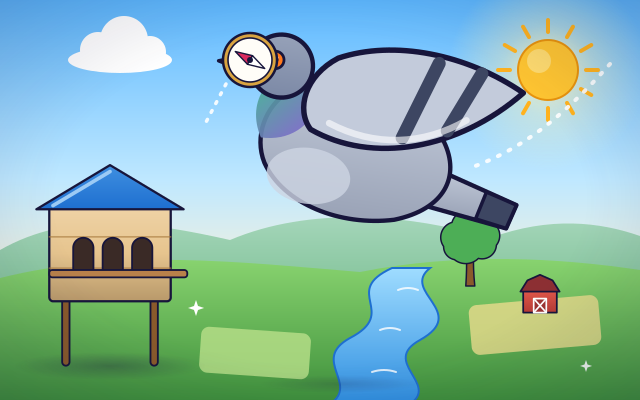
Homing pigeons use several clues together: the sun as a compass, a sense for Earth's magnetism, and landmarks they remember.
The big idea: No single trick gets a pigeon home. The sun and Earth's magnetism tell it which direction is which, like a compass. Near home, familiar landmarks guide the last part.
It's like a hiker with a compass and a good memory: the compass gives the direction, and familiar places show the last part of the way.
The interactive parts didn't load. The explanations below still work; try reloading the page.
How a pigeon finds its way home
- Pidge has been carried far from her loft to a place she has never seen. When the basket opens, she circles once and then heads straight for home. How does she know the way?
- First clue: the sun. It rises in the east and sets in the west. Pidge has a body clock, so she knows the time of day, and that tells her where the sun should be. Now she knows her directions.
- When clouds hide the sun, Pidge has a second compass. Earth is like a giant magnet, and she can sense its pull. It tells her which way is north, even in gray weather.
- A compass only tells you directions. Pidge also needs to know where she is, like having a map. Scientists think smells carried on the wind help her work that out.
- Closer to home, Pidge sees places she knows from many flights: the river, the bridge, the red barn. She follows these landmarks like signposts.
- And there is her loft! Pidge used many clues, one after another: the sun, Earth's magnetism, perhaps smells, and landmarks she remembers.
A pigeon's navigation kit
Tap each part of Pidge to see the clue it gives her on the way home.
- Eyes. Sharp eyes spot the sun's place in the sky, and landmarks such as rivers, roads and buildings on the ground below.
- Body clock. Pidge has a clock inside her body, just as you do. Knowing the time of day tells her where the sun should be, and that turns the sun into a compass.
- Magnet sense. Pidge can sense Earth's magnetic pull, like a built-in compass. She relies on it when clouds hide the sun.
- Nose. At her loft, Pidge learns which smells arrive on which winds. Far away, the smells in the air may tell her roughly where she is.
- Memory. Pidge remembers the landmarks around her home from many practice flights. The more she flies, the bigger her map gets.
- Wings. Strong chest muscles drive her wings. A racing pigeon can fly about as fast as a car on a country road, for hours.
Which clue does she use?
Release Pidge and watch her fly home on this map. Change the weather, and try a tiny magnet that confuses her magnet sense. When does she lose her way?
Experiment: Pidge wears a tiny magnet that confuses her magnet sense. On which day does she lose her way?
- Switch the magnet on. Keep the day sunny and release Pidge.
- Now make it cloudy and release her again.
- Compare the two flights.
What we found: In sunshine the magnet makes no difference, because Pidge uses the sun as her compass. Under cloud she needs her magnet sense, so the magnet muddles her. She has two compasses, and one can cover for the other.
Turn on JavaScript to try it yourself.
Be the sun compass
Use the sun like Pidge does. Read the time of day to work out where the sun is, then tap the arrow that points toward home. Three flights!
How pigeons really find home
For thousands of years people have kept homing pigeons, because these birds have an amazing skill. Carry one far away in a basket, let it go, and it flies back to its own loft, sometimes from hundreds of kilometers away.
To get home you need two things: a compass, to know which way is which, and a map, to know where you are. Pigeons have two compasses. On clear days they use the sun. Because their body clock tells them the time, they know where the sun should be. On cloudy days they sense Earth's magnetism instead.
The map is more of a mystery. Many scientists think pigeons use smells carried on the wind to judge roughly where they are. Closer to home, they certainly use their eyes. They follow rivers, roads and other landmarks they remember.
Scientists learned all this from careful experiments, such as putting tiny magnets on pigeons or gently changing their body clocks. There are still puzzles left. Nobody is completely sure how a pigeon feels magnetism. That is what makes it exciting: there is more to discover.
Key words
- Loft
- The house where homing pigeons live. It is the only place a homing pigeon will fly back to.
- Sun compass
- Using the sun and the time of day to tell directions.
- Magnetic field
- The invisible pull around Earth that makes a compass needle point north.
- Landmark
- Something easy to recognize, such as a river, a bridge or a tall building, that helps you know where you are.
- Body clock
- The sense of time inside a living thing, which follows day and night.
Check your thinking
-
Why does a pigeon need its body clock to use the sun as a compass?
Show the answer
The sun moves across the sky, so she must know the time of day. The sun is in the east in the morning and the west in the evening. Only with the time of day can she turn the sun into directions.
-
A pigeon wearing a small magnet gets lost on a cloudy day, but not on a sunny day. What does that tell us?
Show the answer
She uses the sun when she can, and her magnet sense under clouds. In sunshine the sun compass does the job, so the magnet does no harm. Under cloud she needs the magnetic compass, and the magnet upsets it.
-
A pigeon's body clock is set 6 hours wrong. It is released on a sunny day. About how far off course does it start?
Show the answer
About 90 degrees. The sun moves about 15 degrees an hour, so 6 hours of clock error gives 6 times 15, which is 90 degrees.
-
Why is a compass not enough to get home?
Show the answer
You also need to know where you are. A compass tells you which way is north, but not which way home is. For that you need a kind of map.
-
What do pigeons use for the last part of the journey, close to home?
Show the answer
Landmarks they remember, such as rivers and roads. Tracking shows pigeons following familiar rivers, roads and railways near home.
You're a Animals expert!
You watched, looked inside, tried it, solved the challenge and went deeper. Pick another question below, or switch the age at the top to see this topic another way.
More about animals
 #225
Animals
How do cats clean themselves with their tongues?
Zoom into tongue structures and follow their role in grooming fur.
#225
Animals
How do cats clean themselves with their tongues?
Zoom into tongue structures and follow their role in grooming fur.
 #94
Animals
How do bees make honey?
Follow nectar from flowers to the hive. Explore how bees process it, remove water, and store the resulting honey in honeycomb cells.
#94
Animals
How do bees make honey?
Follow nectar from flowers to the hive. Explore how bees process it, remove water, and store the resulting honey in honeycomb cells.
 #95
Animals
How does a caterpillar become a butterfly?
Arrange the egg, caterpillar, chrysalis, and butterfly stages. Use a time slider and close-up animations to explore the changes during metamorphosis.
#95
Animals
How does a caterpillar become a butterfly?
Arrange the egg, caterpillar, chrysalis, and butterfly stages. Use a time slider and close-up animations to explore the changes during metamorphosis.
 #96
Animals
How do fish breathe underwater?
Follow water across a fish's gills and explore oxygen moving into its blood. Compare the structures and functions of gills and lungs.
#96
Animals
How do fish breathe underwater?
Follow water across a fish's gills and explore oxygen moving into its blood. Compare the structures and functions of gills and lungs.
Keep exploring
Games to play next
- Habitat Builder 3DFind the right home for frogs, camels, polar bears and more.
- Classification ExplorerSort living things by what you can see, then follow and build yes-or-no keys.
- Forest Trails PhotosCreep up on the animals of a big forest valley and take the closest, best wildlife photos you can, without startling them.
Guide for grown-ups
- How to start homeschooling: a step-by-step guide for familiesA guide for parents · 7 min read
Science games by grade
Science worksheets by grade
- Preschool Science Worksheets
- Pre-K Science Worksheets
- Kindergarten Science Worksheets
- 1st Grade Science Worksheets
- 2nd Grade Science Worksheets
- 3rd Grade Science Worksheets
- 4th Grade Science Worksheets
- 5th Grade Science Worksheets
- 6th Grade Science Worksheets
- 7th Grade Science Worksheets
- 8th Grade Science Worksheets