How do diodes guide electricity in one direction?
Flip the battery and compare a plain wire with a diode: the one-way gate that guides electricity.
The big idea: A wire lets electricity flow in either direction. A diode lets it flow in only one. Inside is a junction between two kinds of silicon. One way, the charges can cross it. The other way, they are pulled apart and nothing gets through.
It's like the valve on a bicycle tire. Air can be pumped in, but it cannot rush back out. A diode does that for electricity.
The interactive parts didn't load. The explanations below still work; try reloading the page.
One way only
- Some things only work one way, like this gate. You can go through, but not back. Electronics need a one-way gate for electricity. It is called a diode.
- A diode is a small part with two legs. A stripe marks one end. Electrons can only go in at the striped end and come out at the plain end, never the other way around.
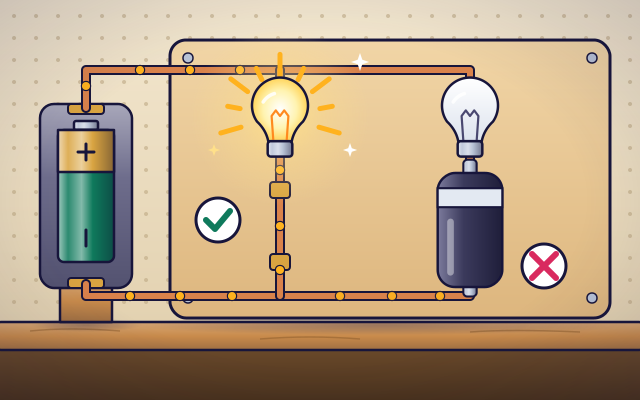
- Here are two paths from one battery: a plain wire and a diode, each with its own lamp. With the battery this way around, current flows through both, and both lamps shine.
- Now flip the battery. Current flows backward through the wire, and its lamp does not mind at all. But the diode blocks the backward current, so its lamp goes dark.
- Inside the diode, two kinds of silicon meet. One way, the battery pushes the charges together and they cross. The other way, it pulls them apart and leaves an empty zone that nothing can cross.
- The electricity from a wall socket swings back and forth many times each second. Gadgets need it to flow one way. Diodes in every charger let only one direction through.
Look inside a diode
Here is a diode drawn very big, with a window cut in its case. Tap each part.
- Case. The case is glass or plastic. It protects the tiny piece of silicon inside and keeps out air and water.
- Stripe. The stripe marks the end where electrons go in. Point the stripe toward the minus side of the battery, and the diode will conduct.
- Plain-end leg. This wire leg joins the plain end, called the anode. When the diode conducts, electrons leave through it.
- Striped-end leg. This wire leg joins the striped end, called the cathode. Electrons come in through it.
- P-type silicon. This half of the silicon has holes: places where an electron is missing. A hole acts like a positive charge that can move.
- N-type silicon. This half of the silicon has spare electrons that are free to move.
- Junction. Where the two halves meet, there is a thin zone with no free charges. Pushed one way, charges cross it. Pushed the other way, the empty zone grows wider and blocks them.
Wire or diode: which way?
Tap the battery to flip it, and compare the plain wire with the diode. Then turn the diode around, and try a very small battery voltage.
Experiment: What happens to the two lamps when you flip the battery?
- Look at both lamps with the battery the first way around.
- Tap the battery to flip it. Which lamp changes?
- Now turn the diode around too. What happens?
What we found: The wire does not care: its lamp shines whichever way the battery goes. The diode's lamp only shines one way. Turn the diode around as well and it works again, because what matters is the diode's direction compared with the battery's.
Turn on JavaScript to try it yourself.
Which way is the battery?
Set the two diodes so the green lamp lights when the battery is one way around, and the red lamp when it is the other way. Then press Test.
How a diode makes a one-way street
A plain wire is like an open corridor: electricity can run through it in either direction. A diode is like a corridor with a one-way gate. It is one of the simplest electronic parts: a tiny piece of silicon with two wire legs and a stripe at one end.
The silicon inside has two halves. One half has spare electrons that can move. The other half has holes, which are gaps where an electron is missing. Where the halves meet, at the junction, the nearby electrons have dropped into the nearby holes, leaving a thin zone with nothing free to move.
Connect a battery one way and it pushes electrons and holes toward the junction from both sides. The empty zone shrinks, the charges cross, and current flows. Connect it the other way and the battery pulls electrons and holes away from the junction. The empty zone gets wider, and nothing can cross it. That is why the diode's lamp went dark when you flipped the battery.
Diodes are everywhere. In a toy, a diode can protect the electronics if someone puts the batteries in backward. In a charger, diodes change the back-and-forth electricity from the wall socket into one-way electricity for a battery. The gate comparison is not perfect: a diode has no moving parts, and it needs a small push, about 0.7 volts, before it lets anything through. An LED is a diode too: one that glows when current passes.
Key words
- Diode
- An electronic part that lets current flow in one direction only.
- Anode and cathode
- The two ends of a diode. The cathode is the striped end, where electrons go in.
- Forward bias
- Connecting a diode the way that lets current flow.
- Reverse bias
- Connecting a diode the way that blocks the current.
- Depletion region
- The thin empty zone at the junction, with no charges free to move.
- Rectifier
- A circuit of diodes that turns back-and-forth (alternating) current into one-way (direct) current.
Check your thinking
-
What is the main difference between a wire and a diode?
Show the answer
A wire conducts both ways; a diode conducts only one way. Flip the battery and a wire still conducts, but a diode blocks.
-
You flip the battery. Why does the lamp on the plain wire stay lit?
Show the answer
A wire lets current flow in either direction, and the lamp does not mind which way. The current just flows the other way around the loop. A simple lamp glows either way.
-
Where do electrons go into a diode?
Show the answer
In at the striped end. Electrons can only enter at the striped end. That is why the stripe must face the minus end of the battery.
-
The diode's lamp is dark. Which change will light it?
Show the answer
Turn the diode around. Turned around, the diode's stripe faces the minus side, so electrons can enter and current flows.
-
Why do phone chargers contain diodes?
Show the answer
To turn back-and-forth electricity from the wall into one-way electricity. Wall-socket electricity keeps reversing. Diodes let only one direction through, which is what a battery needs.
-
A bridge rectifier uses four diodes. How many of them conduct at any one moment?
Show the answer
Two. One pair conducts for each direction of the supply. The other pair is reverse biased and blocks.
You're a Electricity & energy expert!
You watched, looked inside, tried it, solved the challenge and went deeper. Pick another question below, or switch the age at the top to see this topic another way.
More about electricity & energy
 #380
Electricity & energy
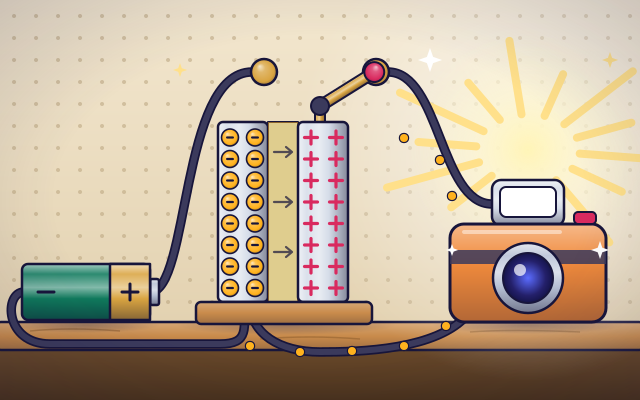
How do capacitors store and release energy?
Charge a virtual capacitor and use its stored energy for a brief action.
#380
Electricity & energy
How do capacitors store and release energy?
Charge a virtual capacitor and use its stored energy for a brief action.
 #381
Electricity & energy
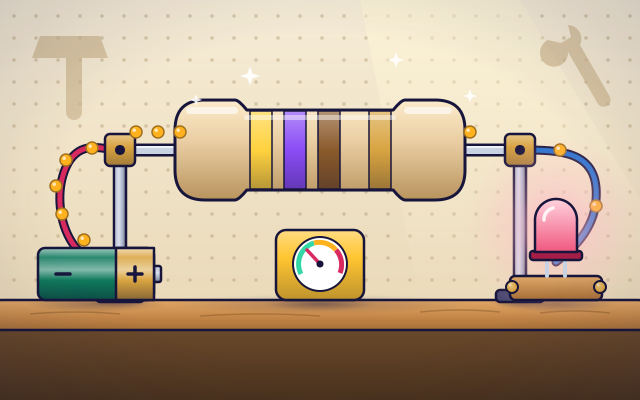
How do resistors control current?
Change resistance and observe corresponding changes on a virtual current meter.
#381
Electricity & energy
How do resistors control current?
Change resistance and observe corresponding changes on a virtual current meter.
 #382
Electricity & energy
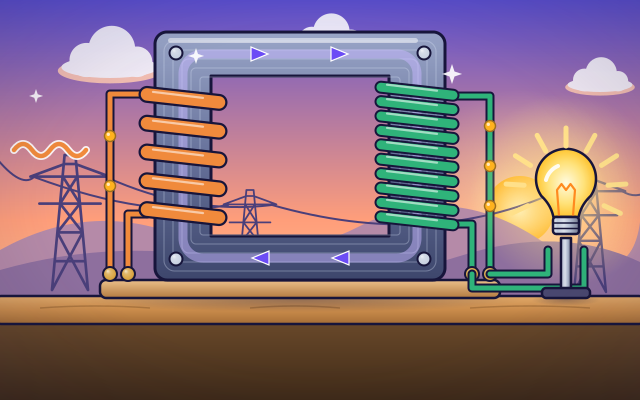
How do transformers change voltage?
Adjust turns in model coils and compare input and output voltages.
#382
Electricity & energy
How do transformers change voltage?
Adjust turns in model coils and compare input and output voltages.
 #383
Electricity & energy
How do inverters change direct current into alternating current?
Follow a switching sequence and watch a steady supply become an alternating waveform.
#383
Electricity & energy
How do inverters change direct current into alternating current?
Follow a switching sequence and watch a steady supply become an alternating waveform.
Keep exploring
Games to play next
- Circuit Workshop 3DWire up batteries, bulbs and switches on a 3D workbench.
- SwitchworksFlip switches to light the lamps in the target pattern — in as few presses as you can.
- Machine RepairFix levers, pulleys, gears and ramps so every contraption works.
Guide for grown-ups
- How to start homeschooling: a step-by-step guide for familiesA guide for parents · 7 min read
Science games by grade
Science worksheets by grade
- Preschool Science Worksheets
- Pre-K Science Worksheets
- Kindergarten Science Worksheets
- 1st Grade Science Worksheets
- 2nd Grade Science Worksheets
- 3rd Grade Science Worksheets
- 4th Grade Science Worksheets
- 5th Grade Science Worksheets
- 6th Grade Science Worksheets
- 7th Grade Science Worksheets
- 8th Grade Science Worksheets