How does a dishwasher clean dishes?
A dishwasher heats a little water, sprays it from spinning arms over and over, then rinses and dries your dishes.
The big idea: A dishwasher fills its bottom with a little water, heats it and pumps it through spray arms. The water squirting out of slanted holes pushes the arms around, so the spray reaches every dish that faces it.
It's like

The interactive parts didn't load. The explanations below still work; try reloading the page.
Inside a dishwasher's wash
- First, the dirty dishes go into the racks: plates and pots below, cups and glasses on top, all facing the middle so the water can reach them.
- The door closes and a valve lets in water, just enough to cover the bottom. A heater warms it up, because hot water melts grease and helps the soap work.
- A pump pushes the water up into the spray arms. It squirts out of slanted holes, which pushes the arms around and around. The soap cup opens, and the spray blasts food off the dishes.
- Now the dirty water is pumped out through a drain hose. A filter at the bottom catches bits of food so they don't get sprayed back onto the dishes.
- Fresh water fills the bottom again and sprays the dishes to rinse away the soap. A drop of rinse aid helps the water slide off in a smooth sheet instead of drops.
- The hot dishes dry off. Steam floats to the cooler metal walls, turns back into water drops and runs down the drain. Sparkling clean!
Inside a dishwasher
We took the door off so you can see inside. Tap each part to watch it work.
- Water inlet valve. This valve opens to let water in from the pipes, then shuts when there is just enough.
- Heater. The heater warms the water so grease melts and the soap works better. It also helps the dishes dry at the end.
- Wash pump. The pump pushes water from the bottom up into the spray arms, again and again during the wash.
- Spray arms. Water squirts out of slanted holes in the arms. Pushing water out one way pushes the arm the other way, so it spins all by itself.
- Racks. The racks hold the dishes in rows with gaps between them, so the water can reach every surface.
- Detergent dispenser. This little cup on the door holds the soap. It pops open at just the right time during the wash.
- Filter and sump. The water collects in a dip at the bottom called the sump. A filter catches food scraps so they don't get sprayed back onto the dishes.
- Drain pump and hose. When the washing is done, the drain pump pushes the dirty water out through a hose to the sink's drain pipe.
Spray arm lab
Change the pump's push and the slant of the spray holes. Follow the water and watch the arms. What makes them spin?
Experiment: Why do the spray arms spin?
- Turn the pump up and make the holes point straight up.
- Now slant the holes. What happens to the arms?
- Watch how much of each dish gets clean.
What we found: When the holes point straight up, the water just goes up and the arm stays still. Slanted holes push water out sideways, so the water pushes the arm the other way and it spins, spraying every dish.
Turn on JavaScript to try it yourself.
Load the dishwasher
Drag every dish into a rack so the spray can reach it. Tap a dish to flip it. For 3 stars, get everything clean in one wash.
Hot water, soap and spinning spray
A dishwasher doesn't fill up like a bathtub. It only puts a little water in the bottom, about a big bucketful, and uses it over and over. A pump pushes the water up into the spray arms, it splashes over the dishes and runs back down to be pumped up again.
The spray arms spin all by themselves. Their holes are slanted, so the water shoots out a little sideways. When the arm pushes the water one way, the water pushes the arm the other way. That push keeps the arms spinning, so the spray sweeps over every dish.
Hot water and dishwasher soap work as a team. Heat melts grease, and the soap contains special ingredients that break down food like egg and pasta. A filter at the bottom catches the scraps, and the dirty water is pumped away before the rinse.
Loading matters. Water can only clean a surface it can reach, so bowls and cups face down, dishes don't hide behind each other, and nothing tall blocks the spinning arms. At the end, the hot dishes dry as steam turns back into water on the cooler walls.
Key words
- Spray arm
- A spinning bar with holes that squirts water over the dishes.
- Sump
- The low bowl at the bottom where the water collects before it is pumped.
- Reaction force
- The push back you get when you push something away, like water out of a hole.
- Detergent
- Dishwasher soap that breaks down food and grease.
- Condensation
- When water vapor cools and turns back into liquid water.
- Torque
- A turning push.
Check your thinking
-
How should cups and bowls be loaded?
Show the answer
Facing down toward the spray. The spray comes up from below, and water can drain out instead of filling the cup.
-
What makes the spray arms spin?
Show the answer
Water pushing back as it shoots out of slanted holes. Pushing water out sideways pushes the arm the opposite way, so it spins.
-
Pump pressure is 30 kPa. About how fast do the jets leave the nozzles? (v = √(2ΔP/ρ), ρ = 1000 kg/m³)
Show the answer
About 7.7 m/s. v = √(2 × 30,000 / 1000) = √60 ≈ 7.7 m/s.
-
Why does a dishwasher have a filter?
Show the answer
So food scraps don't get sprayed back onto the dishes. The same water is used again and again, so it needs to be cleaned as it goes round.
-
How do the dishes dry at the end?
Show the answer
Steam turns back into water on the cooler walls and drains away. Hot dishes make steam, and it condenses on the cooler steel walls.
You're a Everyday machines expert!
You watched, looked inside, tried it, solved the challenge and went deeper. Pick another question below, or switch the age at the top to see this topic another way.
More about everyday machines
 #40
Everyday machines
How does a microwave heat food?
View a simplified animation of microwaves transferring energy to food. Explore uneven heating patterns and investigate how a rotating plate helps.
#40
Everyday machines
How does a microwave heat food?
View a simplified animation of microwaves transferring energy to food. Explore uneven heating patterns and investigate how a rotating plate helps.
 #143
Everyday machines
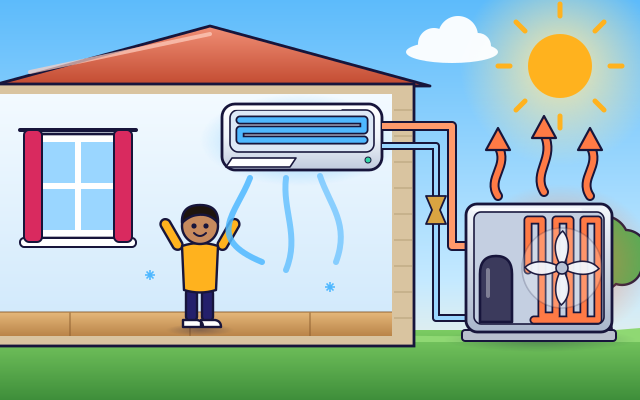
How does an air conditioner cool a room?
Follow heat moving outdoors while cooled air circulates inside a model room.
#143
Everyday machines
How does an air conditioner cool a room?
Follow heat moving outdoors while cooled air circulates inside a model room.
 #144
Everyday machines
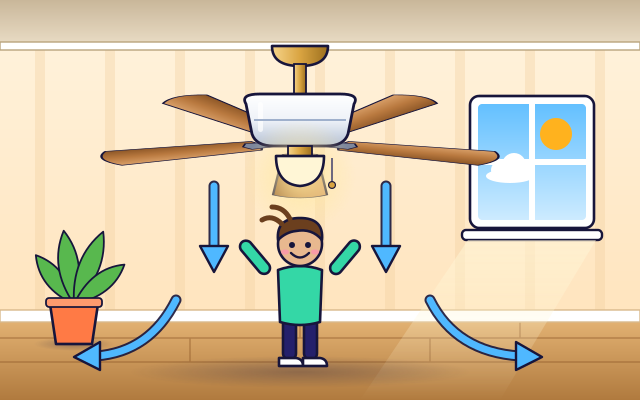
How do ceiling fans help us feel cooler?
Change blade speed and follow airflow around a person in a room.
#144
Everyday machines
How do ceiling fans help us feel cooler?
Change blade speed and follow airflow around a person in a room.
 #145
Everyday machines
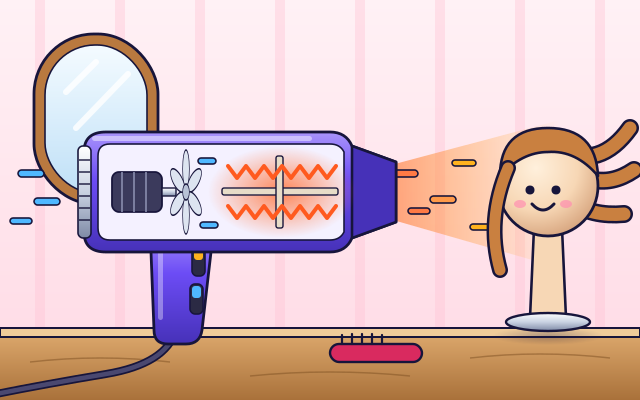
How does a hair dryer work?
Trace air past a heating element and compare airflow, temperature, and drying.
#145
Everyday machines
How does a hair dryer work?
Trace air past a heating element and compare airflow, temperature, and drying.
Keep exploring
Games to play next
- Machine RepairFix levers, pulleys, gears and ramps so every contraption works.
- Circuit Workshop 3DWire up batteries, bulbs and switches on a 3D workbench.
- Clock TowerKeep the town on time: set the tower clock's hands just right.
Guide for grown-ups
- How to start homeschooling: a step-by-step guide for familiesA guide for parents · 7 min read
Science games by grade
Science worksheets by grade
- Preschool Science Worksheets
- Pre-K Science Worksheets
- Kindergarten Science Worksheets
- 1st Grade Science Worksheets
- 2nd Grade Science Worksheets
- 3rd Grade Science Worksheets
- 4th Grade Science Worksheets
- 5th Grade Science Worksheets
- 6th Grade Science Worksheets
- 7th Grade Science Worksheets
- 8th Grade Science Worksheets