How do echoes happen?
An echo is your own sound, bounced back to you. Send claps at rock, trees and hay, and time how long they take to return.
The big idea: An echo is sound that hits a hard surface, bounces off and travels back to your ears. The farther away the surface is, the longer the echo takes. Soft, bumpy things soak the sound up instead.
It's like bouncing a ball off a wall. A hard wall sends it straight back, a pile of pillows swallows it, and a far wall means a longer wait.
The interactive parts didn't load. The explanations below still work; try reloading the page.
How an echo comes back
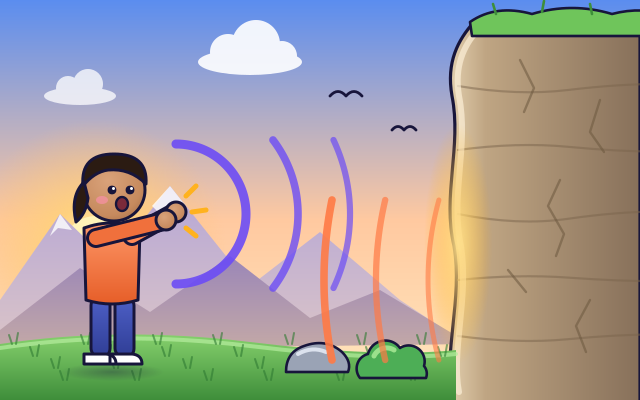
- Mia stands in a canyon and shouts toward a tall cliff. A moment later she hears her own voice again, a little quieter. Nobody is hiding up there. That second sound is an echo.
- Throw a ball at a wall and it bounces back to you. Sound does the same thing. The sound wave travels to the hard rock, bounces off and travels all the way back to Mia's ears.
- Sound needs time to travel. When the cliff is near, the echo is back almost at once. When the cliff is far away, the sound has a long trip there and a long trip back, so Mia waits longer.
- Not every surface makes a good echo. Hard, smooth rock sends the sound straight back. Bumpy trees scatter it in every direction. Soft hay soaks it up, so almost nothing returns.
- In an ordinary room the walls are only a few meters away. The sound bounces back in a tiny fraction of a second, much too soon for your ears to tell it apart from the clap itself. So you hear no echo.
- Bats use echoes to see in the dark. A bat sends out quick squeaks and listens. A fast echo means something is near, and a slow echo means it is far. Ships find the sea floor the same way.
Look inside an echo
Tap each part of the picture to follow the sound to the cliff and back.
- Your shout. Every echo starts with a sound: a shout, a clap or a bark. A short, sharp sound makes the clearest echo, because it is finished before the echo comes back.
- Sound going out. The sound spreads out from Mia as a wave in the air. Part of it heads for the cliff, moving about 340 meters every second.
- Hard cliff. The rock is hard and heavy, so the air cannot push it. The sound wave has nowhere to go but back. A big, flat, hard surface makes the best echo.
- The echo. This is the echo: the same sound on its way back. It is quieter than the shout, because it has spread out over a long trip and the cliff did not return all of it.
- Soft bushes. Leaves and twigs are soft and full of gaps. Sound that lands here gets mixed up and soaked in, so hardly any comes back. Curtains, carpets and snow do the same.
- The wait. The time between the shout and the echo is the delay. The sound has to go there and come back, so a cliff twice as far away gives a wait twice as long.
Clap, wait, listen
Tap Mia to clap. Watch the sound travel to the wall and back, and read the stopwatch. Drag the wall nearer and farther, then swap the rock for trees or hay.
Experiment: You move the wall farther away and clap again. What happens to the echo?
- Clap with the wall where it is. Read the stopwatch.
- Drag the wall much farther away and clap again.
- Now try the trees and the hay. What comes back?
What we found: The farther the wall, the later the echo, because the sound has to travel there and back. Very close walls send the sound back too quickly to hear as a separate echo. Hard rock gives a strong echo, bumpy trees give a faint one, and soft hay gives almost none.
Turn on JavaScript to try it yourself.
Find the cliff in the fog
A cliff is hidden in the fog. Clap, time the echo, and put the flag where you think the cliff is. Then press Check. Find it three times.
How echoes work
Sound is a wave that travels through the air. When the wave meets something hard and heavy, like a cliff or a brick wall, it cannot push its way in. So it bounces off, the way a ball bounces off a wall. When that bounced sound reaches your ears, you hear an echo.
Sound is fast, but it still takes time to travel: about 340 meters every second in air. An echo has to make two trips, one to the wall and one back. So if a cliff is 170 meters away, the sound travels 340 meters in all, and the echo arrives about one second after your shout.
Your ears cannot separate two sounds that arrive very close together. If the wall is nearer than about 17 meters, the echo is back within a tenth of a second and blends into the sound you made. That is why you do not hear echoes in your bedroom. Soft things such as curtains, carpets and beds soak up sound as well.
Animals and people use echoes as a tool. Bats and dolphins make clicks and squeaks, then listen to find food and avoid bumping into things. Ships send sound down to the sea floor and time the echo to measure how deep the water is. One way our ball comparison breaks down: a ball comes back as one ball, but sound spreads out, so only part of it returns.
Key words
- Echo
- A sound that bounces off something and comes back to you.
- Reflection
- The bouncing back of a wave when it meets a surface.
- Delay
- The wait between making a sound and hearing its echo.
- Absorb
- To soak up. Soft, airy materials absorb sound instead of bouncing it back.
- Reverberation
- Many quick echoes that blend together into a ringing sound, as in a big hall.
- Echolocation
- Finding things by making sounds and listening to their echoes, as bats and dolphins do.
Check your thinking
-
What makes an echo?
Show the answer
Sound bouncing off a hard surface and coming back. The sound wave cannot get into the hard rock, so it bounces back, like a ball off a wall.
-
You shout at a cliff, then walk much farther away and shout again. What changes?
Show the answer
The echo takes longer to come back. The sound has farther to travel, there and back, so it needs more time.
-
Which of these makes the strongest echo?
Show the answer
A big, smooth rock wall. Hard, smooth surfaces bounce sound straight back. Soft or bumpy ones soak it up or scatter it.
-
Why don't you hear an echo when you clap in your bedroom?
Show the answer
The walls are so close that the sound is back too quickly to hear apart. The bounce comes back in a tiny fraction of a second and blends into the clap. Soft things in the room soak up sound too.
-
How does a bat find a moth in the dark?
Show the answer
It squeaks and listens for the echo from the moth. The squeak bounces off the moth. The sooner the echo arrives, the closer the moth is.
You're a Light & sound expert!
You watched, looked inside, tried it, solved the challenge and went deeper. Pick another question below, or switch the age at the top to see this topic another way.
More about light & sound
 #438
Light & sound
How do guitar strings create different notes?
Change string length, tension, and thickness and compare vibrations and pitch.
#438
Light & sound
How do guitar strings create different notes?
Change string length, tension, and thickness and compare vibrations and pitch.
 #439
Light & sound
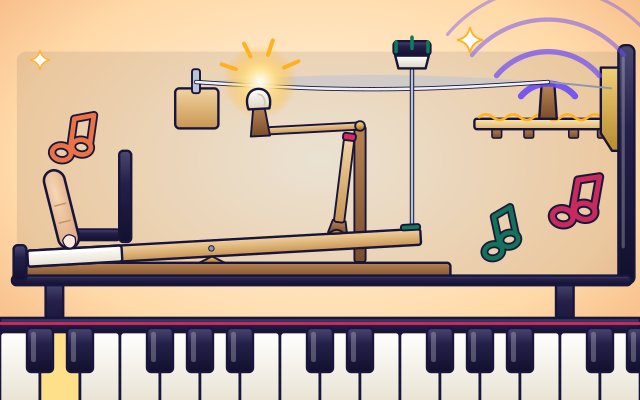
How does a piano make music?
Follow a key press through a hammer, string, damper, and soundboard.
#439
Light & sound
How does a piano make music?
Follow a key press through a hammer, string, damper, and soundboard.
 #440
Light & sound
How do flutes produce different notes?
Open and close holes and explore changing vibrations in an air column.
#440
Light & sound
How do flutes produce different notes?
Open and close holes and explore changing vibrations in an air column.
 #441
Light & sound
How do drums make different sounds?
Change membrane tension and drum size and compare vibration patterns.
#441
Light & sound
How do drums make different sounds?
Change membrane tension and drum size and compare vibration patterns.
Keep exploring
Games to play next
- Listen and FindOlly whispers a clue or plays a sound. Can you find it in the picture?
- Mirror MazeBend a beam of light with mirrors to light up every crystal — in the right order.
- Shadow SculptorStack cubes under three lamps until every shadow matches the outline.
Guide for grown-ups
- How to start homeschooling: a step-by-step guide for familiesA guide for parents · 7 min read
Science games by grade
Science worksheets by grade
- Preschool Science Worksheets
- Pre-K Science Worksheets
- Kindergarten Science Worksheets
- 1st Grade Science Worksheets
- 2nd Grade Science Worksheets
- 3rd Grade Science Worksheets
- 4th Grade Science Worksheets
- 5th Grade Science Worksheets
- 6th Grade Science Worksheets
- 7th Grade Science Worksheets
- 8th Grade Science Worksheets