How do solar and lunar eclipses happen?
Line up the Sun, Earth and Moon to make solar and lunar eclipses, and discover why they don't happen every month.
The big idea: A solar eclipse happens when the Moon passes exactly between the Sun and Earth, and its shadow falls on Earth. A lunar eclipse happens when Earth is exactly between the Sun and the Moon, and Earth's shadow falls on the Moon. The Moon's path is tilted, so usually it passes just above or below the shadows.
It's like
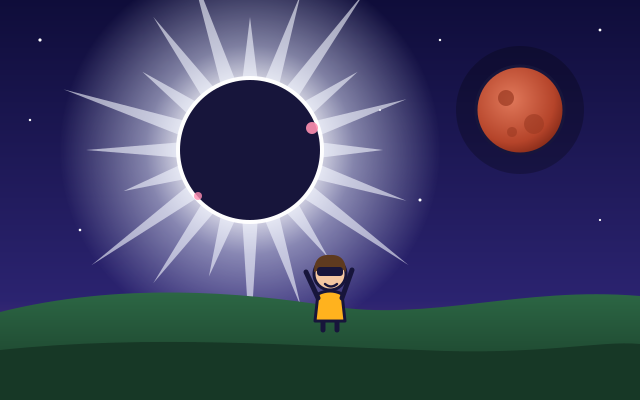
The interactive parts didn't load. The explanations below still work; try reloading the page.
Solar and lunar eclipses
- Earth and the Moon both block sunlight, so each casts a long shadow into space, always pointing away from the Sun.
- When the Moon passes exactly between the Sun and Earth, its shadow falls on Earth. People in the shadow see the Moon cover the Sun: a solar eclipse.
- Inside the darkest part of the shadow the Sun is completely covered. The sky goes dark, stars appear and the Sun's glowing outer air, the corona, shines around the Moon.
- At full Moon, if Earth is exactly between the Sun and the Moon, the Moon slides into Earth's shadow. It turns coppery red: a lunar eclipse.
- Why not every month? The Moon's path is tilted a little. Most months it passes just above or below the Sun's line and misses the shadows.
- Twice a year the tilted path lines up with the Sun. Then new and full Moons can make eclipses. These times are called eclipse seasons.
Inside an eclipse
Tap each part of the diagram. It is not to scale: the real Sun is huge and very far away.
- The Sun. The Sun is the light source. Because it is a big ball, not a single point, shadows have a dark middle and a fuzzy edge.
- Moon in front of the Sun. At new Moon the Moon is between the Sun and Earth. If it is lined up exactly, it blocks the Sun for some places on Earth.
- Path of totality. The darkest part of the Moon's shadow makes a small spot on Earth. People in the spot see a total eclipse. The spot races across Earth in a narrow path.
- Partial shadow. In the lighter part of the Moon's shadow, people see the Moon cover only part of the Sun: a partial eclipse.
- Earth. We watch eclipses from Earth. A solar eclipse is only seen where the Moon's shadow falls, but a lunar eclipse is seen from the whole night side of Earth.
- Earth's shadow. Earth's shadow is much bigger than the Moon's. At the Moon's distance it is almost three Moons wide, so a lunar eclipse can last over an hour.
- Red Moon. During a lunar eclipse the Moon doesn't disappear. Sunlight bending through Earth's air colors it red.
- Tilted orbit. Seen from the side, the Moon's path is tilted compared with Earth's path. That's why we don't get an eclipse every month.
Eclipse maker
Move the Moon to new Moon and to full Moon. Then change the month. The side view shows the Moon's tilted path: when does an eclipse happen, and when does the Moon miss?
Experiment: The Moon goes around Earth every month. Why isn't there an eclipse every month?
- Move the Moon between the Sun and Earth (new Moon). Is there a solar eclipse?
- Move it behind Earth (full Moon). Is there a lunar eclipse?
- Now change the month and try new and full Moon again. Watch the side view.
What we found: The Moon's path is tilted. At most new and full Moons it passes a little above or below the line between the Sun and Earth, so the shadows miss. Only when the tilted path lines up with the Sun, twice a year, can eclipses happen.
Turn on JavaScript to try it yourself.
Eclipse hunter
Find a month and a Moon position that make a solar eclipse, and another that makes a lunar eclipse. Press Look! to check each one.
Lining up the Sun, Earth and Moon
An eclipse happens when one object in space moves into the shadow of another. Because the Sun lights Earth and the Moon from one side, they both cast long shadows into space, always pointing away from the Sun.
In a solar eclipse the Moon passes between the Sun and Earth, and its shadow falls on a small part of Earth. The Moon is about 400 times smaller than the Sun, but also about 400 times closer, so it can cover the Sun exactly. Never look straight at the Sun, even during an eclipse: use special eclipse glasses or a pinhole viewer.
In a lunar eclipse Earth passes between the Sun and the Moon, and Earth's shadow covers the Moon. The Moon turns red because Earth's air bends a little red sunlight into the shadow. Everyone on the night side of Earth can see it, and it is safe to watch.
Eclipses don't happen every month because the Moon's path is tilted by about 5 degrees. Most months the Moon passes just above or below the shadows. Only twice a year, during eclipse seasons, do the Sun, Earth and Moon line up well enough.
Key words
- Solar eclipse
- When the Moon blocks the Sun as seen from part of Earth. It can only happen at new Moon.
- Lunar eclipse
- When the Moon moves into Earth's shadow. It can only happen at full Moon.
- Umbra
- The darkest middle part of a shadow, where the Sun is completely blocked.
- Penumbra
- The lighter outer part of a shadow, where the Sun is only partly blocked.
- Node
- A place where the Moon's tilted path crosses Earth's path around the Sun.
Check your thinking
-
What happens in a solar eclipse?
Show the answer
The Moon passes between the Sun and Earth. The Moon's shadow falls on Earth, hiding the Sun for people in the shadow.
-
Why does the Moon look red during a lunar eclipse?
Show the answer
Earth's air bends red sunlight into the shadow. Sunlight passing through Earth's air loses its blue and bends into the shadow, so the Moon looks red.
-
Why don't eclipses happen every month?
Show the answer
The Moon's path is tilted, so it usually passes above or below the shadows. The tilt means the three only line up during eclipse seasons, about twice a year.
-
How should you watch a solar eclipse?
Show the answer
With certified eclipse glasses or a pinhole projector. Even a thin sliver of the Sun can damage your eyes. Only special filters or projection are safe.
-
Earth's umbra is about 1.4 degrees wide at the Moon's distance and the Moon is about 0.5 degrees wide. About how far can the Moon's center be from the umbra's center and still be totally eclipsed?
Show the answer
About 0.45 degrees. The Moon fits entirely inside if its center is within (1.4 − 0.5) ÷ 2 ≈ 0.45 degrees of the umbra's center.
You're a Space & astronomy expert!
You watched, looked inside, tried it, solved the challenge and went deeper. Pick another question below, or switch the age at the top to see this topic another way.
More about space & astronomy
 #83
Space & astronomy
How does a space station support astronauts?
Explore air, water, food, power, exercise, and waste systems. Manage a small station and discover how astronauts live and work in orbit.
#83
Space & astronomy
How does a space station support astronauts?
Explore air, water, food, power, exercise, and waste systems. Manage a small station and discover how astronauts live and work in orbit.
 #471
Space & astronomy
How does the Sun produce energy?
Explore a simplified fusion model and follow energy from the Sun toward Earth.
#471
Space & astronomy
How does the Sun produce energy?
Explore a simplified fusion model and follow energy from the Sun toward Earth.
 #472
Space & astronomy
How do auroras appear in the sky?
Follow charged particles, Earth's magnetic field, and light emitted high in the atmosphere.
#472
Space & astronomy
How do auroras appear in the sky?
Follow charged particles, Earth's magnetic field, and light emitted high in the atmosphere.
 #473
Space & astronomy
How do spacesuits support astronauts?
Explore pressure, oxygen, cooling, communication, and protective layers inside a suit.
#473
Space & astronomy
How do spacesuits support astronauts?
Explore pressure, oxygen, cooling, communication, and protective layers inside a suit.
Keep exploring
Games to play next
- Seasons and SkiesFrom days of the week to Earth's tilt: dress for the weather, read the sky and discover why seasons happen.
- Globe ExplorerSpin a real 3D globe, flip to the flat map, and find continents, oceans and countries.
- Science QuizzesOlly's Science Quiz Show: plants, animals, the body, weather, space and more, for every grade.
Guide for grown-ups
- How to start homeschooling: a step-by-step guide for familiesA guide for parents · 7 min read
Science games by grade
Science worksheets by grade
- Preschool Science Worksheets
- Pre-K Science Worksheets
- Kindergarten Science Worksheets
- 1st Grade Science Worksheets
- 2nd Grade Science Worksheets
- 3rd Grade Science Worksheets
- 4th Grade Science Worksheets
- 5th Grade Science Worksheets
- 6th Grade Science Worksheets
- 7th Grade Science Worksheets
- 8th Grade Science Worksheets