How does a space station support astronauts?
How do astronauts breathe, drink, eat, sleep and stay strong in orbit? Explore the systems that keep a space station alive.
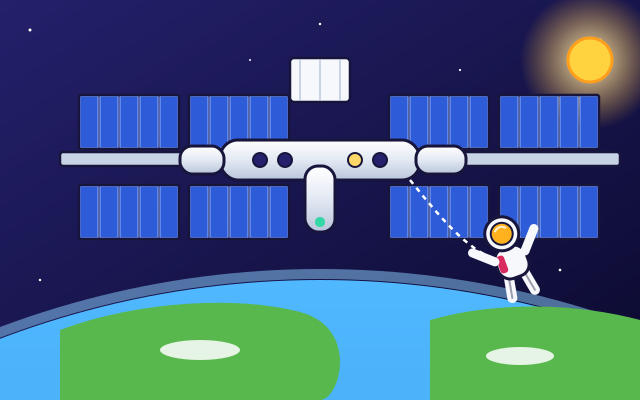
The big idea: A space station is a sealed home falling around Earth. Its machines make oxygen, clean carbon dioxide out of the air and recycle almost all of the water. Solar panels give power, and astronauts exercise every day to keep their bodies strong.
It's like
The interactive parts didn't load. The explanations below still work; try reloading the page.
Living on a space station
- A space station flies around Earth about 400 kilometers up. It goes all the way around in about an hour and a half, so the crew sees about sixteen sunrises a day.
- Inside, everything floats. The station and the astronauts are falling around Earth together, so nothing presses down on the floor.
- There is no air outside, so the station makes it. A machine splits water to make oxygen, and a scrubber pulls out the carbon dioxide that astronauts breathe out.
- Water is heavy to send to space, so it is recycled. Machines collect sweat and moisture from the air, and even urine, and clean it into fresh drinking water.
- Huge solar panels turn sunlight into electricity. In Earth's shadow, batteries take over. Radiators send extra heat away into space.
- Astronauts eat packaged food, sleep in sleeping bags tied to the wall and exercise about two hours a day so their bones and muscles stay strong.
Inside a space station
Tap each part of the station. Watch what happens when you find it!
- Solar arrays. Solar arrays turn sunlight into electricity for lights, computers and all the life-support machines. They turn to face the Sun.
- Radiators. Machines and people make heat. Radiators carry that heat outside and glow it away into space, so the station doesn't get too hot.
- Oxygen maker. The oxygen maker uses electricity to split water into oxygen, which the crew breathe, and hydrogen.
- CO₂ scrubber. Every breath out adds carbon dioxide. The scrubber pulls it out of the air, because too much would make the crew sick and sleepy.
- Water recycler. The water recycler cleans sweat, moisture from the air and even urine into fresh drinking water. Almost nothing is wasted.
- Kitchen. Food comes in sealed packets. Some just need hot water added. Tortillas are popular because bread makes crumbs that float everywhere!
- Sleeping pods. Each astronaut has a tiny cabin with a sleeping bag attached to the wall. In weightlessness, up and down don't matter!
- Space gym. Bungee straps pull the astronaut down onto the treadmill. Exercising about two hours a day keeps bones and muscles from getting weak.
- Space toilet. With no gravity, a toilet can't rely on things falling down. It uses airflow, like a gentle vacuum cleaner. The urine goes to the water recycler!
- Docking port. Cargo ships dock here, bringing food, water, air tanks and science experiments. Crew ships bring astronauts to and from Earth.
Life-support lab
Switch the station's machines on and off and watch the gauges. What happens to the air and the water when a machine stops?
Experiment: What happens to the air if the CO₂ scrubber is switched off?
- Watch the gauges with every machine switched on.
- Switch off the CO₂ scrubber. Watch the air gauge.
- Switch it back on, then try switching off the water recycler.
What we found: Every breath adds carbon dioxide. Without the scrubber it builds up and the air gets stale and unsafe. Without the recycler the water runs out quickly. A station needs all its machines working together!
Turn on JavaScript to try it yourself.
30 days until the cargo ship
Keep the crew safe for 30 days until the cargo ship arrives, and do as much science as you can. Choose your settings, then press Start mission.
How a space station keeps people alive
Space has no air to breathe, no water and no food, and it is extremely hot in sunlight and cold in shadow. A space station is a sealed home that carries everything its crew needs, and it uses clever machines to make and reuse as much as possible.
Air is made from water. A machine uses electricity to split water into oxygen and hydrogen. Another machine, the scrubber, removes the carbon dioxide that astronauts breathe out. Fans keep the air moving, because in space your breath doesn't float away by itself.
Water is precious, so the station recycles almost all of it: sweat, moisture from breath and even urine are cleaned into drinking water. Food can't be recycled, so cargo ships bring packaged meals and fresh fruit every few months.
Floating looks fun, but without weight to carry, bones and muscles get weaker. That's why astronauts exercise for about two hours every day. They sleep in sleeping bags fixed to the wall, and they see about sixteen sunrises a day as the station races around Earth.
Key words
- Life support
- The machines that keep astronauts alive: making air, removing carbon dioxide, recycling water and controlling temperature.
- Carbon dioxide (CO₂)
- The gas we breathe out. Too much of it makes the air unsafe.
- Electrolysis
- Using electricity to split water into oxygen and hydrogen.
- Recycling
- Cleaning and reusing something instead of throwing it away, like turning used water back into drinking water.
- Weightlessness
- The floating feeling astronauts have because they and the station are falling around Earth together.
Check your thinking
-
How does a space station make oxygen?
Show the answer
By splitting water with electricity. Water is made of hydrogen and oxygen; electricity splits it so the crew can breathe the oxygen.
-
Why do astronauts exercise about two hours every day?
Show the answer
To keep their bones and muscles strong. Without weight to carry, bones and muscles get weaker, so exercise keeps them strong.
-
What would happen if the CO₂ scrubber stopped working?
Show the answer
Carbon dioxide would build up and the air would become unsafe. Every breath adds CO₂. Without the scrubber it builds up and makes people feel sick.
-
What does the water recycler clean into drinking water?
Show the answer
Sweat, moisture from the air and urine. Almost every drop is collected and cleaned, so very little water has to come from Earth.
-
A crew of 4 needs about 0.84 kg of oxygen each per day. How much oxygen does the station need for a 30-day mission?
Show the answer
About 100 kg. 4 × 0.84 kg × 30 days ≈ 101 kg.
You're a Space & astronomy expert!
You watched, looked inside, tried it, solved the challenge and went deeper. Pick another question below, or switch the age at the top to see this topic another way.
More about space & astronomy
 #471
Space & astronomy
How does the Sun produce energy?
Explore a simplified fusion model and follow energy from the Sun toward Earth.
#471
Space & astronomy
How does the Sun produce energy?
Explore a simplified fusion model and follow energy from the Sun toward Earth.
 #472
Space & astronomy
How do auroras appear in the sky?
Follow charged particles, Earth's magnetic field, and light emitted high in the atmosphere.
#472
Space & astronomy
How do auroras appear in the sky?
Follow charged particles, Earth's magnetic field, and light emitted high in the atmosphere.
 #473
Space & astronomy
How do spacesuits support astronauts?
Explore pressure, oxygen, cooling, communication, and protective layers inside a suit.
#473
Space & astronomy
How do spacesuits support astronauts?
Explore pressure, oxygen, cooling, communication, and protective layers inside a suit.
 #474
Space & astronomy
How do weather satellites observe Earth?
Compare visible and infrared views and track clouds across successive images.
#474
Space & astronomy
How do weather satellites observe Earth?
Compare visible and infrared views and track clouds across successive images.
Keep exploring
Games to play next
- Seasons and SkiesFrom days of the week to Earth's tilt: dress for the weather, read the sky and discover why seasons happen.
- Science QuizzesOlly's Science Quiz Show: plants, animals, the body, weather, space and more, for every grade.
- Globe ExplorerSpin a real 3D globe, flip to the flat map, and find continents, oceans and countries.
Draw it or make it
- How to draw an astronautDrawing lesson
Guide for grown-ups
- How to start homeschooling: a step-by-step guide for familiesA guide for parents · 7 min read
Science games by grade
Science worksheets by grade
- Preschool Science Worksheets
- Pre-K Science Worksheets
- Kindergarten Science Worksheets
- 1st Grade Science Worksheets
- 2nd Grade Science Worksheets
- 3rd Grade Science Worksheets
- 4th Grade Science Worksheets
- 5th Grade Science Worksheets
- 6th Grade Science Worksheets
- 7th Grade Science Worksheets
- 8th Grade Science Worksheets