How does the Sun produce energy?
The Sun is not on fire. Its core squeezes hydrogen into helium, and the energy travels out and across space to Earth.
The big idea: The Sun's core is so hot and squeezed that hydrogen bits crash and stick together to make helium. Each time, a little energy comes out as light.
It's like clapping your hands very hard: they sting and feel warm. Deep in the Sun, tiny hydrogen bits are slammed together so hard that they stick and give off light.
The interactive parts didn't load. The explanations below still work; try reloading the page.
From the Sun's core to you
- Every morning the Sun lights and warms our world. Plants grow toward it and we feel it on our skin. But where does all that light come from?
- The Sun is a star: a huge ball of glowing gas, mostly hydrogen. More than a million Earths could fit inside it. It is not burning like a fire. It shines in a different way.
- The Sun's own gravity pulls all that gas toward the middle. The center, called the core, is squeezed so hard that it reaches about 15 million degrees.
- In the core, hydrogen bits move so fast that when they crash, they stick together. Step by step, four hydrogens become one helium, and a flash of energy comes out. This is called fusion.
- The energy cannot fly straight out. The Sun is so thick that light gets bumped around in a zigzag for many thousands of years. Near the top, hot gas carries it up like bubbles in boiling soup.
- Once it leaves the surface, light races across 150 million kilometers of space. About eight minutes later it reaches Earth, where it warms the land, drives the weather and feeds every green plant.
Look inside the Sun
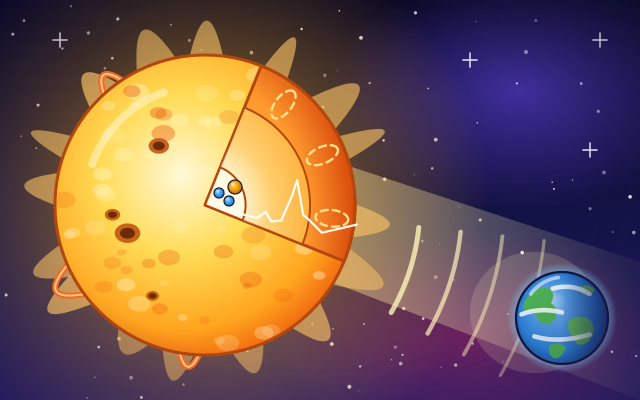
A slice has been cut out of this model Sun. Tap each layer to see what happens there.
- Core. The core is the Sun's power station. It is about 15 million degrees, and here hydrogen fuses into helium and gives out energy.
- Radiative zone. In this thick layer, light cannot travel straight. It is bumped from one bit of gas to the next, zigzagging outward for many thousands of years.
- Convection zone. Near the top, the gas churns like soup in a pot. Hot gas rises, lets its heat out at the surface, cools and sinks again.
- Surface (photosphere). This is the bright layer we see from Earth. It is about 5,500 degrees, and from here light finally escapes into space.
- Sunspots. Sunspots are cooler patches on the surface. They look dark only because everything around them is even brighter.
- Corona. The corona is the Sun's thin outer atmosphere. It streams far out into space, and it is the pale crown you can see around the Sun during a total solar eclipse.
Make hydrogen fuse
This box is a tiny piece of the Sun's core. Drag the plate to squeeze and heat the hydrogen. Watch what the bits do, and watch the little Sun.
Experiment: What happens to the hydrogen when you squeeze and heat it more and more?
- Start with a gentle squeeze. Watch the hydrogen bits bounce.
- Drag the plate, or use the slider, to squeeze harder.
- Watch for flashes, and look at the little Sun on the right.
What we found: With a gentle squeeze the hydrogen bits are too slow: they bounce apart and nothing happens. Squeezed hard, the core gets hotter and more crowded, so the bits crash hard enough to stick together into helium. Every time that happens, a little energy comes out as light. That is how the Sun shines.
Turn on JavaScript to try it yourself.
Just the right sunshine
Set the squeeze so the planet gets just the right amount of light: not icy, not baking. Press Send the light to test it.
How the Sun makes its light
The Sun is a star, and it is our nearest one. It is a giant ball of very hot gas, mostly hydrogen, the lightest stuff there is. The Sun is so heavy that its own gravity squeezes it toward the middle. In the center, called the core, the gas is crushed and heated to about 15 million degrees.
At that heat, the tiny centers of hydrogen atoms fly around at enormous speeds. Most of the time they just bounce off each other. But some crash so hard that they stick. Step by step, four hydrogens join to make one helium. This joining is called fusion, and each time it happens a little energy is set free. Clapping your hands is only a small picture of this: your hands do not change, but the hydrogen really does turn into something new.
That energy has a long trip ahead. The inside of the Sun is so thick that light cannot go straight. It is bumped this way and that for many thousands of years. Near the top, the gas churns like soup in a pot: hot gas rises, cools and sinks again, carrying the heat to the surface.
From the surface, the light finally flies free. It crosses 150 million kilometers of space in about eight minutes and lands on Earth as sunshine. The Sun has been shining like this for about four and a half billion years, and it has enough hydrogen to keep going for billions more. One warning: never look straight at the Sun. It is bright enough to hurt your eyes.
Key words
- Fusion
- When small bits of atoms are pushed together so hard that they join into a bigger one and give out energy.
- Core
- The hot, squeezed center of the Sun, where fusion happens.
- Plasma
- Gas so hot that it glows and its atoms are torn into smaller charged bits.
- Nucleus
- The tiny, heavy center of an atom. A hydrogen nucleus is a single proton.
- Photosphere
- The bright visible surface of the Sun, where light escapes into space.
- Photon
- A tiny packet of light.
Check your thinking
-
What happens in the Sun's core to make its energy?
Show the answer
Hydrogen bits fuse into helium. In the hot, squeezed core, hydrogen joins to make helium, and energy comes out each time.
-
About how long does sunlight take to travel from the Sun to Earth?
Show the answer
About 8 minutes. Light is the fastest thing there is, but the Sun is 150 million kilometers away, so the trip takes about 8 minutes.
-
Why does fusion happen in the core and not at the surface?
Show the answer
Only the core is hot and squeezed enough. Hydrogen bits must crash very hard to stick. Only the core, at about 15 million degrees, is hot and crowded enough.
-
If the Sun's core were squeezed less and became cooler, what would happen?
Show the answer
Less hydrogen would fuse, so the Sun would shine less. Cooler, less crowded hydrogen bits bounce apart instead of sticking, so less energy is made.
-
A planet orbits three times as far from the Sun as Earth does. How much sunlight does each square meter of it receive, compared with Earth?
Show the answer
One ninth as much. Light spreads over a sphere, so its intensity falls with the square of the distance: 1 divided by 3 squared is one ninth.
-
Why does energy made in the core take so long to reach the surface?
Show the answer
Photons are absorbed and re-emitted in random directions again and again. The Sun's interior is dense and opaque, so energy moves outward in a slow random walk before convection carries it the last part of the way.
You're a Space & astronomy expert!
You watched, looked inside, tried it, solved the challenge and went deeper. Pick another question below, or switch the age at the top to see this topic another way.
More about space & astronomy
 #472
Space & astronomy
How do auroras appear in the sky?
Follow charged particles, Earth's magnetic field, and light emitted high in the atmosphere.
#472
Space & astronomy
How do auroras appear in the sky?
Follow charged particles, Earth's magnetic field, and light emitted high in the atmosphere.
 #473
Space & astronomy
How do spacesuits support astronauts?
Explore pressure, oxygen, cooling, communication, and protective layers inside a suit.
#473
Space & astronomy
How do spacesuits support astronauts?
Explore pressure, oxygen, cooling, communication, and protective layers inside a suit.
 #474
Space & astronomy
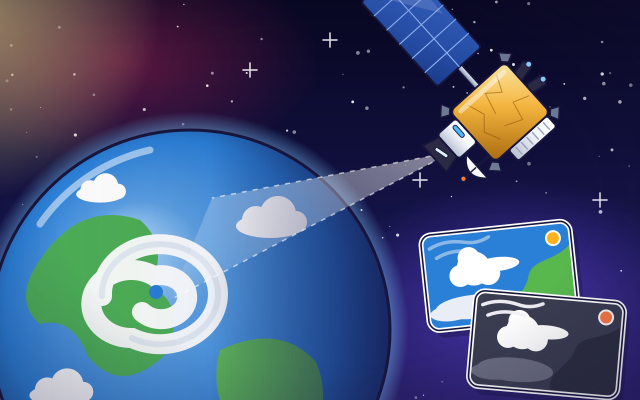
How do weather satellites observe Earth?
Compare visible and infrared views and track clouds across successive images.
#474
Space & astronomy
How do weather satellites observe Earth?
Compare visible and infrared views and track clouds across successive images.
 #475
Space & astronomy
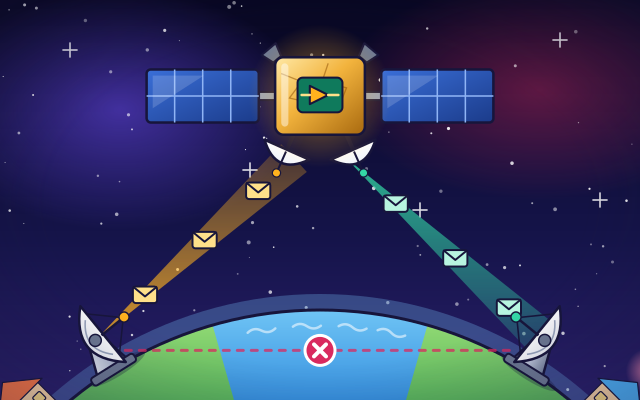
How do communication satellites relay signals?
Route a message through ground stations and a satellite to a distant receiver.
#475
Space & astronomy
How do communication satellites relay signals?
Route a message through ground stations and a satellite to a distant receiver.
Keep exploring
Games to play next
- Seasons and SkiesFrom days of the week to Earth's tilt: dress for the weather, read the sky and discover why seasons happen.
- Globe ExplorerSpin a real 3D globe, flip to the flat map, and find continents, oceans and countries.
- Science QuizzesOlly's Science Quiz Show: plants, animals, the body, weather, space and more, for every grade.
Draw it or make it
- How to draw a sunDrawing lesson
Guide for grown-ups
- How to start homeschooling: a step-by-step guide for familiesA guide for parents · 7 min read
Science games by grade
Science worksheets by grade
- Preschool Science Worksheets
- Pre-K Science Worksheets
- Kindergarten Science Worksheets
- 1st Grade Science Worksheets
- 2nd Grade Science Worksheets
- 3rd Grade Science Worksheets
- 4th Grade Science Worksheets
- 5th Grade Science Worksheets
- 6th Grade Science Worksheets
- 7th Grade Science Worksheets
- 8th Grade Science Worksheets