How do electricity meters measure household use?
An electricity meter adds up every bit of electricity a home uses. Switch more things on and it counts faster.
The big idea: Every appliance uses electricity at its own speed. The meter feels the total and counts it up, slowly for a lamp and quickly for a kettle. The count only ever goes up.
It's like a bucket under a tap. How far the tap is open is the power. The water in the bucket is the energy, and that is what the meter counts.
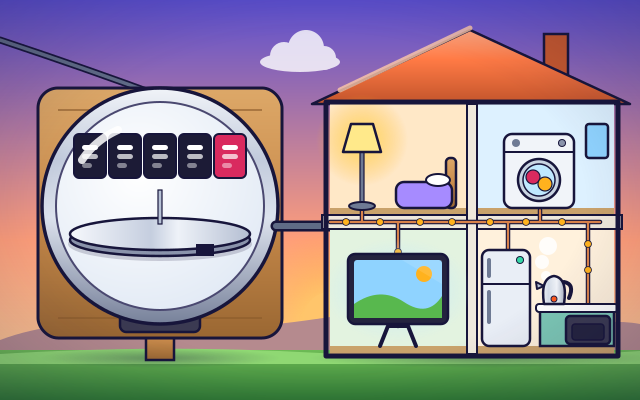
The interactive parts didn't load. The explanations below still work; try reloading the page.
What the meter counts
- All the electricity for this house comes in through one box on the wall: the electricity meter. A wheel inside it turns, and the numbers slowly climb. What is it counting?
- Each appliance uses electricity at its own speed, called its power. A lamp only sips. A television uses about ten times as much, and a kettle more than a hundred times as much.
- Inside an older meter, the electricity flows through coils of wire. The coils act as magnets and push on a thin metal disc. The more electricity the house is using, the faster the disc spins.
- Tiny gears count the turns of the disc and move the number wheels. So the meter adds up two things: how much power, and for how long. The answer is energy.
- Newer smart meters have no spinning disc. A tiny chip measures the electricity many times every second, adds it up, and sends the reading by radio. A screen at home can show what you are using right now.
- Switch off what nobody is using and the meter slows down at once. Less energy counted means a smaller bill, and less fuel burned to make the electricity.
Look inside a spinning-disc meter
Tap each part. Follow the electricity in at the bottom, and see how it ends up as numbers at the top.
- Terminals. The thick wires from the street are fixed here, and so are the wires going on into the house. All the home's electricity passes through.
- Current coil. All the electricity the house is using flows through this coil of thick wire. The more that flows, the stronger a magnet it becomes.
- Voltage coil. This coil has many turns of thin wire. It is always connected, and it makes a second magnetic field that works together with the first one.
- Spinning disc. The two coils push this thin aluminum disc around without touching it. Its speed shows how much power the house is using right now.
- Brake magnet. This strong magnet gently drags on the disc. Without it the disc would keep speeding up. With it, the speed matches the power exactly.
- Gears. A screw thread on the disc's spindle turns a set of tiny gears. They slow the motion down a great deal, so many turns of the disc make one small step of the numbers.
- Register (the numbers). The number wheels show all the energy used since the meter was fitted. To find out how much you used this month, take away last month's reading.
Switch on, switch off, watch the meter
Tap the appliances to switch them on and off. Watch the disc and the numbers. Which one uses electricity the fastest?
Experiment: The lamp is on. What happens to the disc when you switch the kettle on as well?
- Switch on only the lamp. Watch how slowly the disc creeps.
- Now switch on the kettle too.
- Switch the kettle off again, and try the oven.
What we found: The disc spins much faster. A kettle uses electricity about 150 times as fast as an LED lamp, so the numbers race. What the meter counts depends on both how powerful things are and how long they stay on.
Turn on JavaScript to try it yourself.
Hit the power target
Switch on a set of appliances that uses between 600 and 700 watts in total, then press Check.
What a meter really measures
Electricity is delivered to your home through wires, and it all passes through one box: the meter. The meter belongs to the power company. Its job is to count how much electrical energy your home has used, so the company knows how much to charge.
Two things decide how much energy something uses. The first is its power: how fast it uses electricity. Power is measured in watts. An LED lamp uses about 10 watts, a television about 100 and a kettle about 1,500. The second is time: how long it stays on. A lamp left on all night can use more energy than a kettle that boils for three minutes.
Meters count energy in kilowatt-hours. One kilowatt-hour is 1,000 watts used for one hour, enough to boil a kettle about ten times. Old meters do the counting with a spinning disc and gears. New smart meters use a tiny computer chip and send their readings by radio.
The bucket picture helps, but it has a flaw: you can pour a bucket out again, and a meter's count never goes down. It just keeps climbing for years. Each month's bill comes from how far it climbed since the last reading. Meters and their wires carry a lot of electricity, so look at yours but never touch or open it.
Key words
- Power
- How fast something uses electricity. It is measured in watts.
- Watt
- The unit of power. A kilowatt is 1,000 watts.
- Energy
- How much electricity has been used altogether: power multiplied by time.
- Kilowatt-hour
- The unit meters count in: 1,000 watts used for one hour.
- Register
- The row of numbers on a meter that shows the energy used so far.
- Smart meter
- An electronic meter that measures with a chip and sends its readings automatically.
Check your thinking
-
What happens to a meter's disc when more appliances are switched on?
Show the answer
It spins faster. More appliances use more power, and the push on the disc grows with the power.
-
Which of these uses electricity the fastest?
Show the answer
A kettle. Heating things takes a lot of power: about 1,500 watts for a kettle, against 100 for a television and 10 for an LED lamp.
-
What two things decide how much energy an appliance uses?
Show the answer
Its power and how long it is on. Energy is power multiplied by time, so both matter.
-
Last month the meter read 4,200. Today it reads 4,500. How much energy was used this month?
Show the answer
300 kilowatt-hours. The count never goes back to zero, so you subtract the old reading from the new one.
-
Which uses more energy: a 10 watt lamp left on for 10 hours, or a 1,500 watt kettle on for 3 minutes?
Show the answer
The lamp: 0.1 kilowatt-hours against 0.075. Lamp: 0.01 kilowatts times 10 hours is 0.1 kilowatt-hours. Kettle: 1.5 kilowatts times 0.05 hours is 0.075. Time matters as much as power.
-
Why does an induction meter need a brake magnet?
Show the answer
So the disc's speed stays proportional to the power. A steady push with no drag would make the disc keep accelerating. Drag that grows with speed makes it settle at a speed that matches the power.
You're a Electricity & energy expert!
You watched, looked inside, tried it, solved the challenge and went deeper. Pick another question below, or switch the age at the top to see this topic another way.
More about electricity & energy
 #398
Electricity & energy
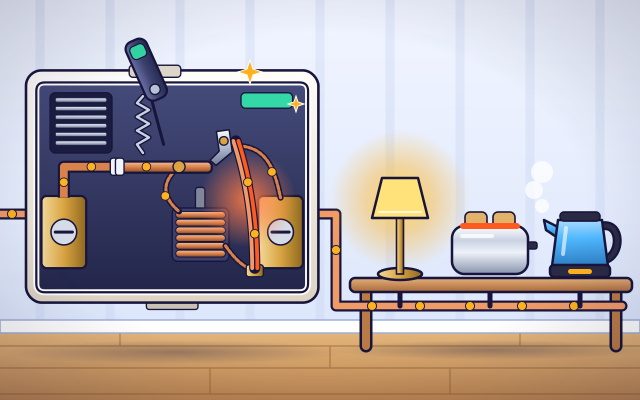
How do circuit breakers interrupt excessive current?
Add virtual loads and watch protective equipment disconnect a model circuit.
#398
Electricity & energy
How do circuit breakers interrupt excessive current?
Add virtual loads and watch protective equipment disconnect a model circuit.
 #399
Electricity & energy
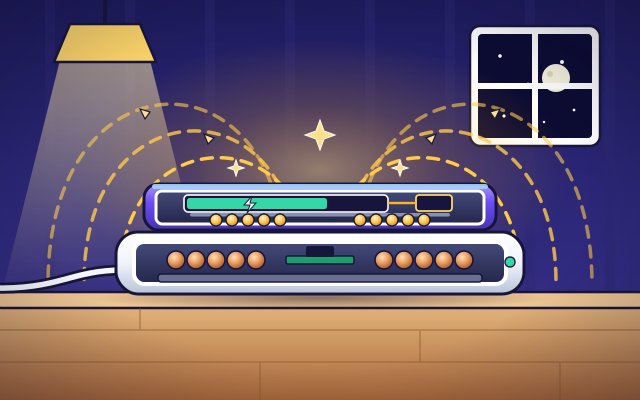
How does wireless charging recharge a device?
Align coils and follow energy transfer between a charging pad and device.
#399
Electricity & energy
How does wireless charging recharge a device?
Align coils and follow energy transfer between a charging pad and device.
 #41
Electricity & energy
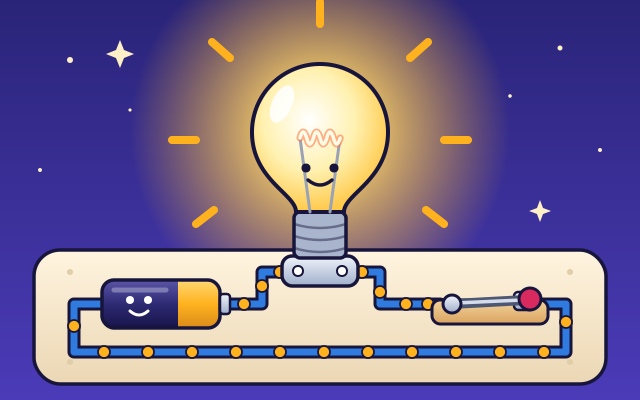
How does electricity turn on a light?
Build virtual circuits using batteries, wires, switches, and bulbs. Find breaks in a circuit and compare simple series and parallel arrangements.
#41
Electricity & energy
How does electricity turn on a light?
Build virtual circuits using batteries, wires, switches, and bulbs. Find breaks in a circuit and compare simple series and parallel arrangements.
 #42
Electricity & energy
How do batteries power things?
Look inside a simplified battery and explore chemical energy becoming electrical energy. Connect different devices and compare how quickly they use its stored energy.
#42
Electricity & energy
How do batteries power things?
Look inside a simplified battery and explore chemical energy becoming electrical energy. Connect different devices and compare how quickly they use its stored energy.
Keep exploring
Games to play next
- Circuit Workshop 3DWire up batteries, bulbs and switches on a 3D workbench.
- SwitchworksFlip switches to light the lamps in the target pattern — in as few presses as you can.
- Machine RepairFix levers, pulleys, gears and ramps so every contraption works.
Guide for grown-ups
- How to start homeschooling: a step-by-step guide for familiesA guide for parents · 7 min read
Science games by grade
Science worksheets by grade
- Preschool Science Worksheets
- Pre-K Science Worksheets
- Kindergarten Science Worksheets
- 1st Grade Science Worksheets
- 2nd Grade Science Worksheets
- 3rd Grade Science Worksheets
- 4th Grade Science Worksheets
- 5th Grade Science Worksheets
- 6th Grade Science Worksheets
- 7th Grade Science Worksheets
- 8th Grade Science Worksheets