How do erasers remove pencil marks?
A pencil leaves tiny gray flakes on the paper. An eraser grabs the flakes and carries them off in crumbs.
The big idea: A pencil mark is made of tiny flakes of graphite caught on the paper's fibers. The flakes stick to rubber better than to paper, so the eraser lifts them and rolls them up in crumbs.
It's like dabbing glitter off a table with a ball of sticky tape: the glitter sticks to the tape better than to the table.
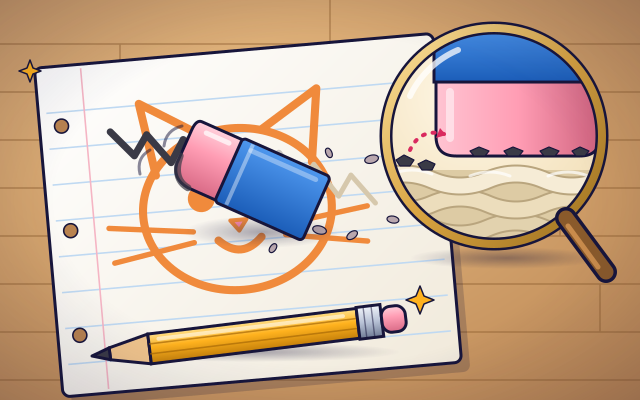
The interactive parts didn't load. The explanations below still work; try reloading the page.
Where does the pencil mark go?
- Oops! The pencil slipped and drew a line right across the cat. An eraser can take it away. But where does the line go?
- Up close, paper is a tangle of tiny threads called fibers. As the pencil slides along, little gray flakes of graphite rub off and get caught on top of them.
- Now rub with the eraser. It is soft, so it squeezes down around the flakes. The flakes stick to rubber better than to paper, so they jump across.
- As you rub, tiny pieces tear off the eraser and roll up into crumbs with the graphite wrapped inside. Now there is clean rubber underneath, ready to grab more.
- Some marks stay. Press hard with a pencil and you push flakes deep down and dent the paper. Pen ink is a liquid: it soaks into the fibers, where an eraser cannot reach.
- Rub gently back and forth, then brush the crumbs away. The graphite has left the page inside those crumbs, and the cat looks right again.
Look inside an eraser at work
The magnifier shows the paper from the side, with an eraser rubbing on top. Tap each part.
- Pencil core. The dark core of a pencil is graphite mixed with clay. People call it pencil lead, but there is no lead metal in it at all.
- Paper fibers. Paper is a mat of tiny plant threads called fibers. Their rough, tangled surface is what scrapes the graphite off the pencil.
- Graphite flakes. These gray flakes are the pencil mark. They sit on top of the fibers and only hold on weakly, which is why they can be lifted off again.
- Eraser. The eraser is soft and a little sticky to graphite. It squashes down around the flakes, and they stick to it better than they stick to the paper.
- Eraser crumbs. Rubbing tears off tiny rolls of eraser with graphite wrapped inside. That is why the crumbs are gray, and why you should brush them off instead of smearing them.
- Groove from pressing hard. Pressing hard squashes the fibers into a dent and pushes flakes deep down. The eraser slides over the top, so a pale ghost of the line stays.
Pencil against pen
Rub each line with the eraser by dragging it, or tap a line. Watch the close-up. Which marks come off, and which stay?
Experiment: You rub all three lines the same way. Which one will the eraser not be able to remove?
- Rub the light pencil line back and forth. Watch the flakes in the close-up.
- Rub the line that was pressed hard. Is anything left?
- Now rub the pen line just as much.
What we found: The light pencil line lifts off easily, because its flakes sit on top of the paper. The line pressed hard leaves a pale ghost in a dent. The pen line stays: its ink soaked into the fibers, where the eraser cannot grab it.
Turn on JavaScript to try it yourself.
A clean page, gently
Rub out every pencil mark without rubbing the paper thin. Choose how hard to press.
How an eraser really works
A pencil does not paint a line. Its dark core is graphite, a soft, slippery material, mixed with clay. Paper feels smooth, but it is really a rough mat of tiny plant fibers. As the pencil slides along, the fibers scrape off little flakes of graphite, and the flakes get caught on top.
Those flakes only hold on weakly. An eraser is soft, so it squashes down around them, and graphite sticks to rubber better than it sticks to paper. Stroke by stroke, the flakes move from the page to the eraser.
Rubbing also tears tiny pieces off the eraser. They roll up into crumbs with the graphite inside. That is useful: the dirty rubber leaves, and clean rubber is ready underneath. It is also why an eraser slowly gets smaller.
Some marks will not come off. If you press hard, the pencil dents the paper and pushes flakes deep into the dent, so a ghost line stays. Pen ink is a liquid that soaks into the fibers and stains them. Our sticky-tape picture explains the lifting, but not the crumbs: tape does not wear away as it works, and an eraser does.
Key words
- Graphite
- The soft, dark, slippery material in a pencil core. It is a kind of carbon.
- Fiber
- One of the tiny plant threads that are tangled together to make paper.
- Adhesion
- The sticking of one material to a different one, as graphite sticks to rubber.
- Friction
- The rubbing force between two surfaces that slide against each other.
- Abrasion
- Wearing something away by rubbing or scraping it.
- Polymer
- A material made of very long chain molecules. Rubber and vinyl are polymers.
Check your thinking
-
Where does a pencil mark go when you erase it?
Show the answer
Onto the eraser and into its crumbs. The flakes stick to rubber better than to paper, and the crumbs carry them off.
-
Why can an eraser remove pencil but not ordinary pen ink?
Show the answer
Pencil flakes sit on top of the fibers, but ink soaks into them. The eraser can only grab what it can touch. Ink is inside the fibers, out of reach.
-
You pressed very hard with your pencil. After erasing, a pale line is still there. Why?
Show the answer
The pencil dented the paper and pushed flakes deep into the dent. The eraser slides over the top of the dent and cannot reach the flakes at the bottom.
-
Why is it useful that an eraser makes crumbs?
Show the answer
The crumbs carry the graphite away and leave clean rubber behind. Without crumbs the dirty rubber would stay on the eraser and smear gray across the page.
-
A gritty ink eraser does remove pen marks. How, and what is the cost?
Show the answer
Its abrasive scrapes away the stained surface fibers, so the paper gets thinner and rougher. Ink sits inside the fibers, so the only way to remove it mechanically is to remove the fibers. That thins and roughens the paper.
You're a Everyday chemistry & materials expert!
You watched, looked inside, tried it, solved the challenge and went deeper. Pick another question below, or switch the age at the top to see this topic another way.
More about everyday chemistry & materials
 #408
Everyday chemistry & materials
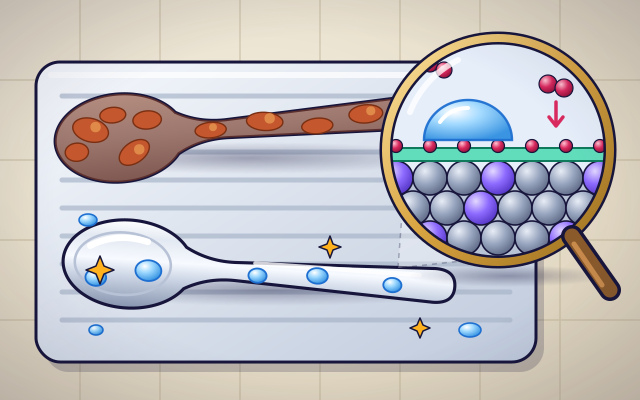
How do nonstick pans resist sticking?
Explore a coated surface and compare its interaction with food and droplets.
#408
Everyday chemistry & materials
How do nonstick pans resist sticking?
Explore a coated surface and compare its interaction with food and droplets.
 #409
Everyday chemistry & materials
Why does stainless steel resist rust?
Inspect its protective surface layer and compare it with ordinary steel.
#409
Everyday chemistry & materials
Why does stainless steel resist rust?
Inspect its protective surface layer and compare it with ordinary steel.
 #410
Everyday chemistry & materials
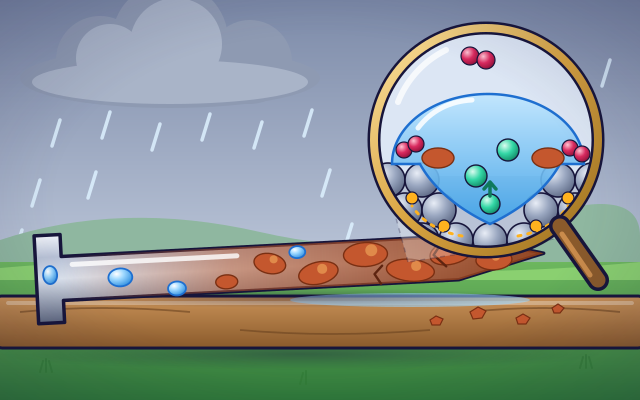
How does rust form?
Change moisture and oxygen around model iron and follow surface changes over time.
#410
Everyday chemistry & materials
How does rust form?
Change moisture and oxygen around model iron and follow surface changes over time.
 #411
Everyday chemistry & materials
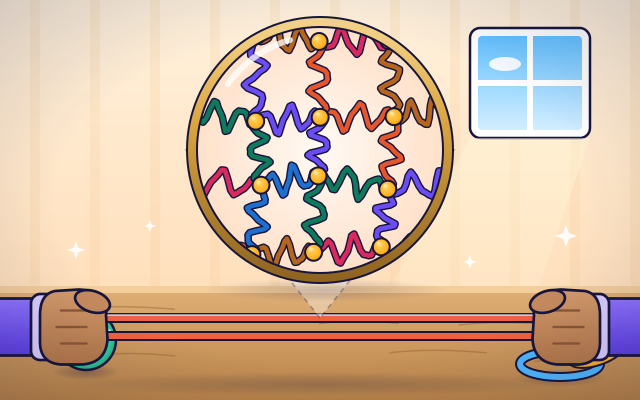
How does rubber stretch and return to shape?
Pull a simplified polymer network and observe rearrangement and recovery.
#411
Everyday chemistry & materials
How does rubber stretch and return to shape?
Pull a simplified polymer network and observe rearrangement and recovery.
Keep exploring
Games to play next
- Weather LabPredict the weather in a box, then run a fair test to find out why.
- Science QuizzesOlly's Science Quiz Show: plants, animals, the body, weather, space and more, for every grade.
- Ratio KitchenScale recipes, fill ratio tables and find the better buy.
Guide for grown-ups
- How to start homeschooling: a step-by-step guide for familiesA guide for parents · 7 min read
Science games by grade
Science worksheets by grade
- Preschool Science Worksheets
- Pre-K Science Worksheets
- Kindergarten Science Worksheets
- 1st Grade Science Worksheets
- 2nd Grade Science Worksheets
- 3rd Grade Science Worksheets
- 4th Grade Science Worksheets
- 5th Grade Science Worksheets
- 6th Grade Science Worksheets
- 7th Grade Science Worksheets
- 8th Grade Science Worksheets