How do nonstick pans resist sticking?
A nonstick pan wears a smooth, slippery coating that food and water cannot grip.
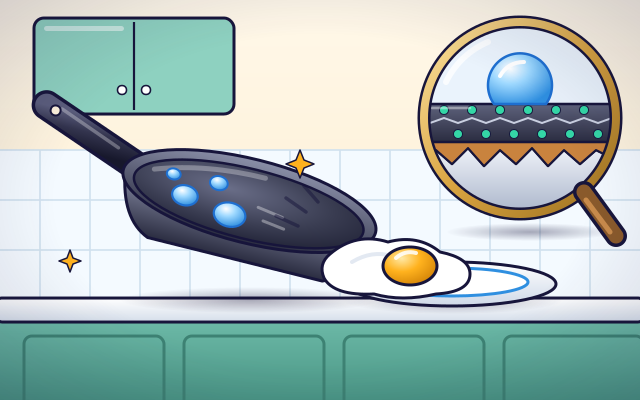
The big idea: Bare metal is full of tiny pits that hot food flows into and grabs. A nonstick coating covers them with a smooth plastic that almost nothing can hold on to.
It's like a raincoat: the water cannot grab on or soak in, so it rolls into little beads and runs off.
The interactive parts didn't load. The explanations below still work; try reloading the page.
Why the egg slides out
- Two eggs are cooking in two pans. Tip them, and the egg in the shiny steel pan stays stuck, but the egg in the dark pan slides right out. What is different?
- Zoom in on the steel. It looks smooth, but it is covered in tiny pits and scratches. Runny egg flows into them, and as it cooks it hardens and holds on tight.
- The dark pan has a coating over the metal, a smooth plastic. It is made of long chains wrapped in a tight jacket of tiny fluorine atoms that hold on only to their own chain.
- Drop water on both. On steel the water spreads out flat, because it grips the metal. On the coating it cannot grip, so it pulls itself into a round bead that rolls away.
- If nothing sticks to the coating, how does it stick to the pan? The metal is roughened first. A sticky first layer locks into the roughness, and the slippery layers are baked on top.
- The coating is soft. A metal fork scratches through to the metal, and food grabs those scratches. Wooden or silicone tools keep it whole, and so does gentle heat.
Look inside a nonstick pan
The magnifier shows a slice through the bottom of the pan. Tap each part.
- Metal body. The body of the pan is metal, usually aluminum. It spreads the heat from the stove evenly. Its surface is made rough on purpose before coating.
- Primer layer. The primer is the first layer. It flows into the rough metal and grips it, and the slippery layer on top can hold on to the primer.
- Slippery top coat. The top coat is the slippery part. It is a smooth plastic that food and water cannot grip. It is very thin, about as thick as a hair.
- Fluorine-wrapped chain. The coating is made of long chains of carbon atoms. Every carbon holds two fluorine atoms, which wrap the chain like a jacket and keep everything else out.
- Water bead. Water cannot spread on the coating, so it pulls itself into a bead. The rounder the bead, the less the water is gripping the surface.
- Scratch. A scratch cuts through the soft coating to the metal underneath. Food can grab the bare metal there, so a scratched pan starts to stick.
- Cool handle. The handle is made of a material that heat travels through slowly, so it stays cool enough to hold while the pan is hot.
Steel pan against nonstick pan
Put water drops and eggs in both pans, then tip them by the handle. Watch the close-ups. What does the coating change?
Experiment: You drop water into both pans and tip them a little. What will the water do?
- Press Drop water with the pans flat. Look at the shape of each drop.
- Lift the handles a little at a time. Which drop moves first?
- Now crack an egg into each pan, let it cook and tip again.
What we found: On the coating, water cannot get a grip, so it stays a round bead and rolls off at a gentle tilt. On steel it spreads out and clings. The egg does the same: it slides off the coating but stays locked into the steel's tiny pits.
Turn on JavaScript to try it yourself.
Three eggs, two spoonfuls of oil
Three eggs, three pans, and only two spoonfuls of oil. Tap the pans that need oil, then cook and serve all three.
How nonstick works
A steel pan looks perfectly smooth. Under a microscope it is covered in tiny pits and scratches. When runny egg lands on hot metal, it flows into those pits. As the egg cooks it turns solid, and now it is locked into the pan like a key in a lock. Parts of the egg even join on to the metal itself.
A nonstick pan has a thin, smooth coating over the metal. The coating is a special plastic made of long chains of carbon atoms. Each chain is wrapped in tiny fluorine atoms, which hold on very tightly to their own chain and hardly pull on anything else. With no pits and nothing to grab, food and water stay on top.
You can see this with a drop of water. On the coating, the water pulls itself into a round bead, because it sticks to itself better than to the pan. On bare steel it spreads out flat.
The coating is soft, so it needs care. Metal forks and knives scratch through to the metal, and food sticks to the scratches. Very high heat harms it too, so grown-ups cook on medium heat and never leave an empty nonstick pan on a hot stove. Our raincoat picture explains the beads, but a raincoat can be washed and scrubbed. This coating cannot.
Key words
- Coating
- A thin layer of one material spread over another to change how its surface behaves.
- PTFE
- The slippery plastic used for nonstick coatings. Its long name is polytetrafluoroethylene.
- Surface energy
- How strongly a surface pulls on things that touch it. A slippery coating pulls very weakly.
- Contact angle
- The angle where the edge of a drop meets a surface. A big angle means a round bead and a weak grip.
- Wetting
- When a liquid spreads out over a surface and into its pits instead of beading up.
- Primer
- A first layer that grips the roughened metal so that the slippery layer can be attached on top.
Check your thinking
-
Why does food slide off a nonstick coating?
Show the answer
The coating is smooth and pulls so weakly that food cannot grip it. There are no pits to flow into and almost no pull from the coating, so food stays on top and slides.
-
A drop of water sits on a new nonstick pan. What shape is it, and why?
Show the answer
A round bead, because water grips itself better than it grips the coating. With almost no pull from the surface, the water pulls itself together into a bead.
-
If nothing sticks to the coating, how is it stuck to the pan?
Show the answer
The metal is made rough and a first layer locks into it. The rough metal gives the first layer something to grip, and the slippery layer is baked on to that.
-
Why should you use a wooden or silicone tool in a nonstick pan?
Show the answer
Metal tools scratch the soft coating, and food sticks to the bare metal. The coating is soft. A scratch opens a path to the metal, and food grabs on there.
-
Water meets surface A at 110 degrees and surface B at 40 degrees. Which statement is right?
Show the answer
A has the lower surface energy, so the water beads on it and releases more easily. A large contact angle means the liquid is attracted to itself more than to the surface: poor wetting and low surface energy.
You're a Everyday chemistry & materials expert!
You watched, looked inside, tried it, solved the challenge and went deeper. Pick another question below, or switch the age at the top to see this topic another way.
More about everyday chemistry & materials
 #409
Everyday chemistry & materials
Why does stainless steel resist rust?
Inspect its protective surface layer and compare it with ordinary steel.
#409
Everyday chemistry & materials
Why does stainless steel resist rust?
Inspect its protective surface layer and compare it with ordinary steel.
 #410
Everyday chemistry & materials
How does rust form?
Change moisture and oxygen around model iron and follow surface changes over time.
#410
Everyday chemistry & materials
How does rust form?
Change moisture and oxygen around model iron and follow surface changes over time.
 #411
Everyday chemistry & materials
How does rubber stretch and return to shape?
Pull a simplified polymer network and observe rearrangement and recovery.
#411
Everyday chemistry & materials
How does rubber stretch and return to shape?
Pull a simplified polymer network and observe rearrangement and recovery.
 #412
Everyday chemistry & materials
How do sponges soak up water?
Follow water into connected pores and compare absorption in different structures.
#412
Everyday chemistry & materials
How do sponges soak up water?
Follow water into connected pores and compare absorption in different structures.
Keep exploring
Games to play next
- Weather LabPredict the weather in a box, then run a fair test to find out why.
- Science QuizzesOlly's Science Quiz Show: plants, animals, the body, weather, space and more, for every grade.
- Ratio KitchenScale recipes, fill ratio tables and find the better buy.
Guide for grown-ups
- How to start homeschooling: a step-by-step guide for familiesA guide for parents · 7 min read
Science games by grade
Science worksheets by grade
- Preschool Science Worksheets
- Pre-K Science Worksheets
- Kindergarten Science Worksheets
- 1st Grade Science Worksheets
- 2nd Grade Science Worksheets
- 3rd Grade Science Worksheets
- 4th Grade Science Worksheets
- 5th Grade Science Worksheets
- 6th Grade Science Worksheets
- 7th Grade Science Worksheets
- 8th Grade Science Worksheets