How does rubber stretch and return to shape?
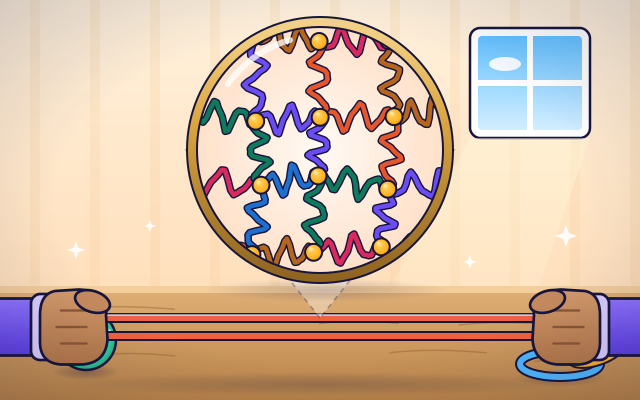
Inside a rubber band, long tangled chains pull straight when you stretch it and coil back up when you let go.
The big idea: Rubber is a net of long, coiled chains. Stretching pulls the coils straight, and their constant jiggling curls them back up when you let go.
It's like a fishing net made of curly telephone cords: pull it and every cord straightens, let go and they all curl up again.
The interactive parts didn't load. The explanations below still work; try reloading the page.
Why a rubber band springs back
- Pull a rubber band and it stretches to three times its length. Let go and it snaps straight back, the same size as before. A string cannot do that. What is special inside rubber?
- Zoom in millions of times. Rubber is made of very long, thin chains. Each one is coiled and wiggly, and they are tangled together like a bowl of cooked noodles.
- Here and there, the chains are tied to each other. These ties are called cross-links. They turn a pile of loose chains into one big, stretchy net.
- When you pull, the coiled chains uncoil and line up. There is a lot of slack in each coil, so the band can get much longer without any chain breaking.
- The chains never stop jiggling. Jiggling makes a straight chain curl up again, and that curling is the pull you feel. Let go, and every chain coils back, so the band shrinks.
- Without cross-links, the chains just slide past each other, like chewed gum. The band would stay long and floppy. The ties pull every chain back to its own place.
Look inside a rubber band
The big lens shows the rubber millions of times bigger. Tap each part to see what it does.
- Rubber band. A loop of rubber. It can stretch to several times its length and still go back to the same size, thousands of times.
- Long chain. One of the long chains that rubber is made of. It is so thin and bendy that it wiggles all the time, like a noodle in boiling water.
- Building blocks. Each chain is made of thousands of small building blocks joined in a row, like beads on a necklace or a very long line of paper clips.
- Cross-link. A tie that joins one chain to another. The cross-links stop the chains from sliding apart, so the whole net pulls back together.
- Coils. The curled-up part of a chain between two ties. The coil is the slack that lets rubber stretch. Pull and it straightens. Let go and it curls up again.
Stretch a band and watch its chains
Drag the hand to stretch the band and watch the chains in the big window. Let go. Then take the cross-links away and try again.
Experiment: What happens after a big stretch if the chains are not tied together by cross-links?
- With "Some" cross-links, stretch the band a long way and let go.
- Choose "None", stretch it a long way and let go again.
What we found: With cross-links, every chain is tied into the net, so when the chains coil back up the band returns to its old shape. Without them the chains slide past each other, and the band stays stretched.
Turn on JavaScript to try it yourself.
Park the rubber-band car
Choose the rubber for the band, pull the car back and let go. Stop the car's nose on the checkered mat.
The secret inside rubber
Most solid things barely stretch at all. Pull a steel wire or a piece of string and it gets only a tiny bit longer before it breaks. Rubber is different. A rubber band can stretch to five times its length and still spring back. The reason is hidden in the shape of its molecules, the tiny pieces that everything is made of.
Rubber is made of very long chains. Each chain is built from thousands of small building blocks joined in a row. The chains are bendy, and they never keep still, because everything warm is jiggling all the time. A chain that is jiggling does not stay straight. It curls into a loose, messy coil, a bit like a long noodle in boiling water.
When you pull on rubber, you pull those coils out straight. The chains do not get longer. They only uncurl. But the jiggling goes on, and it keeps trying to curl them up again. That is the pull you feel in your fingers. Let go, and the chains coil back, so the band shrinks.
There is one more secret. In a rubber band the chains are tied to each other at a few places. These ties are called cross-links. Without them the chains would slide past each other, the way chewed gum pulls out into a string and stays that way. The cross-links make one big net, so every chain is pulled back home. Our noodle picture breaks down here: real noodles do not jiggle by themselves, and rubber chains never stop.
Key words
- Polymer
- A very long chain made of many small building blocks joined in a row.
- Cross-link
- A tie that joins one chain to another.
- Elastic
- Able to go back to its own shape after being stretched or squashed.
- Vulcanization
- Heating rubber with sulfur to tie its chains together.
- Entropy
- A measure of how many different ways the pieces of something can be arranged.
Check your thinking
-
What happens to the chains inside rubber when you stretch it?
Show the answer
The coiled chains uncoil and line up. Stretching uncoils the chains. They do not get longer or thicker, they only straighten.
-
Why does a rubber band need cross-links?
Show the answer
They stop the chains from sliding apart, so the band returns to its shape. Without ties the chains slide past each other and stay where they end up, like chewed gum.
-
What makes a stretched chain curl up again?
Show the answer
Its constant jiggling. Everything warm jiggles. A jiggling chain cannot stay straight, so it curls back into a coil.
-
A rubber is made with far too many cross-links. How does it behave?
Show the answer
It is stiff and breaks at a small stretch. Many cross-links mean short strands with little slack. They pull back hard but run out of length quickly.
-
A stretched rubber band holds up a small weight. You warm the band gently. What happens?
Show the answer
The band pulls harder and lifts the weight a little. Hotter chains are kicked harder toward their coiled shapes, so the pull-back force rises with temperature.
You're a Everyday chemistry & materials expert!
You watched, looked inside, tried it, solved the challenge and went deeper. Pick another question below, or switch the age at the top to see this topic another way.
More about everyday chemistry & materials
 #412
Everyday chemistry & materials
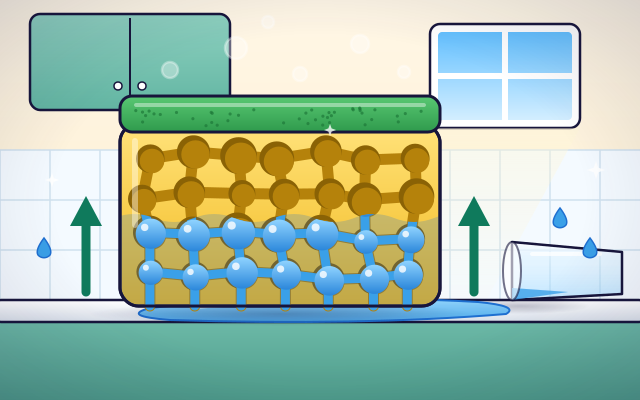
How do sponges soak up water?
Follow water into connected pores and compare absorption in different structures.
#412
Everyday chemistry & materials
How do sponges soak up water?
Follow water into connected pores and compare absorption in different structures.
 #413
Everyday chemistry & materials
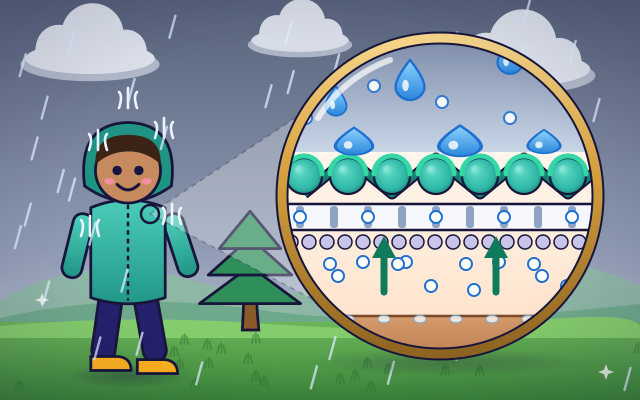
How can clothing be waterproof and breathable?
Compare liquid droplets and water vapor interacting with different fabric layers.
#413
Everyday chemistry & materials
How can clothing be waterproof and breathable?
Compare liquid droplets and water vapor interacting with different fabric layers.
 #414
Everyday chemistry & materials
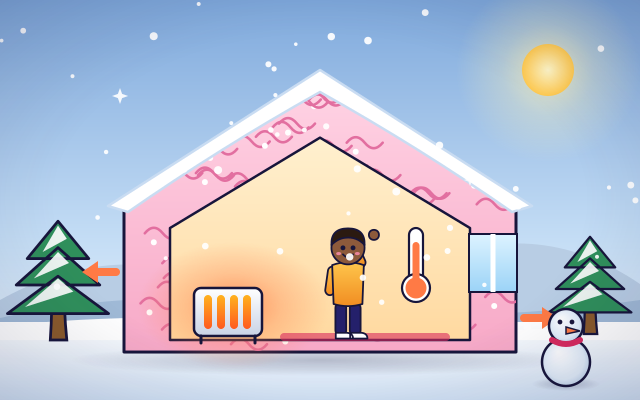
How does insulation slow heat loss?
Compare materials and trapped air around a model home or lunch container.
#414
Everyday chemistry & materials
How does insulation slow heat loss?
Compare materials and trapped air around a model home or lunch container.
 #415
Everyday chemistry & materials
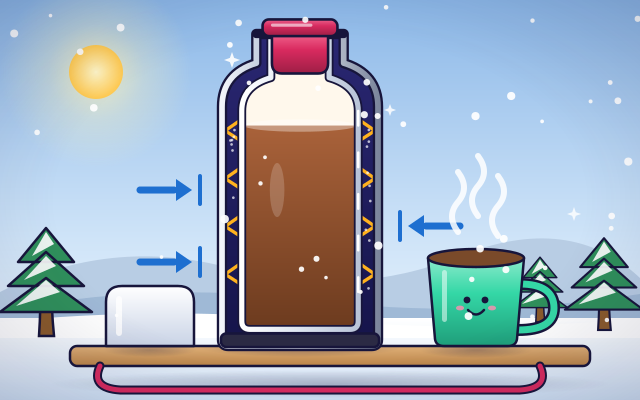
How does a vacuum flask keep drinks hot or cold?
Inspect the vacuum gap, reflective surfaces, and lid while tracking heat transfer.
#415
Everyday chemistry & materials
How does a vacuum flask keep drinks hot or cold?
Inspect the vacuum gap, reflective surfaces, and lid while tracking heat transfer.
Keep exploring
Games to play next
- Weather LabPredict the weather in a box, then run a fair test to find out why.
- Science QuizzesOlly's Science Quiz Show: plants, animals, the body, weather, space and more, for every grade.
- Ratio KitchenScale recipes, fill ratio tables and find the better buy.
Guide for grown-ups
- How to start homeschooling: a step-by-step guide for familiesA guide for parents · 7 min read
Science games by grade
Science worksheets by grade
- Preschool Science Worksheets
- Pre-K Science Worksheets
- Kindergarten Science Worksheets
- 1st Grade Science Worksheets
- 2nd Grade Science Worksheets
- 3rd Grade Science Worksheets
- 4th Grade Science Worksheets
- 5th Grade Science Worksheets
- 6th Grade Science Worksheets
- 7th Grade Science Worksheets
- 8th Grade Science Worksheets