How do escalators move their steps?
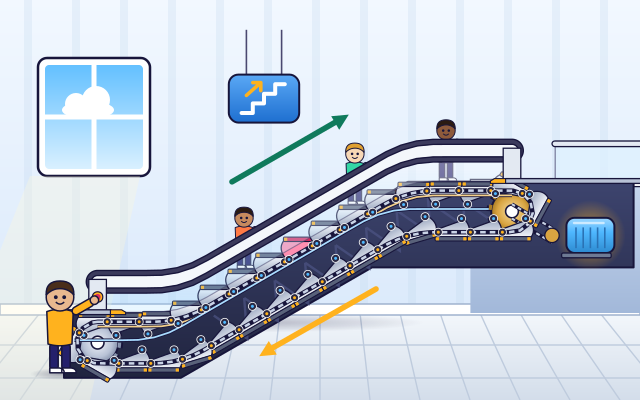
An escalator is a loop of steps hooked to a chain. A motor pulls the chain, and two tracks keep every step level.
The big idea: Escalator steps are linked into an endless loop by a chain. A motor at the top pulls the chain round, so the steps carry you up, turn over and travel back underneath.
It's like a bicycle chain with a stair step clipped to every link: turn the gear and the whole loop of steps goes round and round.
The interactive parts didn't load. The explanations below still work; try reloading the page.
Where do the steps go?
- An escalator is a staircase that moves. You step on at the bottom and ride to the top. But the steps never run out. Where do they all come from?
- Take the side panel off and you can see it: the steps are joined in one big loop. They ride up on top, turn over at the end and travel back down underneath, upside down.
- At the top, an electric motor turns a toothed wheel called the drive gear. Its teeth grab a long chain. Every step is hooked to that chain, so when the chain moves, all the steps move together.
- Each step has two pairs of wheels, and each pair rolls on its own track. The tracks are placed so that the step always stays level, like a tiny floor, even on the slope.
- Near each end the tracks level out, so the steps sink into one flat moving floor. The grooves in the steps slide between the teeth of a comb plate, so nothing gets pulled into the gap as you step off.
- The rubber handrail is another loop, driven by the same motor. It moves at the same speed as the steps, so your hand and your feet travel together. Round and round it all goes, all day long.
Look inside an escalator
The side panel is off. Tap each part to see it move and find out what it does.
- Steps. Each step is a strong metal wedge with a grooved top. All the steps are joined in one long loop, so there is always a new step arriving at the bottom.
- Step chain. The step chain is like a giant bicycle chain. Every step is pinned to it, so the chain drags the whole loop of steps round.
- Motor. An electric motor under the top landing supplies the power. Gears slow its fast spin down into a slow, strong pull.
- Drive gear. The drive gear is a wheel with teeth that fit into the chain. As it turns, it pulls the chain up the slope and sends the steps round the top.
- Wheel tracks. Each step rolls on two tracks. One guides the wheels beside the chain, and the other guides the wheels at the back of the step. Together they keep the step level.
- Comb plate. The comb plate has teeth that fit into the grooves of the steps. The steps slide underneath it, so there is no gap for shoelaces or toys to slip into.
- Handrail. The handrail is a loop of rubber that slides along the top of the side wall. The same motor drives it, so it moves at the same speed as the steps.
- Emergency stop. A red button at each end stops the escalator in an emergency. It is not a toy: it is only for when someone is in danger, so tell a grown-up.
Follow one step around
Open the side panel, paint one step and follow it all the way round. Change the speed, or stop the motor and push the steps by hand.
Experiment: Where does a step go after it reaches the top?
- Tap the side panel to open it.
- Press Paint a step and keep your eye on the bright step.
- Watch what it does at the top, and where it goes next.
What we found: The step rides up the slope, turns over around the big gear at the top and travels back underneath, upside down, to the bottom. There it turns over again and comes up for the next riders. The steps are one endless loop.
Turn on JavaScript to try it yourself.
Escalator repair crew
This escalator has three faults. Press Test run, watch what does not move, then tap the part that needs fixing.
How an escalator works
An escalator looks like a staircase, but it is really a loop. Dozens of metal steps are hooked to two long chains, one on each side, a bit like a huge bicycle chain. The whole loop is tucked inside a strong steel frame called a truss, so you only ever see the top half.
At the top, an electric motor turns a toothed wheel called the drive gear. The teeth grab the chains and pull them up the slope. Because every step is pinned to the chains, they all move together. At the top each step turns over, travels back down underneath, and turns over again at the bottom.
Why do the steps stay flat for your feet? Each one has two pairs of wheels that roll on two different tracks. The tracks are placed so that the step always stays level. Near the ends the tracks even out, and the steps sink into a flat moving floor that slides under the comb plate.
The handrail is a rubber loop driven by the same motor, so it keeps up with the steps. Our bicycle-chain comparison is not perfect: a bike chain only pulls, but an escalator's tracks also steer every step. Ride safely: stand still, hold the handrail and keep your feet away from the sides.
Key words
- Step chain
- The long loop of links that pulls every step.
- Drive gear (sprocket)
- The toothed wheel, turned by the motor, that pulls the chain.
- Truss
- The strong steel frame that holds the whole escalator and hides the returning steps.
- Trailing wheels
- The wheels at the back of a step. Their own track keeps the step level.
- Comb plate
- The toothed plate at each end that the grooved steps slide under.
Check your thinking
-
What happens to a step after it reaches the top?
Show the answer
It turns over and travels back underneath. The steps are one endless loop: up on top, over the gear, and back underneath.
-
What makes all the steps move together?
Show the answer
They are all pinned to a chain that a motor-driven gear pulls. Every step is fixed to the same chain, so when the drive gear pulls the chain, all the steps move at once.
-
Why do the steps stay level on the slope?
Show the answer
Two sets of wheels roll on two tracks that hold each step flat. Each step has two pairs of wheels on two tracks. The tracks are placed so the step cannot tip.
-
An escalator's speed doubles while it carries the same riders. What happens to the power needed to lift them?
Show the answer
It doubles. Lifting power is weight times vertical speed, so twice the speed needs twice the power. (The riders also arrive in half the time.)
-
Why does the handrail move at the same speed as the steps?
Show the answer
So your hand and your feet travel together and you keep your balance. If the handrail were slower or faster than the steps, it would pull your hand backward or forward and tip you.
-
What is the comb plate for?
Show the answer
It closes the gap where the steps slide under the floor. Its teeth fit into the grooves of the steps, so things cannot be carried into the gap.
You're a Buildings & city systems expert!
You watched, looked inside, tried it, solved the challenge and went deeper. Pick another question below, or switch the age at the top to see this topic another way.
More about buildings & city systems
 #352
Buildings & city systems
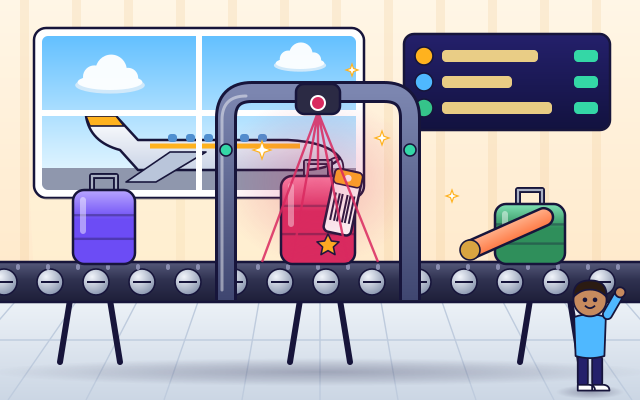
How does airport luggage reach the correct plane?
Scan baggage tags and guide bags through conveyors, sorting points, and loading areas.
#352
Buildings & city systems
How does airport luggage reach the correct plane?
Scan baggage tags and guide bags through conveyors, sorting points, and loading areas.
 #353
Buildings & city systems
How do shipping ports move containers?
Transfer containers between ships, storage yards, trains, and trucks.
#353
Buildings & city systems
How do shipping ports move containers?
Transfer containers between ships, storage yards, trains, and trucks.
 #354
Buildings & city systems
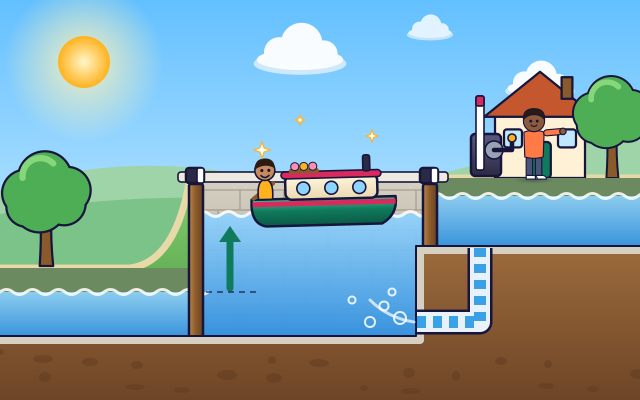
How do canal locks raise and lower boats?
Operate gates and change chamber water levels to move boats between elevations.
#354
Buildings & city systems
How do canal locks raise and lower boats?
Operate gates and change chamber water levels to move boats between elevations.
 #355
Buildings & city systems
How do movable bridges let ships pass?
Compare lifting, swinging, and tilting bridges while coordinating ships and road traffic.
#355
Buildings & city systems
How do movable bridges let ships pass?
Compare lifting, swinging, and tilting bridges while coordinating ships and road traffic.
Keep exploring
Games to play next
- Bridge LabBuild a bridge from beams, brace it with triangles, and stay on budget.
- Area ArchitectDesign rooms that hit the area and perimeter on the blueprint.
- Route PlannerFind the shortest way around town, dodge closed roads, and measure trips with a scale bar.
Guide for grown-ups
- How to start homeschooling: a step-by-step guide for familiesA guide for parents · 7 min read
Science games by grade
Science worksheets by grade
- Preschool Science Worksheets
- Pre-K Science Worksheets
- Kindergarten Science Worksheets
- 1st Grade Science Worksheets
- 2nd Grade Science Worksheets
- 3rd Grade Science Worksheets
- 4th Grade Science Worksheets
- 5th Grade Science Worksheets
- 6th Grade Science Worksheets
- 7th Grade Science Worksheets
- 8th Grade Science Worksheets