How do movable bridges let ships pass?
A movable bridge lets cars cross a river and tall ships sail along it. It tilts, lifts or swings open, helped by a heavy counterweight.
The big idea: A bridge deck is very heavy, but it is balanced by a counterweight that is just as heavy. Because the two balance, like friends on a seesaw, a small motor is enough to open and close the bridge.
It's like a seesaw with a heavy friend on the short end: the deck is so well balanced that a small push tips it up.
The interactive parts didn't load. The explanations below still work; try reloading the page.
Cars or ships? Both!
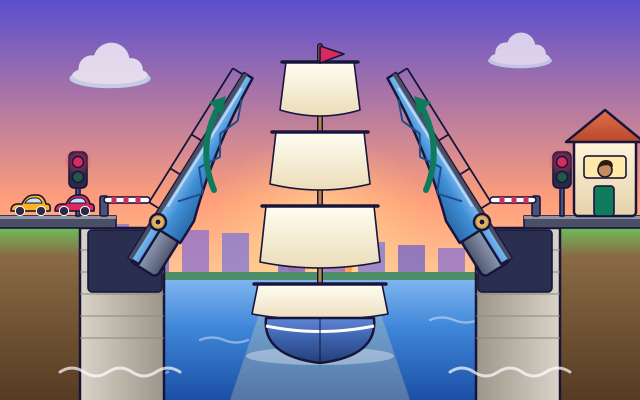
- Cars are driving over a low bridge. Along the river comes a ship with a mast far taller than the gap underneath. The road and the river both need the same spot. What now?
- First the bridge keeper turns the traffic lights red. Barriers come down across the road, and the cars already on the bridge drive off. Nothing moves until the deck is empty.
- This kind of bridge tilts. Its two halves swing up like a pair of drawbridges, leaving the whole sky open above the ship. It is called a bascule bridge.
- How can a motor lift a whole road? Hidden in the bank is a huge block called a counterweight. It is as heavy as the leaf on the other side of the pivot. As it sinks, the leaf rises, like a seesaw with two equal friends.
- Another kind of bridge lifts. The whole deck rises straight up between two towers, staying flat like an elevator. Cables run over wheels at the top to counterweights that slide down inside the towers.
- A third kind of bridge swings. It is balanced on a pier in the middle of the river and turns sideways, like a gate, until it points along the river. Ships then pass on either side of it.
- When the ship has passed, the bridge closes and locks, the barriers lift and the lights turn green. The cars drive on. A good bridge keeper keeps both the ships and the cars waiting as little as possible.
Look inside a tilting bridge
The stone pier is cut open so you can see what is hidden inside. Tap each part to see it work.
- Leaf. Each moving half of the bridge is called a leaf. It carries the road, and it tilts up from the bank like a giant drawbridge.
- Pivot. The leaf turns on a thick steel pin called a trunnion, the way a seesaw turns on its middle bar.
- Counterweight. The counterweight is a huge block of concrete and iron on the short end of the leaf. It balances the long, lighter end, so the leaf is easy to tilt.
- Motor. An electric motor supplies the push. Because the leaf is balanced, the motor can be surprisingly small.
- Rack and pinion. A small gear called a pinion turns against a big curved row of teeth, the rack, fixed to the leaf. As the pinion turns, it pushes the rack round and the leaf tilts.
- Span lock. When the bridge is closed, steel bolts slide across to lock the two leaves together in the middle, so the road stays firm under the cars.
- Lights and barriers. Traffic lights, bells and barriers stop the cars before the bridge moves. The barriers come down only after the cars on the bridge have driven off.
- Control house. The bridge keeper watches the river and the road from the control house, talks to ships by radio and works the lights, the barriers and the bridge.
Tilt, lift or swing?
Open each kind of bridge with the lever. Then tap the counterweight to take it away and try again. Which bridge lets the tallest ship through?
Experiment: What does the big counterweight do?
- Open the tilting bridge with the lever and watch the motor's dial.
- Close it, tap the counterweight to take it away, and pull the lever again.
- Put the counterweight back. Then compare the lifting and swinging bridges.
What we found: With the counterweight in place, the motor's dial stays low and the bridge opens smoothly. Without it, the motor strains and the bridge will not open. The counterweight balances the deck, so the motor only gives a small push.
Turn on JavaScript to try it yourself.
Bridge keeper: ships and cars
Three ships are coming. Stop the cars, open the bridge, close it again and let the cars go. Keep the line of waiting cars as short as you can.
How moving bridges work
A bridge high enough for tall ships needs long ramps, and there is not always room for them. So some bridges are built low and made to move. Cars use the bridge most of the time, and when a tall ship comes, the bridge opens and the cars wait.
There are three main kinds. A bascule bridge tilts: its leaves swing up like drawbridges. A lift bridge rises straight up between two towers, like an elevator. A swing bridge turns sideways on a pier in the middle of the river, like a gate.
A bridge deck can weigh as much as hundreds of cars. The secret to moving it is balance. Tilting and lifting bridges have a counterweight that is as heavy as the part that moves, so the two balance like friends on a seesaw. A swing bridge balances on its middle. Once the weight is balanced, a small motor can move the bridge.
Every opening follows the same safe order: lights red, barriers down, bridge empty, locks open, bridge up. Our seesaw comparison is a good one for the tilting bridge, but a lift bridge is more like an elevator with its counterweight, and a swing bridge is more like a spinning tray balanced on one finger.
Key words
- Bascule bridge
- A bridge whose leaves tilt upward about a pivot, balanced by counterweights.
- Vertical-lift bridge
- A bridge whose whole deck rises straight up between two towers.
- Swing bridge
- A bridge that turns sideways on a pier in the middle of the channel.
- Counterweight
- A heavy block that balances the moving part of the bridge.
- Clearance
- The height of the gap that ships have to fit under.
Check your thinking
-
Why are some bridges built to move?
Show the answer
So a low bridge can still let tall ships past. A low bridge is easy for cars to reach. Moving it lets ships with tall masts go by.
-
How can a small motor move a very heavy bridge?
Show the answer
A counterweight balances the deck, so the motor gives only a small push. When two sides balance, it takes very little force to tip them one way or the other.
-
A ship with a very tall mast is coming. Which bridge might not let it through?
Show the answer
The lifting bridge, because its deck can only rise so high. A lifted deck is still above the river. Tilting and swinging bridges leave the sky open.
-
A leaf's center of mass is 20 meters from the pivot. Its counterweight is centered 5 meters from the pivot. How heavy must the counterweight be to balance it?
Show the answer
Four times as heavy as the leaf. Turning effect is weight times distance. At a quarter of the distance, the counterweight needs four times the weight.
-
What must happen before the bridge starts to open?
Show the answer
Lights red, barriers down and every car off the bridge. The bridge only moves when the road is safely closed and the deck is empty.
You're a Buildings & city systems expert!
You watched, looked inside, tried it, solved the challenge and went deeper. Pick another question below, or switch the age at the top to see this topic another way.
More about buildings & city systems
 #356
Buildings & city systems
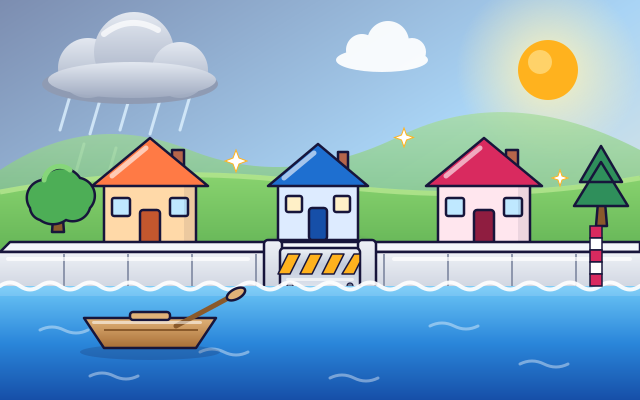
How do flood barriers protect towns?
Place barriers and observe how rising water moves around protected areas.
#356
Buildings & city systems
How do flood barriers protect towns?
Place barriers and observe how rising water moves around protected areas.
 #357
Buildings & city systems
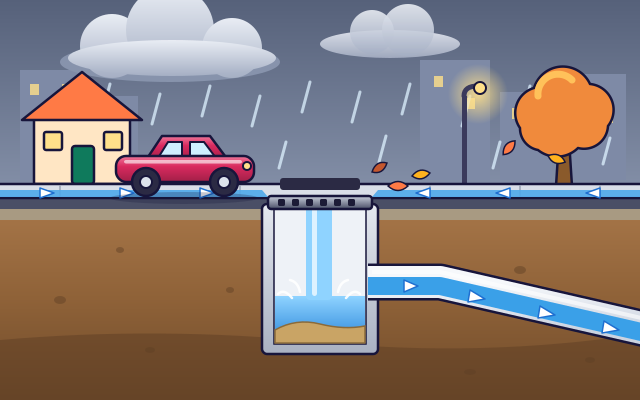
How do storm drains handle heavy rain?
Follow street runoff and compare flooding when drains are clear or blocked.
#357
Buildings & city systems
How do storm drains handle heavy rain?
Follow street runoff and compare flooding when drains are clear or blocked.
 #358
Buildings & city systems
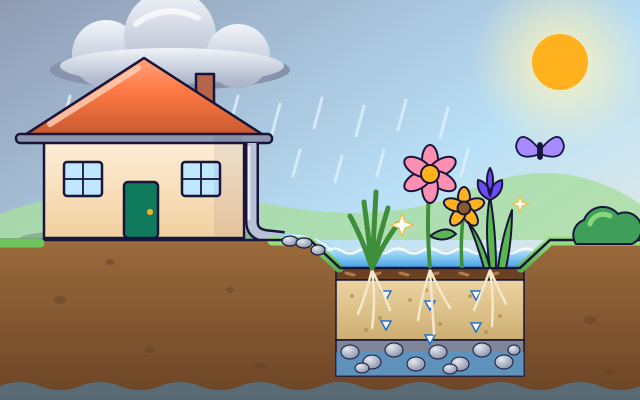
How do rain gardens reduce runoff?
Arrange soil and plants and compare absorption with nearby paved surfaces.
#358
Buildings & city systems
How do rain gardens reduce runoff?
Arrange soil and plants and compare absorption with nearby paved surfaces.
 #359
Buildings & city systems
How do fire hydrants supply water?
Look beneath a street and follow water through an opened hydrant.
#359
Buildings & city systems
How do fire hydrants supply water?
Look beneath a street and follow water through an opened hydrant.
Keep exploring
Games to play next
- Bridge LabBuild a bridge from beams, brace it with triangles, and stay on budget.
- Plane Flight SimulatorTake off from the runway and thread numbered sky hoops in order. Every clean flight is a new personal best.
- Area ArchitectDesign rooms that hit the area and perimeter on the blueprint.
Draw it or make it
- Folded-Beam Paper BridgePaper craft
Guide for grown-ups
- How to start homeschooling: a step-by-step guide for familiesA guide for parents · 7 min read
Science games by grade
Science worksheets by grade
- Preschool Science Worksheets
- Pre-K Science Worksheets
- Kindergarten Science Worksheets
- 1st Grade Science Worksheets
- 2nd Grade Science Worksheets
- 3rd Grade Science Worksheets
- 4th Grade Science Worksheets
- 5th Grade Science Worksheets
- 6th Grade Science Worksheets
- 7th Grade Science Worksheets
- 8th Grade Science Worksheets