How do shipping ports move containers?
Every container is the same shape, so one crane can grab any of them and pass it from ship to yard to truck or train.
The big idea: Shipping containers are all the same size and have the same steel corners. That means the same cranes, trucks, trains and ships can carry any container, and nobody has to unpack it on the way.
It's like building blocks that are all the same size: one grabber fits every block, and the blocks stack neatly on a ship, a train or a truck.
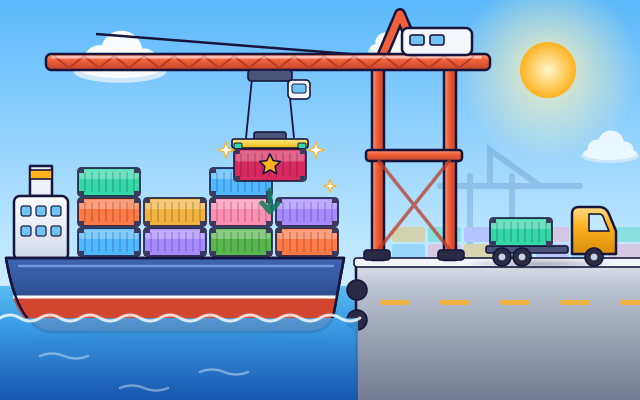
The interactive parts didn't load. The explanations below still work; try reloading the page.
From ship to truck
- A container ship glides up to the quay. Its deck is stacked with steel boxes called containers, each one packed with things like toys, shoes or bananas. How will they all get off?
- Here is the clever part: every container is the same width and has the same strong steel corner blocks. So the same crane can grab any box, and boxes stack on each other like building blocks.
- The crane lowers a frame called a spreader onto the box. A pin drops into the hole in each corner and twists a quarter turn. Click! Now the box is locked on and cannot slip off.
- Steel ropes hoist the box high into the air. A cart called the trolley rolls along the crane's long arm, carrying the box from the ship to the shore, and lowers it onto a carrier waiting below.
- The carrier drives the box to the storage yard, where a yard crane stacks it. A computer remembers exactly where every box is, so it can be found again among thousands.
- When a truck or a train arrives for a box, the yard crane lifts it out of the stack and sets it down on top. The very same box travels by ship, truck and train without ever being opened.
Look inside a container port
Tap each part of the port to see it move and find out what it does.
- Container. A container is a strong steel box with doors at one end. Its wavy walls make it stiff, and it can be stacked many boxes high.
- Corner castings. Every container has a steel block with holes at each of its eight corners. Cranes, trucks, trains and other containers all hold on to the box by these corners.
- Spreader. The spreader is the frame that hangs from the crane. It lands on a container, and a twist lock in each corner turns to hold the box tight.
- Trolley and ropes. The trolley is a cart that rolls along the crane's arm. Steel ropes run down from it to the spreader, so it can lift a box and carry it sideways.
- Ship-to-shore crane. The ship-to-shore crane stands on the quay on tall legs. Its long arm reaches out over the ship, and the whole crane rolls along rails to reach different parts of the ship.
- Carrier. Carriers shuttle boxes between the big crane and the yard. In some ports they drive themselves, guided by a computer.
- Yard crane. The yard crane rolls over the stacks like a giant doorway on wheels. It stacks boxes several high and lifts them out again when their truck or train arrives.
- Truck and train. Trucks carry containers to shops and factories nearby. Trains carry many boxes at once across long distances. The box locks onto both in the same way.
Move the boxes: ship, yard, truck, train
Tap a container, then tap where to put it. Send boxes to the yard, the truck and the train. What happens if you want a box from the bottom of a stack?
Experiment: The truck needs the starred box at the bottom of a stack. What must the crane do?
- Tap the starred box at the bottom of the ship's middle stack. What does the crane say?
- Move the boxes that sit on top of it to the yard.
- Now send the starred box to the truck.
What we found: A crane lifts from above, so it can only take the top box of a stack. To reach a box underneath, it must first move every box on top of it somewhere else. Ports plan their stacks so the boxes that leave first are on top.
Turn on JavaScript to try it yourself.
Dig out the right boxes
The truck is waiting for the box with the truck picture, and the train for the box with the train picture. Deliver both in as few moves as you can.
How a port moves containers
Long ago, ships were loaded by hand with sacks, barrels and crates of every shape. It took many days. Then people had a simple idea: pack everything into steel boxes that are all the same size. These boxes are called containers.
Because every container has the same width and the same steel corners, one kind of crane can lift them all. The crane lowers a frame called a spreader. A lock drops into each corner, twists and holds tight. Then steel ropes hoist the box, and a trolley carries it from the ship to the shore.
On shore, carriers take the boxes to the yard, where yard cranes stack them like building blocks. A computer keeps track of where every box is. When a truck or a train arrives, the crane lifts out the right box. A crane can only reach the top of a stack, so the port tries to keep the boxes that leave soonest on top.
The best part is that nobody opens the box on the way. It rides on a truck, a ship, a train and another truck, locked in the same way each time. Our building-block comparison is a good one, but real containers are not just stacked: they are locked together at the corners, so they stay put even when the ship rolls.
Key words
- Container
- A strong steel box of a standard size that carries goods on ships, trains and trucks.
- Spreader
- The crane's lifting frame that locks onto the top corners of a container.
- Twist lock
- A pin that drops into a corner hole and turns a quarter turn so it cannot come out.
- Quay
- The strong wall and platform where ships tie up to be loaded and unloaded.
- Intermodal
- Using more than one kind of transport, such as ship, train and truck, for the same box.
Check your thinking
-
Why can the same crane lift any container?
Show the answer
Every container has the same width and the same corner blocks. The spreader's four locks fit the same corner blocks on every box.
-
How does the spreader hold on to a container?
Show the answer
A lock drops into each corner hole and twists so it cannot come out. Once a twist lock has turned, its head is wider than the hole, so the box cannot slip off.
-
You need the box at the bottom of a stack of three. What must happen first?
Show the answer
The two boxes on top must be moved somewhere else. A crane lifts from above, so it can only reach the top box of a stack.
-
A hoist lifts a 20-tonne container at 1 meter per second. About how much power does that take?
Show the answer
About 200 kilowatts. Power is weight times lifting speed: 20,000 kg times 9.8 newtons per kilogram times 1 m/s is about 196,000 watts.
-
Why is it useful that a container is never unpacked on its journey?
Show the answer
It can change from ship to train to truck quickly, and the goods stay safe. Moving one sealed box takes minutes. Moving everything inside it by hand would take hours.
You're a Buildings & city systems expert!
You watched, looked inside, tried it, solved the challenge and went deeper. Pick another question below, or switch the age at the top to see this topic another way.
More about buildings & city systems
 #354
Buildings & city systems
How do canal locks raise and lower boats?
Operate gates and change chamber water levels to move boats between elevations.
#354
Buildings & city systems
How do canal locks raise and lower boats?
Operate gates and change chamber water levels to move boats between elevations.
 #355
Buildings & city systems
How do movable bridges let ships pass?
Compare lifting, swinging, and tilting bridges while coordinating ships and road traffic.
#355
Buildings & city systems
How do movable bridges let ships pass?
Compare lifting, swinging, and tilting bridges while coordinating ships and road traffic.
 #356
Buildings & city systems
How do flood barriers protect towns?
Place barriers and observe how rising water moves around protected areas.
#356
Buildings & city systems
How do flood barriers protect towns?
Place barriers and observe how rising water moves around protected areas.
 #357
Buildings & city systems
How do storm drains handle heavy rain?
Follow street runoff and compare flooding when drains are clear or blocked.
#357
Buildings & city systems
How do storm drains handle heavy rain?
Follow street runoff and compare flooding when drains are clear or blocked.
Keep exploring
Games to play next
- Bridge LabBuild a bridge from beams, brace it with triangles, and stay on budget.
- Area ArchitectDesign rooms that hit the area and perimeter on the blueprint.
- Route PlannerFind the shortest way around town, dodge closed roads, and measure trips with a scale bar.
Guide for grown-ups
- How to start homeschooling: a step-by-step guide for familiesA guide for parents · 7 min read
Science games by grade
Science worksheets by grade
- Preschool Science Worksheets
- Pre-K Science Worksheets
- Kindergarten Science Worksheets
- 1st Grade Science Worksheets
- 2nd Grade Science Worksheets
- 3rd Grade Science Worksheets
- 4th Grade Science Worksheets
- 5th Grade Science Worksheets
- 6th Grade Science Worksheets
- 7th Grade Science Worksheets
- 8th Grade Science Worksheets