How do canal locks raise and lower boats?
A lock is a chamber with a gate at each end. Fill it with water and a boat floats up to the higher canal; empty it and the boat floats down.
The big idea: A boat floats at the surface of the water. A lock changes the water level inside its chamber, so the floating boat is carried up or down between a low canal and a high one.
It's like a toy boat in a bathtub: run the tap and the boat rises with the water; pull the plug and it goes down again.
The interactive parts didn't load. The explanations below still work; try reloading the page.
Up the hill by boat
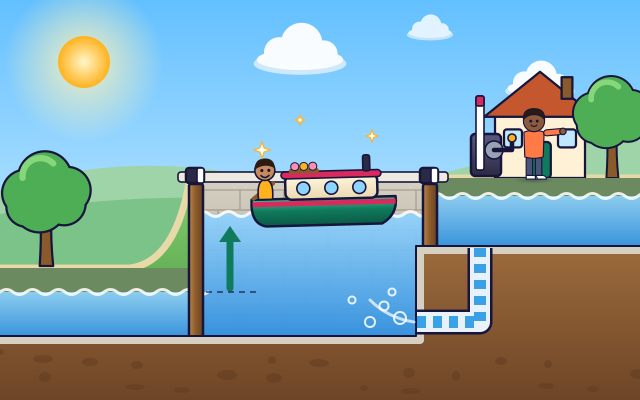
- A canal boat is heading for the hills. Ahead, the canal carries on at a higher level, like a step. Boats cannot climb. So how does this one get up there?
- The water in the lock is as low as the lower canal, so the bottom gate swings open easily. The boat glides into the chamber, and the gate is closed behind it.
- The lock keeper winds open a paddle, a small door for water. Water from the upper canal rushes downhill through a tunnel into the chamber. As the water rises, the floating boat rises with it. No pump is needed!
- When the chamber is as full as the upper canal, the water pushes equally on both sides of the top gate. Now a person can swing it open just by leaning on its long beam.
- The boat sails out onto the upper canal. It has climbed the step without an engine lifting it: the water did all the work.
- A boat going down uses the same lock the other way round. It enters at the top, the bottom paddle lets the water out, and the boat sinks gently to the lower canal.
Look inside a canal lock
The ground is cut away so you can see under the water. Tap each part to see what it does.
- Lock chamber. The chamber is a stone box just big enough for a boat. Its water level can be raised to match the upper canal or lowered to match the lower one.
- Top gate. The top gate holds back the water of the upper canal. It can only be opened when the chamber is full to the same level.
- Bottom gate. The bottom gate is the tall one. When the chamber is full, it holds back all that water, so it has to be very strong.
- Balance beam. Each gate has a long beam sticking out over the bank. It balances the heavy gate and gives people a long lever to push, so they can swing the gate open by leaning on it.
- Top paddle. The top paddle is a sliding door that covers a tunnel. When it is wound up, water from the upper canal runs through the tunnel into the chamber and fills it.
- Bottom paddle. The bottom paddle lets water out of the chamber into the lower canal. As the water drains away, the boat sinks gently down with it.
- Cill. The cill is the stone step that the top gate closes against. Boats going down must stay clear of it as the water drops.
- Upper and lower canal. The level stretches of canal on each side of a lock are called pounds. Each one is flat, like a long thin pond, and the lock is the step between them.
Work the paddles and gates
Tap the paddles to fill or empty the chamber, tap a gate to open it and tap the boat to sail on. Try opening a gate before the levels match.
Experiment: The chamber is low and the upper canal is high. Can you open the top gate?
- With the chamber low, tap the top gate. What happens?
- Tap the top paddle and wait for the chamber to fill.
- Now tap the top gate again, then tap the boat.
What we found: The top gate will not move while the chamber is low, because the deep water on the other side pushes it shut with a huge force. Once the chamber is full, the water pushes equally on both sides, and the gate swings open easily.
Turn on JavaScript to try it yourself.
Two boats, one lock
The green boat wants to go down and the red boat wants to go up. Get both through, filling and emptying the chamber as few times as you can.
How a lock works
Water always lies flat, so a canal cannot slope up a hill like a road. Instead it is built in level stretches, like steps. At each step there is a lock: a stone chamber with a strong gate at each end.
To go up, a boat sails into the chamber when its water is low. The bottom gate is shut behind it. Then a paddle, a small sliding door, is wound open, and water from the upper canal runs into the chamber. Nothing pumps it; it simply flows downhill. The boat floats, so it rises with the water.
The top gate cannot be opened while the chamber is lower than the canal behind it, because the deep water pushes on the gate with the weight of several cars. When the levels are the same, the push is equal on both sides, and a person can swing the gate open by leaning on its long beam.
Going down is the same in reverse: in at the top, let the water out, out at the bottom. Each time, one chamber-full of water moves downhill, so canals need streams or reservoirs to top them up. Our bathtub comparison is close, but a bathtub is filled from a tap. A lock is filled from the canal above it.
Key words
- Lock chamber
- The watertight box between the two gates, where the water level is changed.
- Paddle
- A small sliding door that lets water into or out of the chamber.
- Pound
- A level stretch of canal between two locks.
- Head
- The difference in height between two water levels.
- Buoyancy
- The upward push of water that makes a boat float.
Check your thinking
-
What makes the boat rise inside the lock?
Show the answer
Water flows in, and the floating boat rises with it. The boat floats at the surface, so raising the water raises the boat.
-
Why can't the top gate be opened while the chamber is still low?
Show the answer
The deeper water behind it pushes it shut with a huge force. Water pushes harder where it is deeper. Only when both sides are level do the pushes cancel.
-
A boat is going up. Which is the right order?
Show the answer
Boat in, close the bottom gate, open the top paddle, open the top gate. The boat must be sealed in the chamber before water is let in, and the top gate only opens once the levels match.
-
A lock with a floor area of 100 square meters lifts boats 3 meters. How much water does one fill take from the upper pound?
Show the answer
300 cubic meters. Volume is area times height: 100 square meters times 3 meters is 300 cubic meters, whatever the size of the boat.
-
What would happen if both paddles were open at the same time?
Show the answer
Water would just run through the lock and be wasted. Water would pour in at the top and straight out at the bottom, so the level could not settle at either canal.
You're a Buildings & city systems expert!
You watched, looked inside, tried it, solved the challenge and went deeper. Pick another question below, or switch the age at the top to see this topic another way.
More about buildings & city systems
 #355
Buildings & city systems
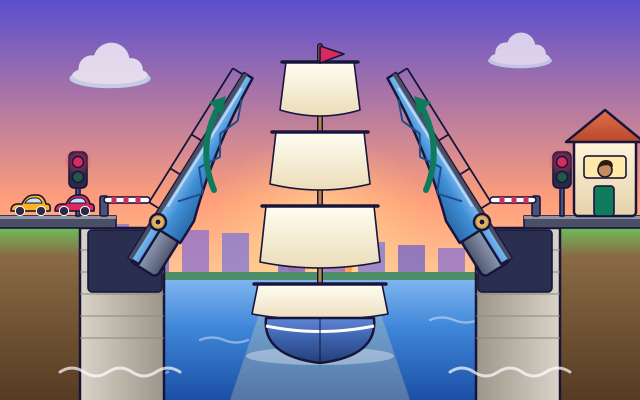
How do movable bridges let ships pass?
Compare lifting, swinging, and tilting bridges while coordinating ships and road traffic.
#355
Buildings & city systems
How do movable bridges let ships pass?
Compare lifting, swinging, and tilting bridges while coordinating ships and road traffic.
 #356
Buildings & city systems
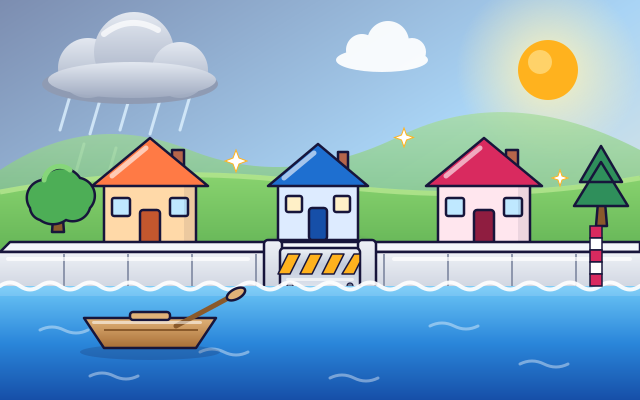
How do flood barriers protect towns?
Place barriers and observe how rising water moves around protected areas.
#356
Buildings & city systems
How do flood barriers protect towns?
Place barriers and observe how rising water moves around protected areas.
 #357
Buildings & city systems
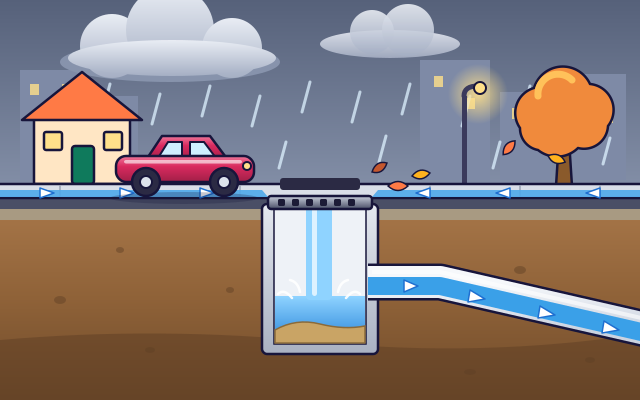
How do storm drains handle heavy rain?
Follow street runoff and compare flooding when drains are clear or blocked.
#357
Buildings & city systems
How do storm drains handle heavy rain?
Follow street runoff and compare flooding when drains are clear or blocked.
 #358
Buildings & city systems
How do rain gardens reduce runoff?
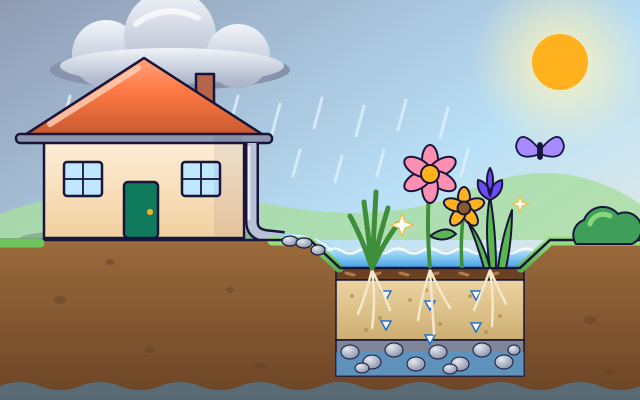
Arrange soil and plants and compare absorption with nearby paved surfaces.
#358
Buildings & city systems
How do rain gardens reduce runoff?
Arrange soil and plants and compare absorption with nearby paved surfaces.
Keep exploring
Games to play next
- River MysterySomething changed the river. Sample sites with a limited budget, follow the evidence and find where the change begins.
- Bridge LabBuild a bridge from beams, brace it with triangles, and stay on budget.
- Area ArchitectDesign rooms that hit the area and perimeter on the blueprint.
Guide for grown-ups
- How to start homeschooling: a step-by-step guide for familiesA guide for parents · 7 min read
Science games by grade
Science worksheets by grade
- Preschool Science Worksheets
- Pre-K Science Worksheets
- Kindergarten Science Worksheets
- 1st Grade Science Worksheets
- 2nd Grade Science Worksheets
- 3rd Grade Science Worksheets
- 4th Grade Science Worksheets
- 5th Grade Science Worksheets
- 6th Grade Science Worksheets
- 7th Grade Science Worksheets
- 8th Grade Science Worksheets