How do flood barriers protect towns?
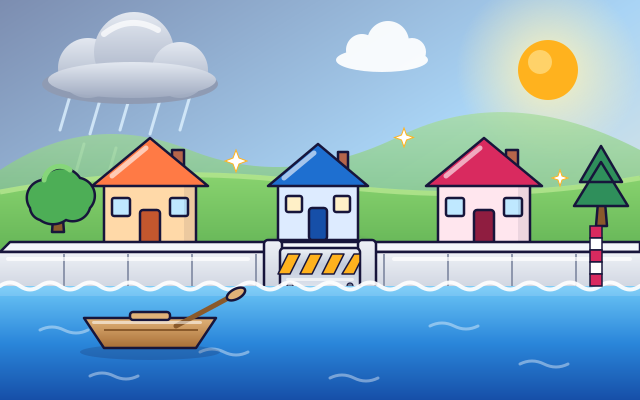
Banks of earth, walls and gates hold a rising river back, but only if the line is high enough and has no gaps.
The big idea: Flood water spreads to every low place it can reach. A barrier keeps a town dry only when it is higher than the water all the way along and joins high ground at both ends.
It's like the side of a bathtub. It holds the water in all the way round. One low spot or one gap, and the water pours out onto the floor.
The interactive parts didn't load. The explanations below still work; try reloading the page.
How a town stays dry
- Many towns are built on flat, low land beside a river. Most days the river stays in its channel. What happens after days of heavy rain?
- Rain far upstream runs into the river. The water level climbs until it is higher than the bank. Then water spills over and spreads across the low ground.
- So people raise the bank. A long bank of packed earth is called a levee. As long as it is higher than the water, the river stays on its own side.
- Seen from above, the barrier is one long line. Water finds any gap, such as a road, and spreads behind the whole wall. A floodgate closes the gap.
- The deeper the water, the harder it pushes. That is why a levee is much wider at the bottom than at the top. A core of clay inside stops water from soaking through.
- A wall keeps water out, but it also keeps rain in. A flap on the drain shuts against the river, and a pump lifts the rainwater over the top until the river falls.
Look inside a levee
The levee is cut open so you can see inside. Tap each part to watch it work.
- Levee. A levee is a long bank of packed earth with gentle, grassy slopes. It is much wider at the bottom than at the top, so the water cannot push it over.
- Clay core. Water can slowly soak through ordinary soil. Clay is packed so tightly that water hardly moves through it, so a wall of clay in the middle keeps the bank from leaking.
- Cutoff wall. Water can also creep through the ground under a levee. A thin wall of steel or clay, pushed deep into the ground, blocks that path.
- Rock armor. Fast water and waves can wear earth away. A layer of heavy rocks on the river side takes the knocks and keeps the soil in place.
- Extra height. Builders make the levee taller than the highest flood they expect. The extra height keeps waves and surprises from spilling over.
- Flap valve. The town's drain pipe ends in a hanging flap. Rainwater pushes it open to get out. When the river rises, the river pushes it shut.
- Pump station. While the flap is shut, rain has nowhere to go. A pump lifts it through a pipe over the levee and drops it in the river.
- River gauge. The striped pole measures the river's height. Readings from many gauges warn towns that high water is on the way.
Barrier line: gaps and height
Tap the bank to add or remove barrier pieces. Raise the river and watch where the water goes. Try a gap, sandbags and a tall wall.
Experiment: The wall is finished except for one piece. How much of the town will flood?
- Tap every dotted spot so the wall is complete, then take one piece out.
- Slide the river up to Flood.
- Watch the water spread behind the wall. Then close the gap and try again.
What we found: One gap is enough. Water pours through it and spreads behind the whole wall, so nearly everything floods. A barrier only works when the whole line is closed and taller than the water.
Turn on JavaScript to try it yourself.
Seven pieces, one town
A flood is coming and you have only 7 wall pieces. Protect every home, then press Start the flood.
Holding back a river
When much more rain falls than usual, a river cannot carry it all in its channel. The water level rises, tops the bank and spreads over the flat land beside it. That flat land is called a floodplain, and many towns are built on it.
A flood barrier is anything that keeps the water on the river's side. A levee is a long bank of packed earth. A flood wall is made of concrete or steel and fits where there is no room for a wide bank. Floodgates close the gaps where roads and railways pass through.
Two rules matter most. The barrier must be higher than the water everywhere, because water spills over the lowest spot first. And it must have no gaps and join high ground at both ends, because water that gets around the end floods everything behind it.
Barriers do not make water disappear. Water kept out of one town still flows on downstream. So many places also give rivers room: parks and fields that are allowed to flood, and wetlands that soak water up like a sponge. Never walk or play in flood water. Even shallow, moving water can knock a grown-up over.
Key words
- Floodplain
- The flat, low land beside a river that the river covers when it floods.
- Levee
- A long bank of packed earth that keeps a river from spreading.
- Floodgate
- A movable gate that closes a gap in a flood barrier, such as a road crossing.
- Freeboard
- Extra height on top of a barrier, just in case.
- Seepage
- Water moving slowly through or under a bank of soil.
- Overtopping
- Water flowing over the top of a barrier because the level is higher than the crest.
Check your thinking
-
A flood wall is complete except for one gap. What happens when the river rises above the bank?
Show the answer
Water pours through the gap and spreads behind the whole wall. Water spreads to every low place it can reach, so one gap floods everything behind the wall.
-
The river will rise 2 m above the bank. Which barrier keeps the town dry?
Show the answer
A complete wall 2.5 m high. It has to be both higher than the water and complete. The low wall is overtopped, and water goes around the end of the short one.
-
Why is a levee much wider at the bottom than at the top?
Show the answer
Water pushes hardest at the bottom, so the bank must be strongest there. The deeper the water, the harder it pushes. A wide, heavy base resists that push.
-
It rains on the town while the river is high and the barrier is closed. Where does the rain go?
Show the answer
It collects behind the wall until a pump lifts it over. A barrier that keeps the river out also keeps rain in, so pumps move it over the top.
-
A levee crest is at 5.0 m along most of its length, but one stretch has settled to 4.4 m. The flood peaks at 4.6 m. What happens?
Show the answer
Water flows over the settled stretch and floods the land behind the whole levee. The lowest point controls the line. Water overtops at 4.4 m and spreads to all connected low ground, and flowing over an earth crest can quickly erode it.
-
What is the safe thing to do near flood water?
Show the answer
Stay out of it and move to higher ground with a grown-up. Flood water can be fast, deep and dirty, and it hides holes. Higher ground is the safe place.
You're a Buildings & city systems expert!
You watched, looked inside, tried it, solved the challenge and went deeper. Pick another question below, or switch the age at the top to see this topic another way.
More about buildings & city systems
 #357
Buildings & city systems
How do storm drains handle heavy rain?
Follow street runoff and compare flooding when drains are clear or blocked.
#357
Buildings & city systems
How do storm drains handle heavy rain?
Follow street runoff and compare flooding when drains are clear or blocked.
 #358
Buildings & city systems
How do rain gardens reduce runoff?
Arrange soil and plants and compare absorption with nearby paved surfaces.
#358
Buildings & city systems
How do rain gardens reduce runoff?
Arrange soil and plants and compare absorption with nearby paved surfaces.
 #359
Buildings & city systems
How do fire hydrants supply water?
Look beneath a street and follow water through an opened hydrant.
#359
Buildings & city systems
How do fire hydrants supply water?
Look beneath a street and follow water through an opened hydrant.
 #360
Buildings & city systems
How do water towers maintain pressure?
Change tank height and water level and observe pressure across a model neighborhood.
#360
Buildings & city systems
How do water towers maintain pressure?
Change tank height and water level and observe pressure across a model neighborhood.
Keep exploring
Games to play next
- Route PlannerFind the shortest way around town, dodge closed roads, and measure trips with a scale bar.
- River MysterySomething changed the river. Sample sites with a limited budget, follow the evidence and find where the change begins.
- Bridge LabBuild a bridge from beams, brace it with triangles, and stay on budget.
Guide for grown-ups
- How to start homeschooling: a step-by-step guide for familiesA guide for parents · 7 min read
Science games by grade
Science worksheets by grade
- Preschool Science Worksheets
- Pre-K Science Worksheets
- Kindergarten Science Worksheets
- 1st Grade Science Worksheets
- 2nd Grade Science Worksheets
- 3rd Grade Science Worksheets
- 4th Grade Science Worksheets
- 5th Grade Science Worksheets
- 6th Grade Science Worksheets
- 7th Grade Science Worksheets
- 8th Grade Science Worksheets