How do storm drains handle heavy rain?
Gutters, grates and sloping pipes carry rain off the street and out to a stream, unless leaves block the way.
The big idea: Pavement cannot soak up rain, so streets are shaped to send it to drains. Pipes that slope downhill carry it to a stream. If a drain is blocked, the water has nowhere to go and the street floods.
It's like a bathtub drain: the water runs down the plughole and through a pipe, unless hair blocks it. Then the tub fills up instead of emptying.
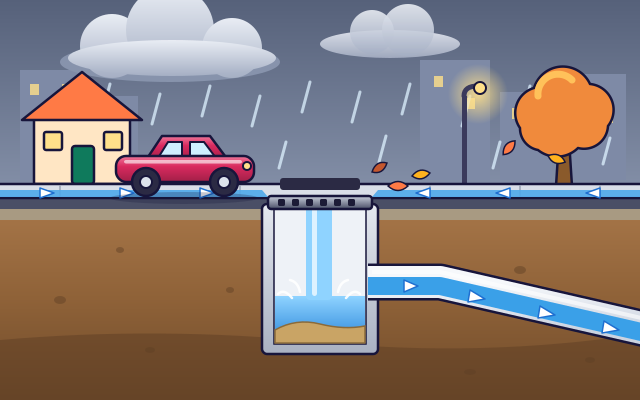
The interactive parts didn't load. The explanations below still work; try reloading the page.
Rain's trip under the street
- Rain falls on a street. Soil can soak up rain like a sponge, but roads, roofs and sidewalks are hard. The water stays on top. Where does it go?
- A road is built a little higher in the middle. Rain runs off to the edge, called the gutter, and then flows along the curb to the lowest point of the street.
- At the low point there is a grate. Water falls between its bars into a box called a catch basin. Sand and grit sink to the bottom, and the water leaves through a pipe higher up.
- Every pipe slopes gently downhill, so the water flows by itself with no pumps. Small pipes from many drains join a bigger pipe called a storm sewer.
- The big pipe ends at a stream. In most towns this water is not cleaned on the way. Whatever goes down a storm drain reaches the fish and ducks, so only rain should go in.
- If leaves cover the grate, the water cannot get in. A puddle grows and can flood the street. Clear the leaves and the water rushes away again.
Look under the street
The ground is cut away. Tap each part to follow the water from the gutter to the stream.
- Curb and gutter. The curb is the step at the edge of the sidewalk. The gutter beside it is a channel that carries rain along the street to the drain.
- Grate. The metal grate lets water fall through its slots. The bars stop branches, balls and other big things, and they are strong enough to drive over.
- Catch basin. Under the grate is a concrete box. It collects the water and sends it into the pipe in its side.
- Sump. The bottom of the box is lower than the pipe. Sand, stones and litter settle there instead of washing into the pipes. Crews suck it out with a vacuum truck.
- Outlet pipe. This pipe leaves the catch basin and slopes downhill to the big pipe. Gravity does all the work.
- Storm sewer. The storm sewer is the big pipe under the street. It gathers water from many drains and carries it out of town.
- Manhole. A shaft with a heavy round lid lets trained workers reach the pipes to inspect and clean them. The lid is round so it can never fall through its own hole.
- Outfall. The outfall is where the pipe ends and the water pours into a stream. Nothing cleans it first, so what goes down the drain ends up here.
Clear drain, blocked drain
Tap the leaves to sweep the drain, or tap the tree to drop more. Change the rain and watch the puddle.
Experiment: It is raining hard. What happens to the street when leaves cover the grate?
- Set the rain to Heavy.
- Tap the tree so leaves cover the grate. Watch the puddle and the car's wheels.
- Tap the leaves to sweep the drain. What happens to the puddle?
What we found: With the grate covered, the rain has no way down, so the puddle grows over the curb. Sweep the leaves and it drains in moments. The pipes were fine all along: the blockage was at the very top.
Turn on JavaScript to try it yourself.
Find what is blocking the drain
This street floods in every storm. Find and fix what is stopping the water, then press Start the storm.
How a street gets rid of rain
In a field, a lot of the rain soaks into the soil. In a town, roofs, roads and parking lots are hard, so nearly all of the rain stays on top and has to run somewhere. That running water is called runoff.
Streets are shaped to guide it. The road is a little higher in the middle, so water runs to the gutter at the edge and then along the curb to the lowest point. There a grate lets it drop into a catch basin, a box under the road. Sand settles at the bottom of the box, and the water leaves through a pipe.
From there gravity does the work. Each pipe slopes downhill and joins a bigger one, like small streams joining a river. The biggest pipe ends at a stream, a lake or the sea. In most towns this water is not cleaned, which is why soap, oil and litter should never go down a storm drain.
The system works only if every part is open. Leaves on the grate, or a catch basin full of sand, can stop the water and flood the street. Grown-ups can rake leaves off a grate from the sidewalk. Children should stay away from drains and flooded streets, because the water can be fast and deeper than it looks.
Key words
- Runoff
- Rain that flows over the surface instead of soaking into the ground.
- Gutter
- The shallow channel along the edge of a road, beside the curb.
- Catch basin
- A box under a street grate that collects water and traps sand.
- Storm sewer
- An underground pipe that carries rainwater away by gravity.
- Outfall
- The place where a sewer pipe ends and its water flows out into a stream, lake or sea.
- Impervious
- Not letting water through. Pavement and roofs are impervious; soil is not.
- Bottleneck
- The part of a system with the smallest capacity, which limits the flow through all of it.
Check your thinking
-
It is raining hard and leaves cover the grate. What happens on the street?
Show the answer
A puddle grows because the water cannot get into the drain. The grate is the way in. If it is covered, the water stays on top and the puddle grows.
-
Why does a town need storm drains when a forest does not?
Show the answer
Roads and roofs cannot soak up rain, so it all runs off. Soil soaks up rain like a sponge. Hard surfaces do not, so the water must be carried away.
-
What makes the water move through the pipes under the street?
Show the answer
The pipes slope downhill, so gravity pulls it along. Each pipe is laid on a gentle slope, so the water runs downhill by itself.
-
Why should you never pour paint or soapy water down a storm drain?
Show the answer
The water usually goes straight to a stream without being cleaned. Storm drains are a shortcut to streams and lakes. Whatever goes in reaches the animals that live there.
-
A street's runoff is 13 L/s. Its grate can take 20 L/s, its outlet pipe can carry 10 L/s and the main can carry 60 L/s. What happens in the storm?
Show the answer
The catch basin fills and water backs up onto the street, because the outlet pipe is the bottleneck. The chain carries only what its smallest part allows. 13 L/s arrives but only 10 L/s can leave the basin, so the extra 3 L/s collects on the street.
-
A grate near your home is blocked and the street is filling with water. What is the safe thing to do?
Show the answer
Stay out of the water and tell a grown-up. Water rushing into a drain pulls hard, and puddles hide what is underneath. A grown-up can rake the leaves away from the sidewalk.
You're a Buildings & city systems expert!
You watched, looked inside, tried it, solved the challenge and went deeper. Pick another question below, or switch the age at the top to see this topic another way.
More about buildings & city systems
 #358
Buildings & city systems
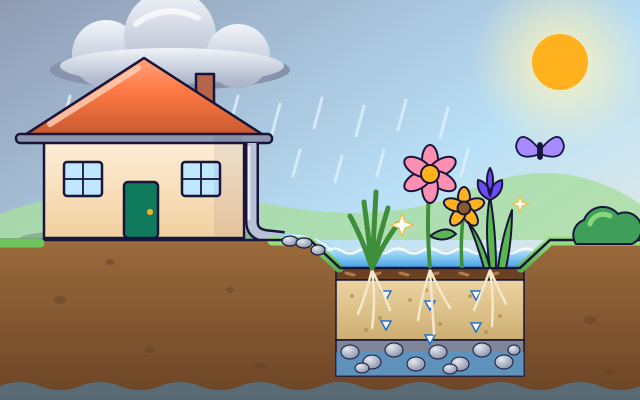
How do rain gardens reduce runoff?
Arrange soil and plants and compare absorption with nearby paved surfaces.
#358
Buildings & city systems
How do rain gardens reduce runoff?
Arrange soil and plants and compare absorption with nearby paved surfaces.
 #359
Buildings & city systems
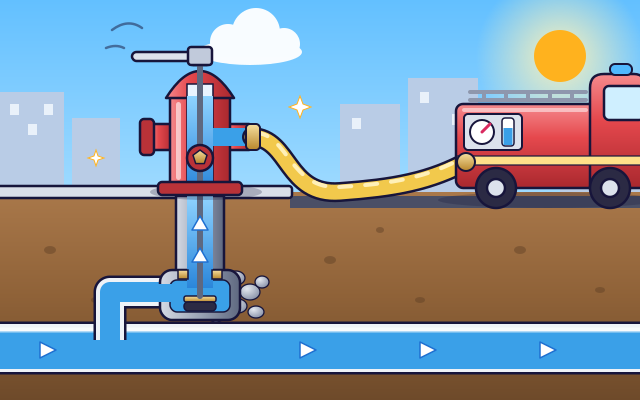
How do fire hydrants supply water?
Look beneath a street and follow water through an opened hydrant.
#359
Buildings & city systems
How do fire hydrants supply water?
Look beneath a street and follow water through an opened hydrant.
 #360
Buildings & city systems
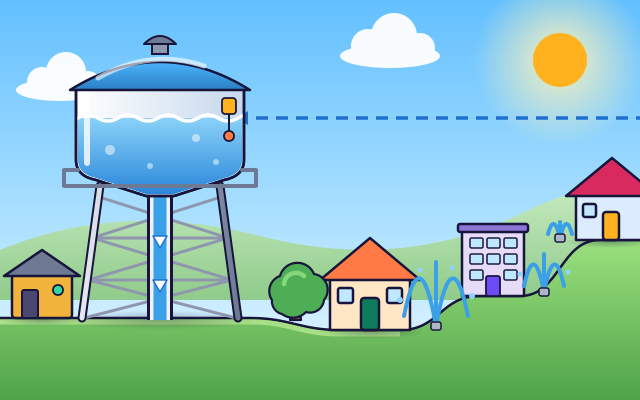
How do water towers maintain pressure?
Change tank height and water level and observe pressure across a model neighborhood.
#360
Buildings & city systems
How do water towers maintain pressure?
Change tank height and water level and observe pressure across a model neighborhood.
 #361
Buildings & city systems
How do desalination plants remove salt from seawater?
Explore a simplified membrane system and compare its freshwater and concentrated saltwater outputs.
#361
Buildings & city systems
How do desalination plants remove salt from seawater?
Explore a simplified membrane system and compare its freshwater and concentrated saltwater outputs.
Keep exploring
Games to play next
- River MysterySomething changed the river. Sample sites with a limited budget, follow the evidence and find where the change begins.
- Bridge LabBuild a bridge from beams, brace it with triangles, and stay on budget.
- Area ArchitectDesign rooms that hit the area and perimeter on the blueprint.
Guide for grown-ups
- How to start homeschooling: a step-by-step guide for familiesA guide for parents · 7 min read
Science games by grade
Science worksheets by grade
- Preschool Science Worksheets
- Pre-K Science Worksheets
- Kindergarten Science Worksheets
- 1st Grade Science Worksheets
- 2nd Grade Science Worksheets
- 3rd Grade Science Worksheets
- 4th Grade Science Worksheets
- 5th Grade Science Worksheets
- 6th Grade Science Worksheets
- 7th Grade Science Worksheets
- 8th Grade Science Worksheets