How do fire hydrants supply water?
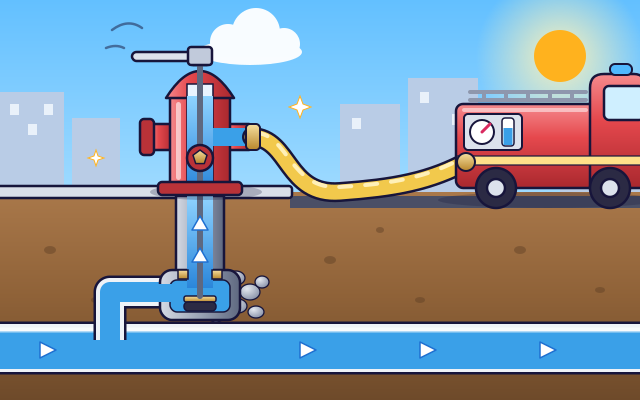
A hydrant connects fire hoses to the big water pipe under the street. A long rod opens a valve far below the ground.
The big idea: A big pipe under the street is always full of water that is being pushed hard. A hydrant is a pipe up from it. Turning the top opens a valve at the bottom, and the push sends water up and into the hose.
It's like a giant kitchen tap. The water is already pushing behind it, so opening it is enough. A hydrant's tap is just hidden at the bottom of a long pipe.
The interactive parts didn't load. The explanations below still work; try reloading the page.
Where hydrant water comes from
- Firefighters are holding a practice drill. A fire engine carries some water, but it runs out in a few minutes. For more, they use the hydrant. Where does its water come from?
- Under the street runs a water main: a big pipe that is always full, with the water pushing hard on its walls. A branch pipe leads from it to the bottom of the hydrant.
- The firefighter fits a wrench on the nut at the top and turns it. The nut drives a long rod, called a stem, that opens the valve at the very bottom of the hydrant.
- Now the push in the main sends water up the barrel, out through the hose and into the fire engine. The engine's pump pushes it even harder, so it can spray a long way.
- When they finish, the firefighter turns the nut back and the valve closes. A small drain hole opens at the bottom, and the water left in the barrel seeps away into the ground.
- The cap goes back on and the hydrant is ready again. Hydrants are bright so they are easy to find, and no one may park in front of one. Only firefighters and water workers open them.
Look inside a hydrant
The hydrant and the ground are cut open. Tap each part to see it work.
- Operating nut. The nut on top has five sides, so ordinary tools do not fit it. Firefighters carry a special wrench. Turning the nut moves the rod inside.
- Stem. The stem is a long rod that runs from the nut down through the middle of the hydrant to the valve at the bottom.
- Barrel. The barrel is the upright pipe. It is empty until the valve opens. Then water from the main rises up through it to the hose outlets.
- Hose outlet and cap. Hoses screw onto the outlets on the side. A cap on a short chain covers each outlet when it is not in use, to keep dirt out.
- Main valve. This is the real tap: a thick rubber disc at the bottom of the hydrant. The water's own push presses it shut. The stem pushes it open.
- Drain hole. When the valve closes, this little hole opens. The water left in the barrel drains out into the stones around the bottom, so it cannot freeze.
- Shutoff valve. A second valve sits on the branch pipe, under a small lid in the sidewalk. Water workers close it when the hydrant needs repair, so the street's water can stay on.
- Water main. The water main carries drinking water to every building on the street. It is always full, and pumps or a water tower keep the water pushing hard.
Open it, close it, watch the water
Take the cap off, connect the hose and turn the wrench. Follow the water. Then close the hydrant and keep watching the barrel.
Experiment: The firefighter closes the hydrant. What happens to the water still inside the barrel?
- Tap the cap, then the hose, then the wrench. Watch the water rise.
- Tap the wrench again to close the valve.
- Watch the bottom of the hydrant and the water level in the barrel.
What we found: When the valve at the bottom closes, a drain hole opens and the barrel empties into the stones around it. An empty hydrant cannot freeze in winter, and it is ready to use next time.
Turn on JavaScript to try it yourself.
The firefighter's steps
Fill the engine's tank without spilling. Then leave the hydrant the way you found it: closed, drained and capped.
How a hydrant gets its water
Under most streets runs a big pipe called a water main. It carries clean water to every home, and it is always full. Pumps or a water tower push on that water all the time, which is why water rushes out when you open a tap.
A fire hydrant is a branch off that pipe. It has no tank inside. In places with cold winters, the part you see is just an empty pipe called a barrel. The valve that holds the water back is at the very bottom, deeper than the ground ever freezes.
To use it, a firefighter takes a cap off, screws on a hose and turns the nut on top with a special wrench. A long rod opens the valve below, and the push in the main sends water up the barrel and into the hose. The fire engine's pump then pushes the water harder still.
Afterward the valve is closed, and the leftover water drains out through a small hole at the bottom, so nothing is left to freeze. Hydrants must be easy to reach, so cars may not park in front of them. They are only for firefighters and water workers: opening one wastes a huge amount of water and lowers the pressure for the whole street.
Key words
- Water main
- The large underground pipe that carries water under pressure along a street.
- Barrel
- The upright pipe of a hydrant, between the valve at the bottom and the hose outlets.
- Frost line
- The depth down to which the ground freezes in winter. Water pipes are buried below it.
- Static pressure
- How hard the water in a pipe pushes when none is flowing.
- Residual pressure
- The push that is left in the pipe while water is flowing out.
- Water hammer
- A sudden surge of pressure when moving water is stopped too quickly.
Check your thinking
-
Where does the water in a hydrant come from?
Show the answer
The water main under the street, which is always full and pushing. A hydrant is just a branch off the main. The main's push sends the water up and out.
-
Why is the valve at the bottom of the hydrant, deep in the ground?
Show the answer
So no water sits in the upper part, where it could freeze in winter. Deep ground does not freeze. With the valve down there, the part above stays empty and cannot freeze solid.
-
What happens to the water left in the barrel after the hydrant is closed?
Show the answer
It drains out through a small hole at the bottom. Closing the valve opens a drain hole, and the barrel empties into the stones around the base.
-
Why must no one park in front of a hydrant?
Show the answer
Firefighters need to reach it and connect hoses quickly. In an emergency every second counts. A parked car blocks the hoses and the wrench.
-
A hydrant flows 2,000 L/min when the main is at 300 kPa. Roughly what would it flow at 600 kPa, if nothing else changed?
Show the answer
About 2,800 L/min. Flow follows the square root of pressure. The square root of 2 is about 1.4, so the flow rises to about 2,800 L/min.
You're a Buildings & city systems expert!
You watched, looked inside, tried it, solved the challenge and went deeper. Pick another question below, or switch the age at the top to see this topic another way.
More about buildings & city systems
 #360
Buildings & city systems
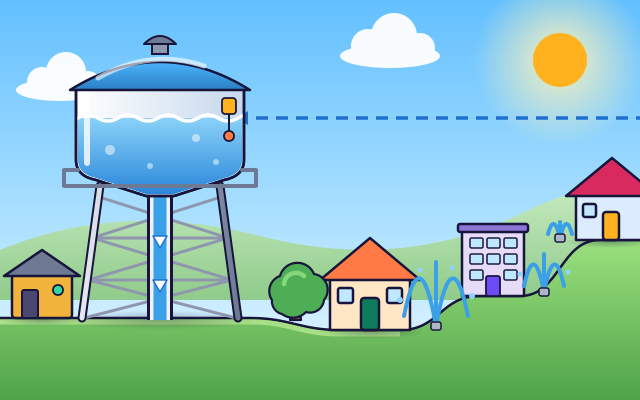
How do water towers maintain pressure?
Change tank height and water level and observe pressure across a model neighborhood.
#360
Buildings & city systems
How do water towers maintain pressure?
Change tank height and water level and observe pressure across a model neighborhood.
 #361
Buildings & city systems
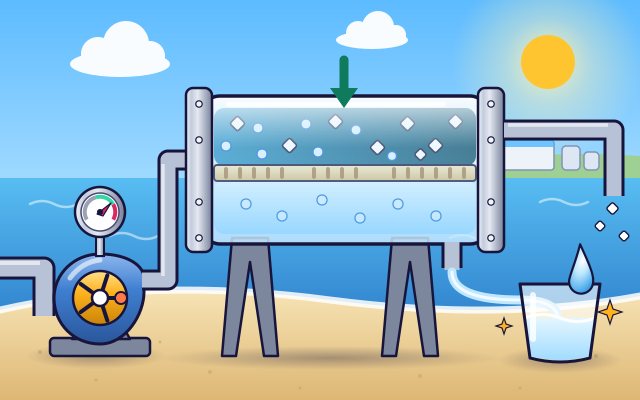
How do desalination plants remove salt from seawater?
Explore a simplified membrane system and compare its freshwater and concentrated saltwater outputs.
#361
Buildings & city systems
How do desalination plants remove salt from seawater?
Explore a simplified membrane system and compare its freshwater and concentrated saltwater outputs.
 #362
Buildings & city systems
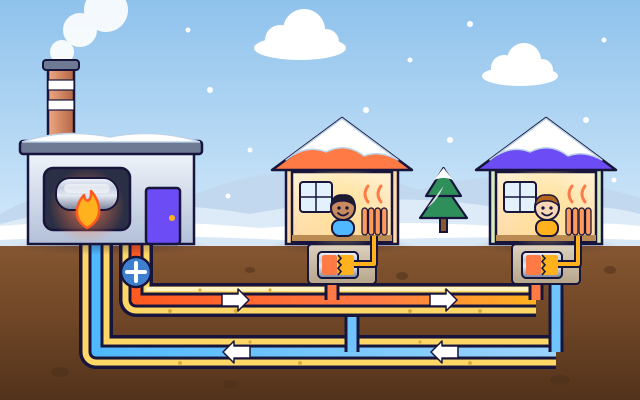
How can one heating plant warm a neighborhood?
Follow heat through insulated district pipes and building heat exchangers.
#362
Buildings & city systems
How can one heating plant warm a neighborhood?
Follow heat through insulated district pipes and building heat exchangers.
 #363
Buildings & city systems
How do prefabricated buildings fit together?
Assemble factory-made sections and match their structural, plumbing, and electrical connections.
#363
Buildings & city systems
How do prefabricated buildings fit together?
Assemble factory-made sections and match their structural, plumbing, and electrical connections.
Keep exploring
Games to play next
- River MysterySomething changed the river. Sample sites with a limited budget, follow the evidence and find where the change begins.
- Bridge LabBuild a bridge from beams, brace it with triangles, and stay on budget.
- Area ArchitectDesign rooms that hit the area and perimeter on the blueprint.
Draw it or make it
- How to draw a fire truckDrawing lesson
Guide for grown-ups
- How to start homeschooling: a step-by-step guide for familiesA guide for parents · 7 min read
Science games by grade
Science worksheets by grade
- Preschool Science Worksheets
- Pre-K Science Worksheets
- Kindergarten Science Worksheets
- 1st Grade Science Worksheets
- 2nd Grade Science Worksheets
- 3rd Grade Science Worksheets
- 4th Grade Science Worksheets
- 5th Grade Science Worksheets
- 6th Grade Science Worksheets
- 7th Grade Science Worksheets
- 8th Grade Science Worksheets