How do floods develop?
Rain soaks in, runs off and fills the river. See what makes a river spill over its banks.
The big idea: Soil soaks up rain like a sponge. When the soil is full, or the ground is hard, rain runs off into the river. If more water arrives than the river can carry, it spills over its banks.
It's like pouring water on a sponge in the sink. At first it soaks in. Once the sponge is full, every extra drop runs off and the sink starts to fill.
The interactive parts didn't load. The explanations below still work; try reloading the page.
How a river fills and spills
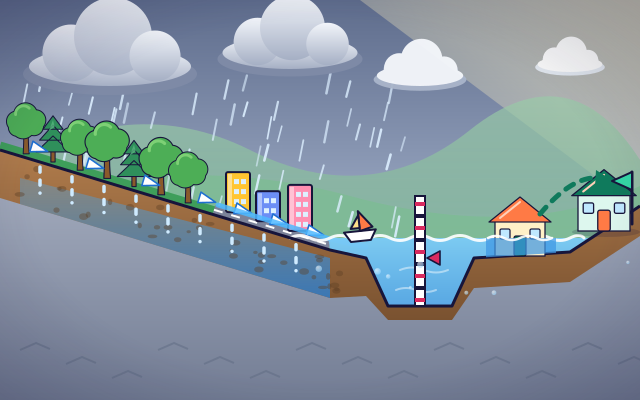
- This model shows a valley cut through the middle. Rain falls on the hill. All the land that sends its water to one river is called that river's watershed.
- At first the soil soaks up the rain, just like a sponge. Water trickles down into tiny spaces between the bits of soil, so only a little reaches the river.
- If the rain keeps falling, the soil fills up. A full sponge cannot hold any more, so the new rain slides over the ground. This is called runoff.
- The runoff pours into the river from the whole hillside at once. The river rises up its gauge, closer and closer to the top of its banks.
- When the river is fuller than its banks, water spreads over the flat land beside it. That is a flood, and the flat land is called a floodplain. Higher ground stays dry.
- A forest soaks up most of a storm. But roads, roofs and car parks cannot soak up anything. The same rain runs off at once, so the river rises faster and higher.
- Flood water is deeper and faster than it looks, so stay away from it. Move to higher ground and listen to grown-ups and warnings. The water goes down again when the rain stops.
Inside the model watershed
Tap each part of the model. Each one changes where the rain goes.
- Hilltop divide. The top of the hill is the edge of the watershed. Rain that falls on this side runs down to our river. Rain on the far side runs to a different one.
- Forest. Leaves catch some rain before it lands. Roots and fallen leaves keep the soil loose and full of holes, so water sinks in fast instead of running off.
- Soil. Soil has tiny spaces between its grains. Rain fills them, like water filling a sponge. When they are all full, the soil cannot take any more.
- Paved ground. Roads, roofs and car parks are waterproof. Rain cannot soak in, so nearly all of it runs off into drains and then into the river, very quickly.
- River channel. The river flows in a channel with a bank on each side. The channel can only carry a certain amount of water. More than that, and it overflows.
- River gauge. A river gauge measures how high the water is. People watch gauges during storms so they can warn everyone in time if the river is rising fast.
- Floodplain. The flat land beside a river is its floodplain. When the river overflows, this is where the water spreads out. It gives the flood room and slows it down.
- High ground. Land that is higher than the flood stays dry. In a flood, the safe thing is to move to higher ground and stay away from the water.
Same rain, different ground
Choose what covers the hillside and make it rain. Watch how much soaks in, how much runs off and how high the river climbs.
Experiment: The same steady rain falls on a forest hillside and on a paved hillside. Which river rises higher in the first hour?
- Choose Forest and set the rain to steady. Watch the soil and the river for a few seconds.
- Now choose Paved. This gives you a fresh, dry model with the same rain.
- Compare the colored pins on the river gauge.
What we found: The forest soil soaked up most of the rain, so the river rose slowly. The paved hill could not soak up anything, so the rain ran straight to the river and it spilled over its banks. A forest can flood too, but only after its soil has filled up.
Turn on JavaScript to try it yourself.
Two tree packs
A big storm is coming and you have two packs of trees. Plant them where they will help most, then start the storm. The river must stay inside its banks.
How floods develop
When rain lands, it can do two things. It can soak into the ground, or it can run over the ground toward the nearest stream. Soil is full of tiny spaces, so it works like a sponge. Forests and meadows soak up rain especially well, because roots and worms keep the soil loose.
A sponge can only hold so much. If rain falls for a long time, or falls very hard, the soil fills up. After that, the new rain cannot soak in, so it becomes runoff and flows downhill. All the land that drains into one river is called its watershed, and the runoff from the whole watershed ends up in that river.
A river channel can only carry a certain amount of water. When more water arrives than it can carry away, the river rises. If it rises above its banks, water spreads over the flat land beside it, which is called the floodplain. That is a flood. Hard ground such as roads and roofs makes floods more likely, because it cannot soak up any rain at all.
People have many ways to lower the risk. They plant trees, protect wetlands, leave floodplains as parks and fields, and build ponds that hold storm water. Forecasters watch the rain and the river gauges and send out warnings. If there is ever a flood near you, stay away from the water, move to higher ground and listen to the grown-ups who are helping.
Key words
- Watershed
- All the land that sends its rain to one river.
- Infiltration
- Water soaking down into the soil.
- Saturated
- Completely full of water, with no room for more.
- Runoff
- Rain that flows over the ground instead of soaking in.
- Floodplain
- The flat land beside a river that is covered when the river overflows.
- Hydrograph
- A graph that shows how a river rises and falls over time.
Check your thinking
-
What happens to most of the rain at the start of a storm on a forest hillside?
Show the answer
It soaks into the soil. Loose forest soil has lots of spaces, so it soaks up rain quickly while they are still empty.
-
The same rain falls on a forest and on a car park. Which sends more water to the river?
Show the answer
The car park. Pavement is waterproof, so nearly all the rain runs off. Forest soil soaks most of it up.
-
It has rained for three days and the soil is full. Then a new storm arrives. What happens?
Show the answer
Most of the new rain runs off, so the river rises fast. A full sponge cannot hold more. The new rain has to run over the ground to the river.
-
You see flood water across a path. What is the safe thing to do?
Show the answer
Stay out of it and move to higher ground. Flood water is deeper and faster than it looks. Higher ground stays dry and safe.
-
A town wants fewer floods. Which idea helps the ground soak up more rain?
Show the answer
Plant trees and make parks with ponds. Trees, soil and ponds hold rain back, so less of it rushes to the river at once.
-
A forest in a watershed is replaced by streets and car parks. How does the river's hydrograph change for the same storm?
Show the answer
An earlier and higher peak. Impervious surfaces turn almost all rain into runoff at once and deliver it quickly, so the river rises sooner and higher.
You're a Earth & weather expert!
You watched, looked inside, tried it, solved the challenge and went deeper. Pick another question below, or switch the age at the top to see this topic another way.
More about earth & weather
 #458
Earth & weather
How do droughts develop?
Follow rainfall, evaporation, soil moisture, and stored water through a dry period.
#458
Earth & weather
How do droughts develop?
Follow rainfall, evaporation, soil moisture, and stored water through a dry period.
 #459
Earth & weather
How do ocean currents move water?
Explore wind, temperature, salinity, and Earth's rotation in a simplified ocean model.
#459
Earth & weather
How do ocean currents move water?
Explore wind, temperature, salinity, and Earth's rotation in a simplified ocean model.
 #460
Earth & weather
How do ocean waves form and reach the shore?
Add wind and follow wave energy toward shallower water.
#460
Earth & weather
How do ocean waves form and reach the shore?
Add wind and follow wave energy toward shallower water.
 #461
Earth & weather
How do tsunamis form?
Displace a model seafloor and follow waves across deep and shallow water.
#461
Earth & weather
How do tsunamis form?
Displace a model seafloor and follow waves across deep and shallow water.
Keep exploring
Games to play next
- River MysterySomething changed the river. Sample sites with a limited budget, follow the evidence and find where the change begins.
- Weather LabPredict the weather in a box, then run a fair test to find out why.
- Landform ExplorerMountains, valleys, peninsulas and deltas — learn the shapes of the land and find them on Earth.
Guide for grown-ups
- How to start homeschooling: a step-by-step guide for familiesA guide for parents · 7 min read
Science games by grade
Science worksheets by grade
- Preschool Science Worksheets
- Pre-K Science Worksheets
- Kindergarten Science Worksheets
- 1st Grade Science Worksheets
- 2nd Grade Science Worksheets
- 3rd Grade Science Worksheets
- 4th Grade Science Worksheets
- 5th Grade Science Worksheets
- 6th Grade Science Worksheets
- 7th Grade Science Worksheets
- 8th Grade Science Worksheets