How do ocean currents move water?
Wind pushes the top of the sea and cold, salty water sinks to the bottom. Together they carry water all the way around the world.
The big idea: Ocean currents are like rivers in the sea. Wind drags the water on top, and the spinning Earth bends it into giant loops. Cold, salty water is heavy, so it sinks and flows slowly along the sea floor.
It's like a checkout conveyor belt. Warm water rides along the top, drops down at the cold end, creeps back underneath and comes up again.
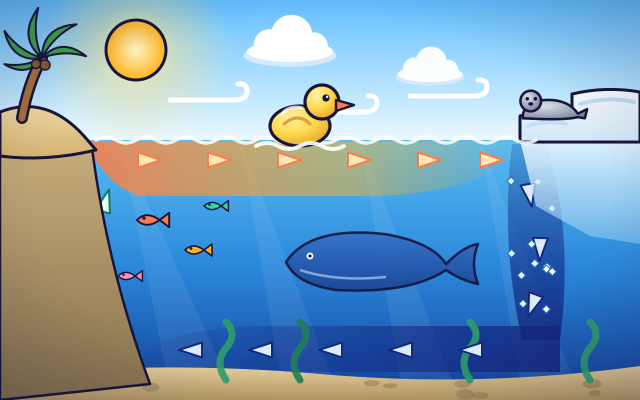
The interactive parts didn't load. The explanations below still work; try reloading the page.
Rivers in the sea
- A toy duck falls into the sea and drifts away. Nobody is pulling it. The water itself is moving, like a wide, slow river. That is an ocean current.
- Wind blowing over the sea rubs against the water and drags the top layer along. Winds that blow the same way all year make currents that never stop.
- Seen from above, the water does not go straight. The Earth is spinning underneath it, so the current bends and curls round into a giant loop called a gyre.
- Near the ice the water gets very cold. When sea ice forms, it leaves its salt behind in the water. Cold, salty water is heavy, so it sinks to the bottom.
- The cold water creeps along the sea floor toward the warm part of the world. It is very slow. Far away it rises again, bringing food for fish from the deep.
- Together the currents make one giant loop, like a conveyor belt. Warm water travels on top, cold water underneath. It carries heat from hot places to cold ones.
Inside the model ocean
Tap each part. Each one helps to keep the ocean moving.
- The sun. The sun heats the sea most strongly near the equator. Warm water is lighter than cold water, so it stays at the surface.
- Wind. Steady winds drag the surface of the sea with them. The harder they blow, the faster the top of the sea moves.
- Surface current. A surface current is a river of water on top of the sea. This one carries warm water from the tropics toward the cold part of the world.
- Polar ice. Near the poles the air chills the sea. When sea water freezes, the ice is nearly fresh: the salt is left behind in the water, which makes it even heavier.
- Sinking water. Cold, salty water is heavier than the water around it, so it sinks, like syrup sinking in a glass of water.
- Deep current. Down on the sea floor, the cold water spreads slowly toward the equator. It is so slow that a trip around the world takes about a thousand years.
- Rising water. In some places deep water rises back to the top. It is full of food for tiny sea plants, so these places are crowded with fish.
- The loop from above. This little window shows the same ocean from above. Because the Earth spins, the current bends into a huge loop called a gyre.
Wind, cold, salt and spin
Change the wind, the polar water and the Earth's spin. Watch the duck on top, the purple dye in the deep and the little window from above.
Experiment: Very cold, salty water forms beside the ice. Where does it go?
- Make the polar water icy and leave it at Normal. Watch the purple dye.
- Now choose Fresh, like water from melted ice. What does the deep current do?
- Try warm polar water too.
What we found: Icy, salty water was heavier than the water around it, so it sank by the ice and crept back along the sea floor. Fresh or warm polar water was too light to sink, so it floated and the deep current stopped.
Turn on JavaScript to try it yourself.
Start the conveyor
Get both currents running. The duck must ride the top current to the ice, and the purple dye must sink and travel along the bottom to the ring. Then press Start.
How ocean currents work
The sea is never still. Besides waves and tides, there are currents: huge streams of water that flow through the ocean like rivers. Some are warm and some are cold. Some move as fast as a person walking, and others move slower than a snail.
Currents at the top of the sea are pushed by the wind. Where winds blow the same way most of the year, they drag the surface water along with them. But the water does not travel in a straight line, because the Earth is spinning. The spin bends the moving water, and the continents get in the way, so the currents curl into giant loops called gyres.
Deep currents work differently. Near the poles, sea water gets very cold, and when some of it freezes, the salt is left behind in the water that remains. Cold, salty water is heavier than warm or fresh water, so it sinks to the bottom and spreads slowly along the sea floor. Far away, it rises again.
Joined together, the currents work like a giant conveyor belt that carries warmth around the planet. Warm currents make some coasts milder, and rising deep water brings up food that feeds enormous numbers of fish. Our picture is a simple model: the real ocean has many loops, eddies and layers.
Key words
- Current
- A steady flow of water through the sea, like a river within the ocean.
- Gyre
- A giant loop of currents that circles a whole ocean.
- Coriolis effect
- The way the spinning Earth bends anything that moves a long way across it.
- Salinity
- How much salt is dissolved in water. Sea water has about 35 grams in each kilogram.
- Density
- How heavy something is for its size. Cold, salty water is denser than warm, fresh water.
- Upwelling
- Deep water rising to the surface, bringing nutrients with it.
Check your thinking
-
What drives the currents at the top of the sea?
Show the answer
Wind blowing over the water. Wind rubs on the surface and drags the top layer of the sea along with it.
-
Which water is heaviest and sinks?
Show the answer
Cold, salty water. Cold makes water heavier and so does salt. Water that is both is the heaviest of all.
-
Why do ocean currents curl into giant loops instead of going straight?
Show the answer
The Earth is spinning, which bends the moving water. The spinning Earth bends moving water, and the continents turn it too, so it circles round in a gyre.
-
A warm current flows past a cold coast. What happens to the weather there?
Show the answer
It becomes milder, because the water brings warmth. Warm water gives its heat to the air above it, which warms the land nearby.
-
Lots of ice melts and adds fresh water to the polar sea. What happens to the sinking there?
Show the answer
It slows down, because fresher water is lighter. Fresh water is lighter than salty water, so it floats on top instead of sinking.
-
A steady wind of 10 meters per second blows over the sea. Using the 3 percent rule, about how far does the surface water drift in one day (86,400 seconds)?
Show the answer
About 26 kilometers. 3 percent of 10 m/s is 0.3 m/s. In 86,400 seconds that is 0.3 × 86,400 = 25,920 meters, about 26 kilometers.
You're a Earth & weather expert!
You watched, looked inside, tried it, solved the challenge and went deeper. Pick another question below, or switch the age at the top to see this topic another way.
More about earth & weather
 #460
Earth & weather
How do ocean waves form and reach the shore?
Add wind and follow wave energy toward shallower water.
#460
Earth & weather
How do ocean waves form and reach the shore?
Add wind and follow wave energy toward shallower water.
 #461
Earth & weather
How do tsunamis form?
Displace a model seafloor and follow waves across deep and shallow water.
#461
Earth & weather
How do tsunamis form?
Displace a model seafloor and follow waves across deep and shallow water.
 #462
Earth & weather
How do aquifers store groundwater?
Send water through soil and rock layers and explore storage and movement underground.
#462
Earth & weather
How do aquifers store groundwater?
Send water through soil and rock layers and explore storage and movement underground.
 #463
Earth & weather
How do natural springs bring water to the surface?
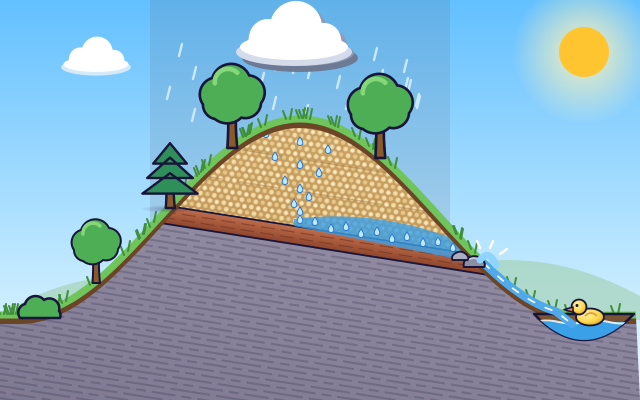
Follow groundwater until rock layers and terrain direct it above ground.
#463
Earth & weather
How do natural springs bring water to the surface?
Follow groundwater until rock layers and terrain direct it above ground.
Keep exploring
Games to play next
- River MysterySomething changed the river. Sample sites with a limited budget, follow the evidence and find where the change begins.
- Globe ExplorerSpin a real 3D globe, flip to the flat map, and find continents, oceans and countries.
- Weather LabPredict the weather in a box, then run a fair test to find out why.
Guide for grown-ups
- How to start homeschooling: a step-by-step guide for familiesA guide for parents · 7 min read
Science games by grade
Science worksheets by grade
- Preschool Science Worksheets
- Pre-K Science Worksheets
- Kindergarten Science Worksheets
- 1st Grade Science Worksheets
- 2nd Grade Science Worksheets
- 3rd Grade Science Worksheets
- 4th Grade Science Worksheets
- 5th Grade Science Worksheets
- 6th Grade Science Worksheets
- 7th Grade Science Worksheets
- 8th Grade Science Worksheets