How do mountains create rain shadows?
Mountains squeeze the rain out of the wind. One side gets forests and rivers. The other side, the rain shadow, can be a desert.
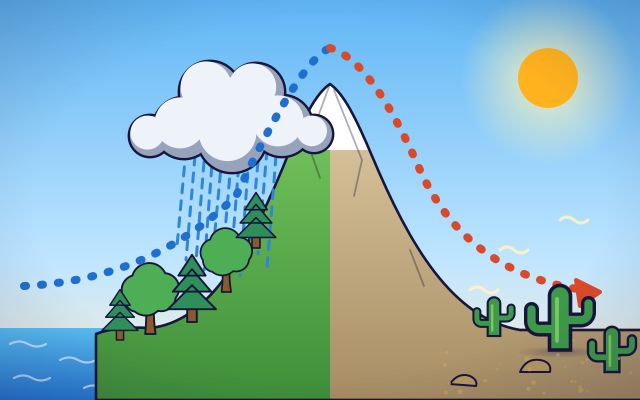
The big idea: Wind from the sea carries water vapor. A mountain pushes the air up, where it cools, makes clouds and rains. By the time the air comes down the far side it has lost its water, so that side stays dry.
It's like squeezing a wet sponge as you carry it up a hill. The water drips out on the way up, so the sponge comes down the other side nearly dry.
The interactive parts didn't load. The explanations below still work; try reloading the page.
How a mountain makes a rain shadow
- On one side of this mountain range there are thick green forests. On the other side, just a short drive away, it is dry enough for cactus. How can one mountain have two such different sides?
- It starts over the sea. Water evaporates into the air, so the wind that blows toward the land is carrying lots of invisible water vapor.
- The mountain forces the air to rise. Higher up there is less air pressing on it, so it spreads out and cools. Cold air cannot hold as much vapor, so some turns into tiny drops: a cloud.
- As the air climbs higher it keeps cooling, and more and more water falls out as rain or snow. The side facing the wind, called the windward side, is wet and green.
- Past the top, the air sinks down the other side. Now it is squeezed and warms up. Warm air can hold more vapor, but this air has very little left, so the clouds vanish.
- The sheltered side, called the leeward side, gets very little rain. This dry area is the rain shadow. Some of the world's great deserts lie in the rain shadow of mountains.
The parts of a rain shadow
Follow the air from the sea to the far side of the mountain. Tap each part to see what happens there.
- The sea. Water evaporates from the sea, so the wind blowing off it is full of water vapor.
- Windward slope. The windward side faces the wind. The slope pushes the air upward, and that is where the story starts.
- Cloud forming. Rising air cools. Cool air cannot hold as much water vapor, so the extra turns into the tiny drops of a cloud.
- Rain and snow. Higher up the air is colder still, so more water falls out as rain, or as snow near the top. Rivers and forests live on this water.
- The top. By the top of the mountain the air has dropped most of its water. It is cold, and it has little vapor left.
- Leeward slope. The leeward side is sheltered from the wind. Air sinks here, gets squeezed and warms up, and the clouds disappear.
- Rain shadow. This dry land is the rain shadow. The air above it is warm and has almost no water to give, so deserts and dry grasslands form.
Tall mountain or low hill?
Drag the puff of air over the mountain, or press Blow the wind. Watch its water, the two rain gauges and the plants. Then try a low hill.
Experiment: What does a taller mountain do to the far side?
- Choose the tall mountain and blow the wind over it. Look at the far side.
- Now choose the low hill and blow the wind again.
- Compare the water left in the air and the plants on the far side.
What we found: A tall mountain lifts the air high, where it gets very cold and drops almost all its water on the windy side. The far side is left dry. A low hill only squeezes out a little, so the air beyond it still carries water for rain later.
Turn on JavaScript to try it yourself.
Wet side, dry side
Each round asks for the wettest or the driest place. Look at the wind arrow and the mountain, then tap a flag before the wind blows. Read each question under this goal.
Why mountains have a wet side and a dry side
Wind that has crossed a sea is full of water vapor, which is water in the form of an invisible gas. When this wind meets a mountain range it cannot go through, so it has to go up and over.
Going up changes the air. Higher in the sky there is less air pressing down, so the rising air spreads out, and spreading out makes it colder. Cold air cannot hold as much water vapor as warm air. The extra vapor turns into tiny droplets, which we see as cloud, and when the droplets grow heavy they fall as rain or snow. Most of this happens on the windward side, the side facing the wind. That is why it is green.
At the top the air has lost most of its water. As it sinks down the leeward side, the sheltered side, it is squeezed by the thicker air below and warms up again. Warm air could hold plenty of vapor, but this air has almost none left, so the sky is clear and the land is dry. That dry land is called a rain shadow.
The sponge comparison is not perfect. Nothing actually squeezes the air: cooling is what makes it give up its water. And the wind does not blow from the same side every day, so a rain shadow is a pattern over many years, not a wall where the rain stops.
Key words
- Windward
- The side of a mountain that faces the wind. It usually gets the rain.
- Leeward
- The sheltered side of a mountain, away from the wind. It is usually drier.
- Rain shadow
- The dry area on the leeward side of a mountain range.
- Water vapor
- Water as an invisible gas mixed into the air.
- Lapse rate
- How much colder the air gets as you go higher.
Check your thinking
-
Which side of a mountain range is usually the wet one?
Show the answer
The windward side, which faces the wind. Air rises on the windward side, cools and drops its water there.
-
Why does air get colder as it climbs a mountain?
Show the answer
There is less air pressing on it, so it spreads out and cools. Higher up the air pressure is lower. Air that spreads out gets colder.
-
A town lies just behind a tall mountain range, away from the sea wind. What is its weather probably like?
Show the answer
Dry and sunny. It is in the rain shadow: the air reaching it has already lost its water.
-
The mountains are replaced by low hills. What happens to the dry side?
Show the answer
It gets wetter, because the air keeps more of its water. Low hills do not lift the air very high, so it stays warmer and keeps most of its water.
You're a Earth & weather expert!
You watched, looked inside, tried it, solved the challenge and went deeper. Pick another question below, or switch the age at the top to see this topic another way.
More about earth & weather
 #455
Earth & weather
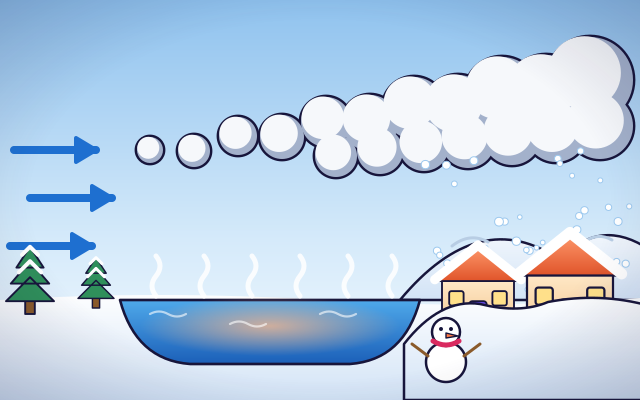
How does lake-effect snow happen?
Move cold air across warmer lake water and follow moisture into snowfall.
#455
Earth & weather
How does lake-effect snow happen?
Move cold air across warmer lake water and follow moisture into snowfall.
 #456
Earth & weather
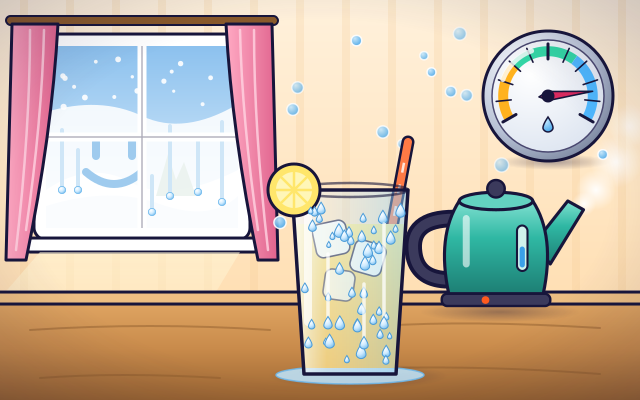
How does humidity affect the air around us?
Change temperature and water vapor and explore relative humidity and condensation.
#456
Earth & weather
How does humidity affect the air around us?
Change temperature and water vapor and explore relative humidity and condensation.
 #457
Earth & weather
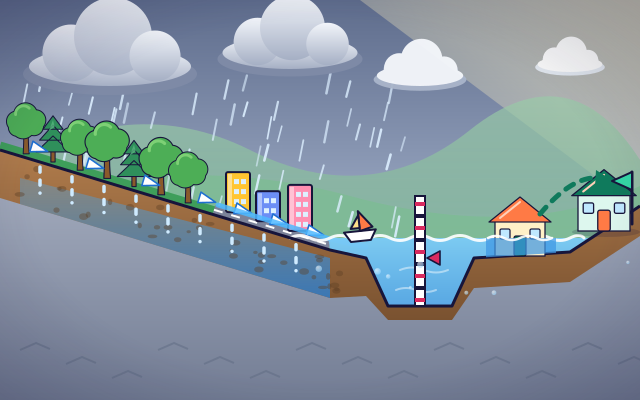
How do floods develop?
Add rainfall to a model watershed and compare absorption, runoff, and river levels.
#457
Earth & weather
How do floods develop?
Add rainfall to a model watershed and compare absorption, runoff, and river levels.
 #458
Earth & weather
How do droughts develop?
Follow rainfall, evaporation, soil moisture, and stored water through a dry period.
#458
Earth & weather
How do droughts develop?
Follow rainfall, evaporation, soil moisture, and stored water through a dry period.
Keep exploring
Games to play next
- Weather LabPredict the weather in a box, then run a fair test to find out why.
- Landform ExplorerMountains, valleys, peninsulas and deltas — learn the shapes of the land and find them on Earth.
- River MysterySomething changed the river. Sample sites with a limited budget, follow the evidence and find where the change begins.
Guide for grown-ups
- How to start homeschooling: a step-by-step guide for familiesA guide for parents · 7 min read
Science games by grade
Science worksheets by grade
- Preschool Science Worksheets
- Pre-K Science Worksheets
- Kindergarten Science Worksheets
- 1st Grade Science Worksheets
- 2nd Grade Science Worksheets
- 3rd Grade Science Worksheets
- 4th Grade Science Worksheets
- 5th Grade Science Worksheets
- 6th Grade Science Worksheets
- 7th Grade Science Worksheets
- 8th Grade Science Worksheets