How do gears change speed and direction?
Gears are toothed wheels that turn each other. Change their sizes and you change how fast, which way and how strongly things turn.
The big idea: Two gears that touch turn in opposite directions. A small gear spins faster than the big gear it meshes with, and a big gear turns more slowly but with more force.
It's like a grown-up and a small child walking hand in hand: they cover the same ground, so the child with short legs must take more steps.
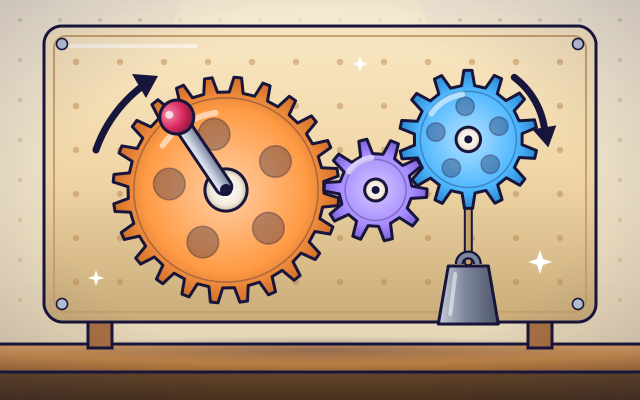
The interactive parts didn't load. The explanations below still work; try reloading the page.
How gears turn each other
- Mia turns the crank of an eggbeater slowly, but the beaters whirl around many times. Something between her hand and the beaters is speeding things up.
- Gears are wheels with teeth around the edge. The teeth of two gears fit together, or mesh. When one gear turns, each tooth pushes a tooth on the other gear, so they can never slip.
- Two gears that mesh always turn in opposite directions. Add a third gear in the middle, and the last gear turns the same way as the first.
- This big gear has 24 teeth and the small one has 8. Every tooth that passes pushes one tooth along, so one turn of the big gear spins the small gear three times.
- Swap them around. Now the small gear drives the big one. The big gear turns three times more slowly, but with three times the turning force. It can lift a heavier load.
- Gears make a clock's hands turn at different speeds. On a bike, toothed wheels and a chain let you pedal easily uphill or race along the flat.
Look inside a gear train
Three gears are turning together. Tap each part to see what it does.
- Crank. The crank is the handle you turn. It is fixed to the first gear, so your hand's push becomes a turning force.
- Driver gear. The driver is the gear that you turn. Its teeth push the next gear, so it is where the motion comes in.
- Teeth. The teeth are the bumps around the rim. They are all the same size on gears that work together, so a big gear simply has more of them.
- Where the teeth meet. This is where the teeth mesh. One tooth pushes one tooth, so the two gears pass exactly the same number of teeth through this spot.
- Middle gear. A gear in the middle is called an idler. It makes the last gear turn the same way as the first, but it does not change how fast the last gear turns.
- Driven gear. The driven gear is the last one, where the motion goes out. If it is bigger than the driver it turns slowly and strongly; if it is smaller it turns fast and weakly.
- Axle. Every gear spins on an axle through its center. The axles hold the gears at just the right distance so the teeth stay meshed.
Change the gears
Swap the blue gear for a small, medium or big one, and add a middle gear. Watch the speed, the direction and the weight it can lift.
Experiment: The crank gear has 16 teeth. Which blue gear will spin fastest?
- Tap the small gear in the tray. How fast does it spin?
- Now tap the big gear. Look at the weight it can lift.
- Add a middle gear and watch which way the blue gear turns.
What we found: The small gear spins fastest: with 8 teeth it turns twice for every turn of the 16-tooth crank gear. The big gear turns at half the speed, but it can lift twice the weight. A middle gear changes the direction, not the speed.
Turn on JavaScript to try it yourself.
Lift it the right way
Lift the crate. It needs twice the turning force of the crank, and the winch only winds when the blue gear turns the same way as the crank.
Why gear size matters
A gear is a wheel with teeth around its rim. When the teeth of two gears fit together, we say they mesh. Turn one gear and its teeth push the teeth of the other, one by one, so the second gear has to turn too. Because the teeth lock together, gears never slip the way smooth wheels can.
Two meshed gears always turn in opposite directions. If you want the last gear to turn the same way as the first, you can put a third gear, called an idler, between them.
Size changes the speed. Every tooth that goes past on one gear moves exactly one tooth on the other. A gear with 8 teeth has gone all the way around after 8 teeth have passed, but a gear with 24 teeth has only made a third of a turn. So small gears spin faster than the big gears they mesh with.
There is a trade. When a small gear drives a big one, the big gear turns slowly but with more turning force, enough to lift a heavy load. When a big gear drives a small one, you get speed but less force. Our walking comparison is not perfect here: walkers can speed up or let go, but meshed gears are locked together tooth by tooth.
Key words
- Gear
- A wheel with teeth around its rim that passes turning motion to another toothed wheel.
- Mesh
- The way the teeth of two gears fit together so that one pushes the other.
- Driver and driven gear
- The driver is the gear you turn. The driven gear is the one it turns.
- Gear ratio
- How many teeth the driven gear has compared with the driver. It tells you how much slower and stronger the output is.
- Idler
- A gear between two others. It reverses the direction but does not change the gear ratio.
- Torque
- Turning force: how hard something twists.
Check your thinking
-
Two gears mesh. Which way does the second one turn?
Show the answer
The opposite way to the first. Where the teeth meet they move together, so one wheel goes clockwise and the other counterclockwise.
-
A gear with 24 teeth turns a gear with 8 teeth. How many times does the small gear turn for one turn of the big gear?
Show the answer
3 times. 24 teeth pass, and the small gear needs only 8 for each turn: 24 ÷ 8 = 3 turns.
-
You want more turning force to lift a heavy load. What should you do?
Show the answer
Let a small gear drive a big gear. The big driven gear turns more slowly but with more force.
-
You put a third gear between two gears. What changes for the last gear?
Show the answer
Its direction. A middle gear flips the direction, so the last gear turns the same way as the first. The speed stays the same.
-
Why can a gear pair never give you more torque and more speed at the same time?
Show the answer
Power is torque times speed, and gears cannot add power. Gears pass power along; they do not create it. If the torque goes up by some factor, the speed must go down by the same factor.
-
Why do gears not slip the way two smooth wheels might?
Show the answer
Their teeth lock together. Each tooth sits in a gap on the other gear, so one cannot move without pushing the other.
You're a Forces & mechanisms expert!
You watched, looked inside, tried it, solved the challenge and went deeper. Pick another question below, or switch the age at the top to see this topic another way.
More about forces & mechanisms
 #109
Forces & mechanisms
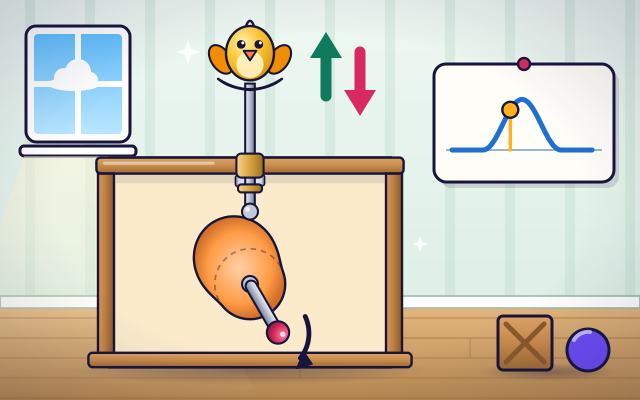
How do cams create repeating movements?
Rotate differently shaped cams and watch connected parts rise, pause, and fall.
#109
Forces & mechanisms
How do cams create repeating movements?
Rotate differently shaped cams and watch connected parts rise, pause, and fall.
 #110
Forces & mechanisms
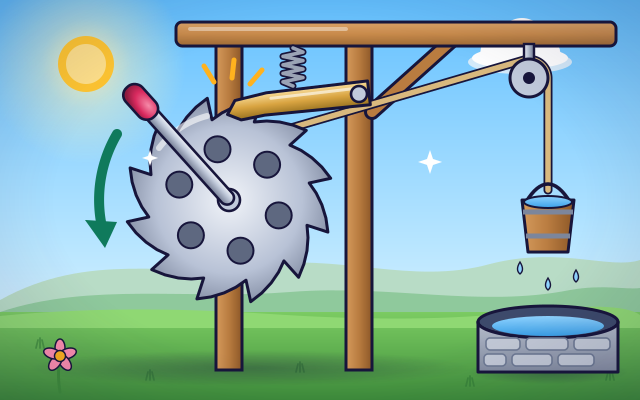
How do ratchets allow movement in only one direction?
Explore a toothed wheel and pawl, then build a mechanism that prevents backward movement.
#110
Forces & mechanisms
How do ratchets allow movement in only one direction?
Explore a toothed wheel and pawl, then build a mechanism that prevents backward movement.
 #111
Forces & mechanisms
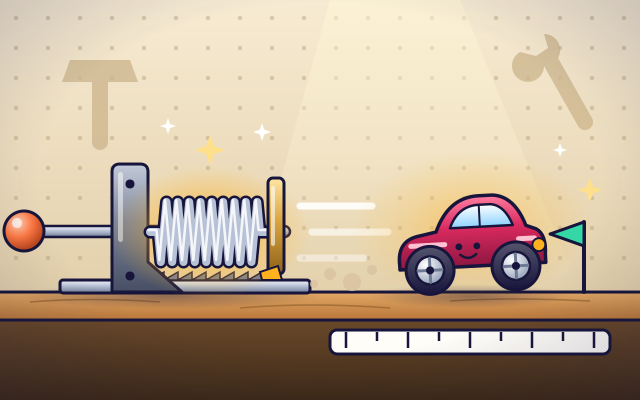
How do springs store and release energy?
Stretch or compress virtual springs and compare the movement produced when released.
#111
Forces & mechanisms
How do springs store and release energy?
Stretch or compress virtual springs and compare the movement produced when released.
 #112
Forces & mechanisms
How do ball bearings help wheels turn smoothly?
Compare sliding surfaces with rolling bearings while moving the same load.
#112
Forces & mechanisms
How do ball bearings help wheels turn smoothly?
Compare sliding surfaces with rolling bearings while moving the same load.
Keep exploring
Games to play next
- Machine RepairFix levers, pulleys, gears and ramps so every contraption works.
- Marble MountainLay straights, curves, drops and splitters to roll marbles down the mountain.
- Bridge LabBuild a bridge from beams, brace it with triangles, and stay on budget.
Guide for grown-ups
- How to start homeschooling: a step-by-step guide for familiesA guide for parents · 7 min read
Science games by grade
Science worksheets by grade
- Preschool Science Worksheets
- Pre-K Science Worksheets
- Kindergarten Science Worksheets
- 1st Grade Science Worksheets
- 2nd Grade Science Worksheets
- 3rd Grade Science Worksheets
- 4th Grade Science Worksheets
- 5th Grade Science Worksheets
- 6th Grade Science Worksheets
- 7th Grade Science Worksheets
- 8th Grade Science Worksheets