How do rainbows form?
Follow sunlight into a raindrop and out again to find where every rainbow color comes from.
The big idea: White sunlight is a mix of colors. When it goes into a raindrop it bends, bounces off the back and bends again, and each color comes out at a slightly different angle. Red comes back at about 42 degrees and violet at about 40.
It's like
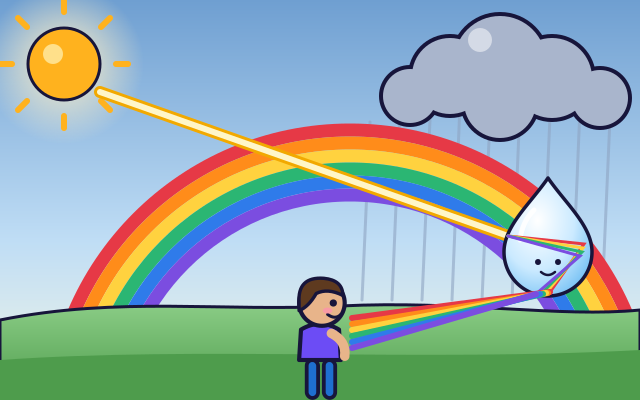
The interactive parts didn't load. The explanations below still work; try reloading the page.
Inside a raindrop
- Rainbows appear when the sun is behind you and rain is falling in front of you. Your shadow points straight toward the middle of the rainbow.
- Sunlight looks white, but it is really a mix of all the colors. A glass prism bends each color a slightly different amount, so the colors spread out.
- Each raindrop works like a tiny prism. When sunlight goes into the drop, it slows down and bends. This bending is called refraction.
- The light crosses the drop and some of it bounces off the back surface, like a mirror. This is reflection.
- As the light leaves the drop it bends again. Red light comes back out at about 42 degrees from the sunlight, and violet at about 40 degrees.
- You see red from the drops that sit at 42 degrees from your shadow, and violet from drops at 40 degrees. All those drops together form a big curved band of colors.
- Sometimes light bounces twice inside the drops. That makes a fainter second rainbow outside the first, with its colors in the opposite order.
Light's trip through a raindrop
Step through a raindrop with a beam of sunlight. Tap the drop or press Next.
- 1. White sunlight arrives. Sunlight looks white, but it is a mix of every color of the rainbow traveling together.
- 2. It bends going in. Light travels more slowly in water than in air, so when it enters the drop it changes direction. This is called refraction.
- 3. The colors spread out. Violet light bends a little more than red light, so the colors begin to fan out. This is called dispersion.
- 4. It bounces off the back. When the light hits the back of the drop, some of it reflects, like light off a mirror.
- 5. It bends again coming out. As the light leaves the drop and enters the air, it bends again, and the colors spread farther apart.
- 6. Each color has its own angle. Red light comes back at about 42 degrees to the sunlight, and violet at about 40 degrees. The other colors are in between.
- 7. Millions of drops make the bow. Your eye gets red from drops 42 degrees away from your shadow and violet from drops at 40 degrees. Together they make a curved band. Everyone sees their own rainbow!
Rainbow lab: sun, rain and you
Move the sun, the rain and yourself. Follow the light from the sun into the drops and back to your eye. When can you see a rainbow?
Experiment: What happens to the rainbow as the sun climbs higher in the sky?
- Start with the sun low and the rain in front of you.
- Slowly raise the sun.
- Watch the colored lines and the "What you see" window.
What we found: The rainbow is always centered on the shadow of your head. When the sun climbs higher, your shadow points lower, so the whole rainbow sinks. When the sun is higher than about 42 degrees, the rainbow is below the horizon and you can't see it. That's why rainbows appear in the morning or late afternoon.
Turn on JavaScript to try it yourself.
Touch the star with red
Move the sun and yourself so the red edge of the rainbow touches the star. Then press Check.
How raindrops make rainbows
Sunlight looks white, but it is really a mix of colors. You can see them when light goes through a prism or bounces off a soap bubble. In a rainbow, raindrops do the job of a prism.
When sunlight goes into a raindrop it slows down and bends. This is called refraction. Then it bounces off the back of the drop and bends again as it comes out. Each color bends a slightly different amount, so the colors leave the drop going in slightly different directions.
Red light comes back toward you at about 42 degrees from the sunlight, and violet at about 40 degrees. That means you see red from drops a little higher in the sky and violet from drops a little lower, so the rainbow has red on the outside and violet on the inside.
A rainbow is really a circle around the shadow of your head. The ground usually hides the bottom half. From an airplane you can sometimes see a whole circle! And because the circle is centered on your own shadow, the person next to you sees a different rainbow from different drops.
Key words
- Refraction
- The bending of light as it passes from one material into another, like air into water.
- Reflection
- Light bouncing off a surface.
- Dispersion
- When white light splits into its colors because each color bends a different amount.
- Spectrum
- The band of colors in white light: red, orange, yellow, green, blue and violet.
- Antisolar point
- The spot exactly opposite the sun, where the shadow of your head points.
Check your thinking
-
Where is the sun when you see a rainbow?
Show the answer
Behind you. Light goes from the sun behind you, into the raindrops in front of you, and back to your eyes.
-
What does a raindrop do to sunlight to make a rainbow?
Show the answer
Bends it, bounces it and bends it again. Refraction in, reflection at the back and refraction out send the colors back toward you.
-
Which color is on the outside of the main rainbow?
Show the answer
Red. Red comes back at about 42 degrees, a little higher than violet at 40 degrees.
-
Why do we usually see rainbows in the morning or late afternoon?
Show the answer
The sun must be low, or the rainbow is below the horizon. The rainbow sinks as the sun rises. When the sun is higher than about 42 degrees, the bow is below the horizon.
-
In the secondary rainbow, light reflects twice inside each drop. What happens to the order of the colors?
Show the answer
It is reversed: red on the inside. The extra reflection flips the order, so the secondary bow has red on the inside and violet on the outside.
-
You and a friend stand side by side looking at a rainbow. Do you see the same rainbow?
Show the answer
No, each of you sees light from different drops. The rainbow is centered on each person's own shadow, so you each see your own.
You're a Earth & weather expert!
You watched, looked inside, tried it, solved the challenge and went deeper. Pick another question below, or switch the age at the top to see this topic another way.
More about earth & weather
 #71
Earth & weather
How do lightning and thunder happen?
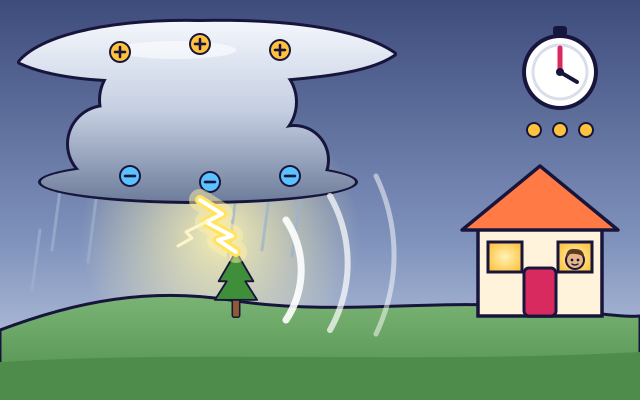
Explore a simplified storm cloud and the buildup of electrical charge. Compare when a flash is seen and its thunder is heard at different distances.
#71
Earth & weather
How do lightning and thunder happen?
Explore a simplified storm cloud and the buildup of electrical charge. Compare when a flash is seen and its thunder is heard at different distances.
 #72
Earth & weather
How do volcanoes erupt?
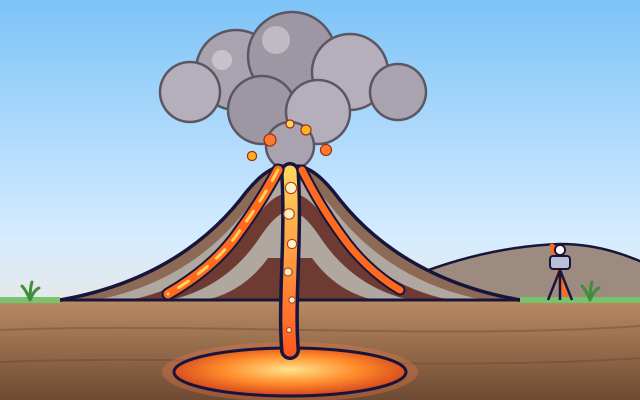
Look beneath a volcano and follow magma, gases, and pressure in a simplified model. Compare different volcano shapes and eruption styles.
#72
Earth & weather
How do volcanoes erupt?
Look beneath a volcano and follow magma, gases, and pressure in a simplified model. Compare different volcano shapes and eruption styles.
 #73
Earth & weather
How do earthquakes happen?
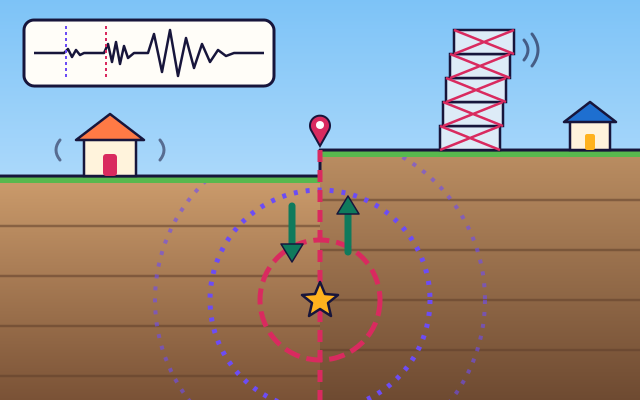
Move sections of Earth's crust, watch a fault slip, and follow earthquake waves. Compare how different model buildings respond to shaking.
#73
Earth & weather
How do earthquakes happen?
Move sections of Earth's crust, watch a fault slip, and follow earthquake waves. Compare how different model buildings respond to shaking.
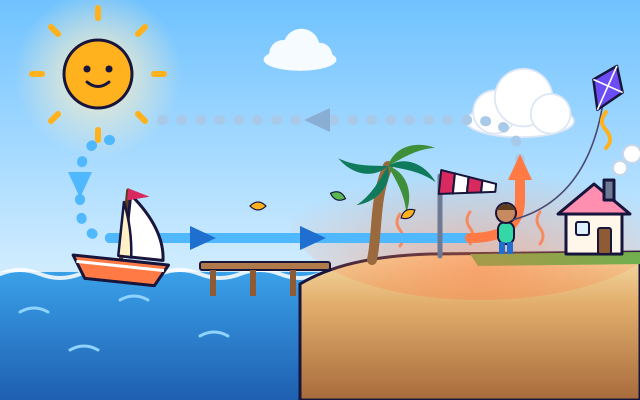 #74
Earth & weather
How does wind form?
Explore uneven heating, air pressure, and moving air. Change land and water temperatures in a simplified coastal model to investigate sea breezes.
#74
Earth & weather
How does wind form?
Explore uneven heating, air pressure, and moving air. Change land and water temperatures in a simplified coastal model to investigate sea breezes.
Keep exploring
Games to play next
- Weather LabPredict the weather in a box, then run a fair test to find out why.
- Landform ExplorerMountains, valleys, peninsulas and deltas — learn the shapes of the land and find them on Earth.
- River MysterySomething changed the river. Sample sites with a limited budget, follow the evidence and find where the change begins.
Draw it or make it
- How to draw a rainbowDrawing lesson
- Paper-Strip RainbowPaper craft
Guide for grown-ups
- How to start homeschooling: a step-by-step guide for familiesA guide for parents · 7 min read
Science games by grade
Science worksheets by grade
- Preschool Science Worksheets
- Pre-K Science Worksheets
- Kindergarten Science Worksheets
- 1st Grade Science Worksheets
- 2nd Grade Science Worksheets
- 3rd Grade Science Worksheets
- 4th Grade Science Worksheets
- 5th Grade Science Worksheets
- 6th Grade Science Worksheets
- 7th Grade Science Worksheets
- 8th Grade Science Worksheets