How do lightning and thunder happen?
See how a storm cloud builds up electric charge, why lightning flashes and how counting seconds tells you how far away it is.
The big idea: Ice bumping around inside a storm cloud separates electric charges. When enough charge builds up, it jumps as a giant spark called lightning. The spark heats the air so fast that it booms. Light reaches you almost at once, but sound takes about 3 seconds to travel 1 kilometer.
It's like
The interactive parts didn't load. The explanations below still work; try reloading the page.
How a storm makes lightning and thunder
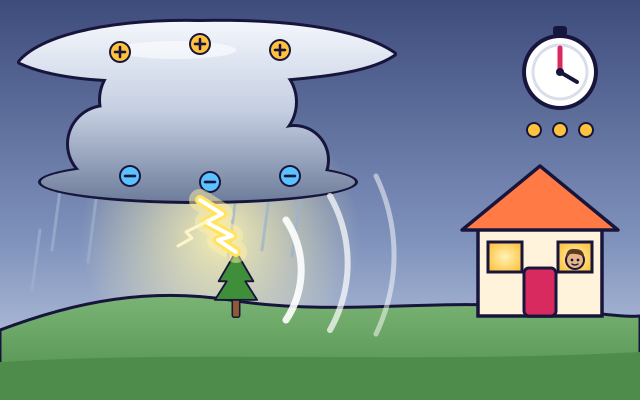
- On a warm, humid day, warm air rises fast. It carries water high into the sky, where a huge, tall storm cloud grows.
- Inside the cloud, small ice crystals are carried up while heavier, soft hail falls. When they bump, tiny electric charges rub off.
- The top of the cloud fills with positive charge and the bottom with negative charge. The ground underneath becomes positive. Opposite charges pull toward each other.
- When the charge gets too big, the air can't hold it back. A path zigzags down from the cloud, meets a spark rising from the ground, and a giant flash of lightning races along it.
- Lightning heats the air to about 30,000 degrees Celsius, five times hotter than the surface of the sun. The air expands so fast that it makes a huge boom: thunder.
- Light reaches you almost instantly, but sound is slower. Count the seconds from flash to boom and divide by 3 for kilometers. If you can hear thunder, go indoors.
Inside a thundercloud
Tap each part of the storm. Watch how the charge builds up and lets go!
- Updraft. Warm, wet air rushes up through the middle of the cloud. It carries water and ice high into the sky.
- Anvil top. When the rising air can't go any higher, it spreads out into a flat top called an anvil. The top of the cloud holds positive charge.
- Ice crystals. Small, light ice crystals get carried up by the rising air. When they bump into soft hail, they usually take positive charge.
- Soft hail (graupel). Soft hail, called graupel, is heavier, so it falls through the rising air. It bumps into ice crystals and picks up negative charge.
- Negative cloud base. Negative charge collects in the lower part of the cloud. It pulls on the positive charge in the ground below.
- Ground charge. The negative cloud base pushes negative charges in the ground away, leaving the ground below positive. Tall things like trees get the strongest pull.
- Lightning bolt. When enough charge builds up, it jumps as a giant spark. The bolt is only a few centimeters wide, but it can be kilometers long.
- Thunder. The bolt heats the air so much that it bursts outward. That push travels to your ears as the rumble of thunder.
Storm lab: charge, flash and boom
Push air up to build charge until lightning flashes. Then compare when the flash is seen and when each listener hears the thunder.
Experiment: If you stand farther away from the lightning, what happens to the time between the flash and the thunder?
- Stand close to the storm and make lightning. Count the seconds to the boom.
- Move far away and make lightning again.
- Compare the seconds. Watch the cow and the house too!
What we found: The farther away you are, the longer the thunder takes, because sound travels much more slowly than light. Sound goes about 1 kilometer every 3 seconds, so you can count the seconds and divide by 3 to find how far away the lightning was.
Turn on JavaScript to try it yourself.
Storm spotter
Use the seconds between flash and boom to find how far away each strike is. Is the storm coming closer?
Sparks, booms and staying safe
Have you ever touched a doorknob and felt a tiny zap? That is static electricity, the same kind of thing as lightning, just much, much smaller. Rubbing your feet on a carpet moves tiny electric charges, and when they jump to the doorknob you feel a spark.
A storm cloud does the same thing on a giant scale. Inside it, bits of ice and soft hail crash into each other millions of times. Each crash moves a little charge, so the top of the cloud becomes positive and the bottom becomes negative. When the difference gets big enough, the charge jumps as lightning.
A lightning bolt heats the air around it to about 30,000 degrees Celsius. The air expands so fast that it makes a sound wave: thunder. Light travels so fast that you see the flash almost at once, but sound needs about 3 seconds to travel 1 kilometer. Count the seconds and divide by 3 to find how far away the lightning was.
Lightning can strike about 15 kilometers away from a storm, which is about as far as you can hear thunder. So remember: when thunder roars, go indoors. A house or a car with a metal roof is a safe place. Wait until 30 minutes after the last thunder before you go back outside.
Key words
- Electric charge
- A property of tiny particles that can be positive or negative. Opposite charges pull toward each other.
- Graupel
- Soft hail: small balls of ice formed when supercooled droplets freeze onto ice crystals.
- Static electricity
- Electric charge that builds up in one place, like on a balloon rubbed on your hair.
- Thunder
- The sound made when lightning heats the air so fast that it bursts outward.
- Speed of sound
- How fast sound travels: about 1 kilometer in 3 seconds.
Check your thinking
-
What is the safest thing to do when you hear thunder?
Show the answer
Go inside a building or a car. Buildings and cars with metal roofs keep you safe. Trees attract lightning.
-
Why do you see lightning before you hear thunder?
Show the answer
Light travels much faster than sound. They happen at the same moment, but light zooms to you almost instantly while sound is much slower.
-
You count 9 seconds between a flash and its thunder. About how far away was the lightning?
Show the answer
About 3 km. Sound travels about 1 km every 3 seconds, so 9 ÷ 3 = 3 km.
-
What makes thunder?
Show the answer
Lightning heats the air so fast that it bursts outward. The air heats to about 30,000 °C and expands so fast that it makes a huge sound.
-
Inside a thundercloud, which particles usually end up carrying positive charge to the top?
Show the answer
Small ice crystals lifted by the updraft. In the main charging zone, small crystals gain positive charge in collisions with graupel and are carried upward.
-
The seconds between flash and boom go from 12, to 9, to 6. What is the storm doing?
Show the answer
Coming closer. Shorter delays mean shorter distances: the storm is getting closer. Time to go inside!
You're a Earth & weather expert!
You watched, looked inside, tried it, solved the challenge and went deeper. Pick another question below, or switch the age at the top to see this topic another way.
More about earth & weather
 #72
Earth & weather
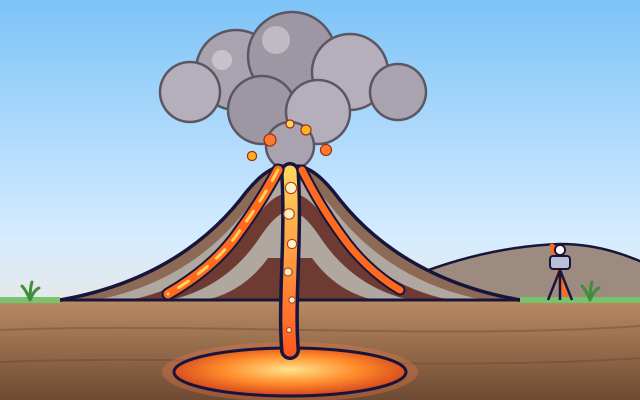
How do volcanoes erupt?
Look beneath a volcano and follow magma, gases, and pressure in a simplified model. Compare different volcano shapes and eruption styles.
#72
Earth & weather
How do volcanoes erupt?
Look beneath a volcano and follow magma, gases, and pressure in a simplified model. Compare different volcano shapes and eruption styles.
 #73
Earth & weather
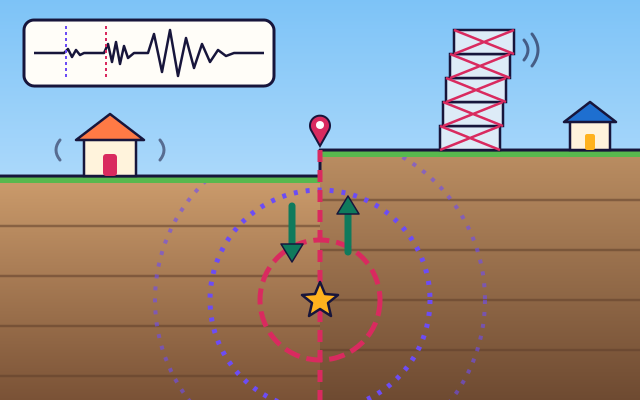
How do earthquakes happen?
Move sections of Earth's crust, watch a fault slip, and follow earthquake waves. Compare how different model buildings respond to shaking.
#73
Earth & weather
How do earthquakes happen?
Move sections of Earth's crust, watch a fault slip, and follow earthquake waves. Compare how different model buildings respond to shaking.
 #74
Earth & weather
How does wind form?
Explore uneven heating, air pressure, and moving air. Change land and water temperatures in a simplified coastal model to investigate sea breezes.
#74
Earth & weather
How does wind form?
Explore uneven heating, air pressure, and moving air. Change land and water temperatures in a simplified coastal model to investigate sea breezes.
 #75
Earth & weather
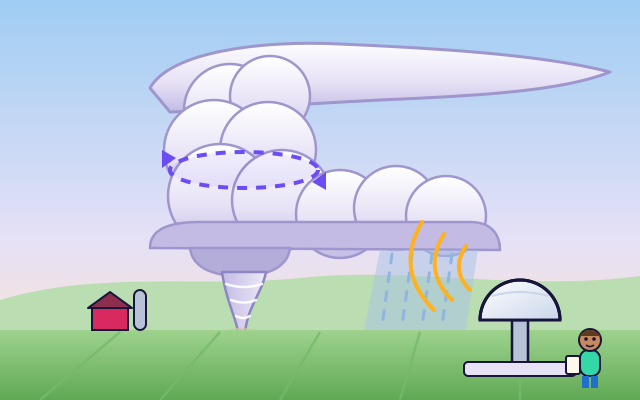
How do tornadoes form?
Explore airflow inside a simplified rotating thunderstorm. Watch a tornado develop and follow its movement across a model landscape.
#75
Earth & weather
How do tornadoes form?
Explore airflow inside a simplified rotating thunderstorm. Watch a tornado develop and follow its movement across a model landscape.
Keep exploring
Games to play next
- Weather LabPredict the weather in a box, then run a fair test to find out why.
- River MysterySomething changed the river. Sample sites with a limited budget, follow the evidence and find where the change begins.
- Landform ExplorerMountains, valleys, peninsulas and deltas — learn the shapes of the land and find them on Earth.
Guide for grown-ups
- How to start homeschooling: a step-by-step guide for familiesA guide for parents · 7 min read
Science games by grade
Science worksheets by grade
- Preschool Science Worksheets
- Pre-K Science Worksheets
- Kindergarten Science Worksheets
- 1st Grade Science Worksheets
- 2nd Grade Science Worksheets
- 3rd Grade Science Worksheets
- 4th Grade Science Worksheets
- 5th Grade Science Worksheets
- 6th Grade Science Worksheets
- 7th Grade Science Worksheets
- 8th Grade Science Worksheets