How does an hourglass measure time?
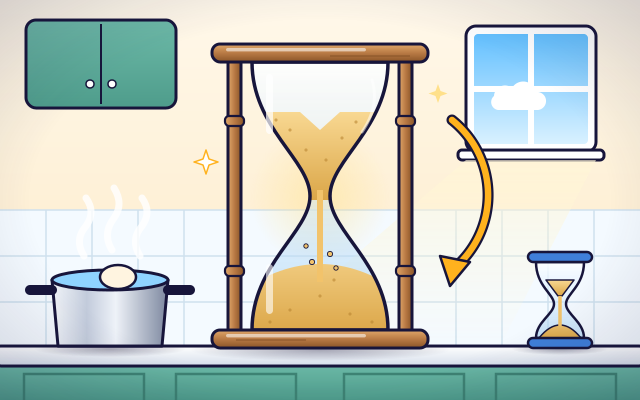
An hourglass measures time with sand that trickles through a narrow neck at a steady speed.
The big idea: Sand runs through the neck at a steady speed. More sand takes longer, and a bigger hole lets it through faster.
It's like a crowd leaving through one narrow door: people pass at a steady pace, so more people take longer and a wider door is quicker.
The interactive parts didn't load. The explanations below still work; try reloading the page.
Measuring time with sand
- How long should the egg cook? Turn the sand timer over and it starts counting. No batteries, no numbers, just sand.
- Between the two glass bulbs is a narrow neck. Only a thin stream of grains can squeeze through at once, so the sand takes a while to get down.
- Here is the clever part. The sand falls just as fast when the top is full as when it is nearly empty. That steady trickle is what makes a good timer.
- Two things set the time. A bigger hole lets the sand through faster, so the timer is shorter. More sand takes longer to run through.
- When the last grains drop, the time is up. The same sand through the same neck takes the same time, every time you flip it.
Look closely at an hourglass
Tap each part of the hourglass. The round window shows the neck up close.
- Upper bulb. The sand starts in the upper bulb. Its sloping glass sides guide the grains toward the neck.
- Sand. The grains are tiny, dry and nearly all the same size, so they flow smoothly and do not stick together.
- Neck. The narrow neck lets only a thin stream of sand through. Its width decides how fast the timer runs.
- Falling stream. The sand falls in a thin, steady stream. It is just as thick at the start as at the end.
- Lower bulb. The sand lands in the lower bulb and builds a cone-shaped pile. When all the sand is here, time is up.
- Frame. Two flat ends and some posts protect the glass and let the timer stand either way up.
What sets the time?
Change the size of the opening and the amount of sand in the yellow timer. Race it against the blue one-minute timer.
Experiment: You put twice as much sand in the timer but keep the same opening. What happens to the time?
- Set the sand to 50 grams and note the time.
- Change the sand to 100 grams with the same opening.
- Now try a bigger opening. Which change makes the bigger difference?
What we found: Twice the sand takes twice as long, because the sand always runs through at the same steady speed. A bigger opening makes the timer much shorter: even a little wider lets a lot more sand through.
Turn on JavaScript to try it yourself.
Build a timer
Build a sand timer that runs for the target time. Choose the opening and the sand, then test it.
Why sand keeps good time
People used sand timers hundreds of years ago, long before small clocks were common. Sailors used them to time their turns on watch and to measure the speed of their ships. A sand timer works on a rocking ship, in the cold and in the dark, and it never needs winding.
The timer has two glass bulbs joined by a narrow neck. When you flip it, gravity pulls the sand down, but only a thin stream of grains can squeeze through the neck at once. The grains above have to wait their turn, like a crowd at a narrow door.
Here is what makes sand special. If you fill a bottle with water and poke a hole in the bottom, the water squirts out fast at first and then slows down as the bottle empties. Sand does not do that. The grains rub and lean against each other and against the glass, so the grains at the neck are not squashed harder when there is more sand on top. The stream stays the same all the way through.
Because the stream is steady, the time depends on just two things: how much sand there is, and how wide the neck is. Twice the sand takes twice as long. A slightly wider neck lets through a lot more sand, so the timer is much shorter. The crowd idea is not perfect: people can push and hurry, but grains of sand never do.
Key words
- Hourglass
- A timer made of two glass bulbs with sand that runs from one to the other.
- Neck
- The narrow opening between the bulbs. It sets how fast the sand runs.
- Flow rate
- How much sand passes through the neck each second.
- Granular material
- Stuff made of lots of small solid bits, like sand, rice or sugar.
- Jam
- When grains wedge together into an arch over a hole and block it.
Check your thinking
-
How do you know an hourglass has finished?
Show the answer
All the sand has run into the lower bulb. The timer measures how long the sand takes to run through. When the top is empty, the time is over.
-
Two timers hold the same sand. One has a bigger hole. Which finishes first?
Show the answer
The one with the bigger hole. A bigger hole lets more grains through each second, so the sand is gone sooner.
-
Why is sand better than water for a simple timer?
Show the answer
Sand runs at the same speed from start to finish. Water slows down as it runs out. Sand keeps a steady trickle, so every part of the time is measured evenly.
-
A timer runs for 1 minute. You want one that runs for 3 minutes with the same neck. What should you do?
Show the answer
Use three times as much sand. The sand runs at a steady speed, so three times the sand takes three times as long.
-
Coarse grains 1 millimeter across are put in a timer with a 3 millimeter opening. What is likely to happen?
Show the answer
The grains form an arch and jam. When the opening is only about three grains wide, the grains can lock together into a stable arch that blocks it.
You're a Measuring & instruments expert!
You watched, looked inside, tried it, solved the challenge and went deeper. Pick another question below, or switch the age at the top to see this topic another way.
More about measuring & instruments
 #182
Measuring & instruments
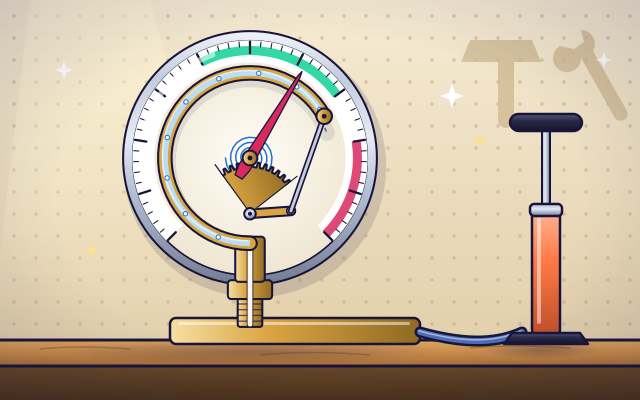
How does a mechanical pressure gauge work?
Change pressure and watch a flexible sensing element move the dial's pointer.
#182
Measuring & instruments
How does a mechanical pressure gauge work?
Change pressure and watch a flexible sensing element move the dial's pointer.
 #391
Measuring & instruments
How do microscopes reveal tiny details?
Position a sample and adjust focus and magnification to reveal structures.
#391
Measuring & instruments
How do microscopes reveal tiny details?
Position a sample and adjust focus and magnification to reveal structures.
 #392
Measuring & instruments
How do thermal cameras show heat patterns?
Compare familiar objects in visible-light and simulated infrared images.
#392
Measuring & instruments
How do thermal cameras show heat patterns?
Compare familiar objects in visible-light and simulated infrared images.
 #393
Measuring & instruments
How do X-ray machines look inside objects?
Send simulated X-rays through different materials and compare their resulting images.
#393
Measuring & instruments
How do X-ray machines look inside objects?
Send simulated X-rays through different materials and compare their resulting images.
Keep exploring
Games to play next
- Clock TowerKeep the town on time: set the tower clock's hands just right.
- Data DetectiveRead the clues hidden in graphs — and build your own.
- Globe ExplorerSpin a real 3D globe, flip to the flat map, and find continents, oceans and countries.
Guide for grown-ups
- How to start homeschooling: a step-by-step guide for familiesA guide for parents · 7 min read
Science games by grade
Science worksheets by grade
- Preschool Science Worksheets
- Pre-K Science Worksheets
- Kindergarten Science Worksheets
- 1st Grade Science Worksheets
- 2nd Grade Science Worksheets
- 3rd Grade Science Worksheets
- 4th Grade Science Worksheets
- 5th Grade Science Worksheets
- 6th Grade Science Worksheets
- 7th Grade Science Worksheets
- 8th Grade Science Worksheets