How do hovercraft travel over land and water?
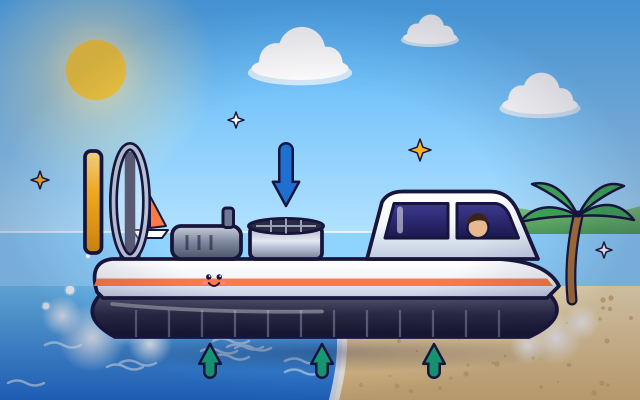
A big fan blows air under the hovercraft. A rubber skirt traps it, and the craft floats on a cushion of air over land and sea.
The big idea: A lift fan pushes air under the craft, and a flexible skirt holds it there. The trapped air presses up on the whole bottom of the craft and lifts it, so nothing rubs on the ground and it glides over almost any surface.
It's like an air hockey puck: air blowing underneath lifts it a tiny bit, so it glides with hardly any rubbing. A hovercraft carries its own fan to make the air.
The interactive parts didn't load. The explanations below still work; try reloading the page.
How a hovercraft floats on air
- A hovercraft speeds across the water and drives straight up the beach without stopping. It has no wheels and it does not float like a boat. So what holds it up?
- A big fan on the deck pulls air in from above and blows it down, into the space under the craft.
- A flexible rubber skirt hangs all around the edge and traps the air. The air squashes together under the craft and pushes up on it. The whole hovercraft rises.
- A little air keeps leaking out under the bottom of the skirt. The craft rides on that thin layer of moving air, so almost nothing rubs on the ground. Rubbing is called friction.
- A propeller at the back blows air backward, and that pushes the hovercraft forward. Flaps called rudders swing in the stream of air to turn it left or right.
- Because it never touches the surface, a hovercraft can cross water, sand, grass, mud and ice. But with so little grip it slides sideways in turns, so the pilot has to steer early.
Look inside a hovercraft
The side is cut away so you can follow the air. Tap each part to see what it does.
- Lift fan. The lift fan pulls air in from above and blows it down under the craft. It has to keep running, or the cushion leaks away.
- Air chamber. The air from the fan spreads out in this chamber, so it reaches every part of the skirt evenly.
- Skirt. The skirt is made of tough rubber fabric. It traps the air and bends over waves, rocks and bumps, so the craft can ride high without losing its cushion.
- Air cushion. This is the cushion of trapped air. It is squashed a little, so it pushes up on the whole bottom of the craft and carries its weight.
- Thrust propeller. The thrust propeller blows air backward to push the craft forward. A ring around it guides the air and keeps people safely away from the blades.
- Rudders. The rudders sit in the wind from the propeller. Swinging them pushes that wind to one side, which turns the hovercraft.
- Engine. The engine turns the lift fan and the thrust propeller. More power to the fan lifts the craft higher.
- Cabin. The pilot sits at the front with a steering control for the rudders and levers for the fan and the propeller.
Fill the air cushion
Slide the fan power up and follow the air into the cushion. Then press Push! on different surfaces, with the fan on and with it off.
Experiment: The hovercraft sits on sand with its fan off. You turn the fan up high. What will the same push do now?
- With the fan off, choose sand and press Push! How far does it go?
- Slide the fan up until the craft lifts. Watch the air go under the skirt.
- Press Push! again. Then try grass, water and ice.
What we found: With the fan off, the hovercraft sits on the ground and rubs, so a push hardly moves it. With the fan on, trapped air lifts it and it rides on a thin layer of air. Now the same push sends it gliding a long way, on any surface.
Turn on JavaScript to try it yourself.
Steer through the gates
Switch on the lift fan and press Go! Steer between the flags on water, sand, grass and ice. The hovercraft slides, so steer early.
A cushion of air
Push a heavy box across the floor and you feel it rub. That rubbing is called friction, and it slows down everything that slides. A hovercraft beats friction in a clever way: it does not touch the ground at all.
A big fan blows air under the craft. A rubber skirt around the edge keeps most of that air from getting away, so the air underneath gets squashed. Squashed air pushes back in every direction, and that includes up. It only pushes a little on each bit of the craft's bottom, but the bottom is huge, so all those little pushes add up to enough to lift the whole craft.
The skirt does not seal tight. A thin sheet of air keeps sliding out under its edge, and the fan keeps topping the cushion up. The hovercraft rides on that moving air. It is just like a puck on an air hockey table, except that the hovercraft brings its own fan along.
Since it does not touch, a hovercraft does not care what is underneath: water, sand, mud, grass or ice. That makes it useful for rescues on mudflats and thin ice. But a craft with no grip is hard to steer. It keeps sliding the way it was going, so pilots turn early and gently.
Key words
- Air cushion
- The trapped, slightly squashed air under a hovercraft that holds it up.
- Skirt
- The flexible rubber wall around a hovercraft's edge that traps the cushion of air.
- Friction
- The rubbing that slows things down when they slide over each other.
- Pressure
- How hard something pushes on each bit of a surface.
- Thrust
- The forward push made by blowing air backward.
Check your thinking
-
What holds a hovercraft above the ground?
Show the answer
A cushion of trapped air under it. The fan blows air under the craft, the skirt traps it, and the squashed air pushes the craft up.
-
What is the rubber skirt for?
Show the answer
It traps the air and bends over bumps. The skirt holds the cushion of air in, and because it is bendy it can pass over waves and bumps.
-
Why can one small push send a hovering hovercraft a long way?
Show the answer
It rides on air, so there is almost no rubbing to slow it. Friction comes from surfaces rubbing. The hovercraft does not touch the ground, so very little slows it down.
-
A hovercraft has a mass of 3,000 kg and a hull area of 30 square meters. About what cushion pressure does it need? (Use g = 10 N/kg.)
Show the answer
About 1,000 pascals. Weight = 3,000 x 10 = 30,000 N. Pressure = force / area = 30,000 / 30 = 1,000 Pa, about 1 percent of atmospheric pressure.
-
Why must a hovercraft pilot start turning early?
Show the answer
With no grip on the ground, it keeps sliding the way it was going. A car's tires grip the road in a turn. A hovercraft has nothing gripping, so it drifts until the propeller's push changes its path.
You're a Flight & transportation expert!
You watched, looked inside, tried it, solved the challenge and went deeper. Pick another question below, or switch the age at the top to see this topic another way.
More about flight & transportation
 #126
Flight & transportation
How do sailboats use the wind?
Adjust sail angle and rudder position to navigate with winds from different directions.
#126
Flight & transportation
How do sailboats use the wind?
Adjust sail angle and rudder position to navigate with winds from different directions.
 #127
Flight & transportation
How do jet engines produce thrust?
Follow air through compression, heating, and expansion inside a transparent engine.
#127
Flight & transportation
How do jet engines produce thrust?
Follow air through compression, heating, and expansion inside a transparent engine.
 #128
Flight & transportation
How do propellers push vehicles forward?
Rotate blades through air or water and inspect the direction of the resulting flow.
#128
Flight & transportation
How do propellers push vehicles forward?
Rotate blades through air or water and inspect the direction of the resulting flow.
 #129
Flight & transportation
How do disc brakes stop a vehicle?
Press pads against a spinning disc and compare stopping under different simulated conditions.
#129
Flight & transportation
How do disc brakes stop a vehicle?
Press pads against a spinning disc and compare stopping under different simulated conditions.
Keep exploring
Games to play next
- Plane Flight SimulatorTake off from the runway and thread numbered sky hoops in order. Every clean flight is a new personal best.
- Machine RepairFix levers, pulleys, gears and ramps so every contraption works.
- Timetable TerminalRead the departure board, count the minutes and catch your connection on time.
Guide for grown-ups
- How to start homeschooling: a step-by-step guide for familiesA guide for parents · 7 min read
Science games by grade
Science worksheets by grade
- Preschool Science Worksheets
- Pre-K Science Worksheets
- Kindergarten Science Worksheets
- 1st Grade Science Worksheets
- 2nd Grade Science Worksheets
- 3rd Grade Science Worksheets
- 4th Grade Science Worksheets
- 5th Grade Science Worksheets
- 6th Grade Science Worksheets
- 7th Grade Science Worksheets
- 8th Grade Science Worksheets