How does humidity affect the air around us?
Air carries invisible water. See why warm days feel sticky and why cold glasses get wet.
The big idea: Air carries water as an invisible gas called water vapor. Warm air has room for more of it than cold air. When the air is full, the extra water turns into tiny drops.
It's like a cup that changes size. Warm air is a big cup, cold air a small one. Humidity tells you how full it is, and a full cup spills drops.
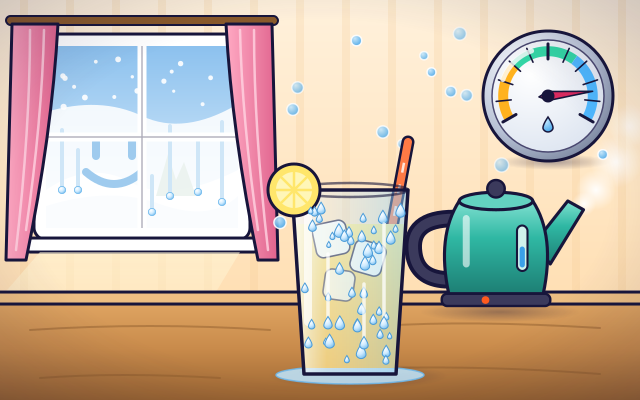
The interactive parts didn't load. The explanations below still work; try reloading the page.
The water you cannot see
- Some warm days feel sticky and heavy. The dial on the wall, called a hygrometer, says the air is carrying a lot of water. But where is it?
- When water warms up, tiny bits of it float away into the air. This is evaporation. The water is now a gas called water vapor, and it is invisible.
- Think of the air as a cup for water vapor. When the air warms up, the cup grows. When the air cools down, the cup shrinks.
- The hygrometer shows how full the cup is. That is relative humidity. Half full is 50 percent. Cool the same air and the cup shrinks, so it reads fuller and fuller.
- A cold glass chills the air that touches it. That air's cup becomes too small for its water, so the extra water turns into drops on the glass. This is condensation.
- Your sweat cools you as it dries. In very humid air the cup is nearly full, so sweat dries slowly and you feel sticky. Drier air lets it dry and cool you.
Humidity in one room
Tap each part of the room. Each one shows something about the water in the air.
- Water vapor. The blue dots stand for water vapor: water that has become a gas and mixed into the air. Real vapor is invisible, so we have drawn it for you.
- Boiling kettle. Heating water makes it evaporate quickly. Showers, cooking, drying laundry, plants and even your breath all add water vapor to the air in a home.
- Thermometer. Temperature matters a lot. Warm air has room for much more water vapor than cold air, so the same air can feel dry when warm and damp when cold.
- The air's cup. This cup is our model. Its size is how much water vapor the air has room for, and the water in it is the vapor that is really there.
- Hygrometer. A hygrometer measures relative humidity: how full the air's cup is. About 30 to 60 percent feels comfortable indoors.
- Cold glass. The glass did not leak. It cooled the air beside it until that air had too little room for its water, and the extra condensed into drops.
- Foggy window. In winter the window is the coldest thing in the room. When there is lots of vapor indoors, it condenses on the cold glass as a mist of tiny drops.
- Sweaty skin. Sweat cools you when it evaporates. In humid air it evaporates slowly, so you stay wet and feel hotter. In dry air it dries fast and you feel cooler.
Warm it, cool it, add water
Change the temperature and the water in the air. Watch the air's cup, the dial, the cold glass and the window.
Experiment: You do not add or take away any water. What happens to the dial when the room gets colder?
- Leave the water slider alone.
- Slide the temperature all the way to cold. Watch the cup and the dial.
- Now slide it all the way to hot. What does the dial say?
What we found: The water stayed the same, but the cup changed size. Cold air has a small cup, so it was soon full and fog appeared. Hot air has a huge cup, so the same water made the dial read low.
Turn on JavaScript to try it yourself.
Make the room comfy
Make the room cozy: the temperature in the green band, the dial in the green zone and no mist on the window. Then press Check.
How humidity works
There is water in the air all around you, even on a sunny day. It gets there by evaporation: tiny bits of water float away from puddles, seas, plants, wet laundry and your own breath. Once in the air, the water is a gas called water vapor, and you cannot see it at all.
Air only has room for so much water vapor, and the amount depends on how warm it is. Warm air has room for a lot. Cold air has room for only a little. That is why we drew the air as a cup that grows and shrinks. Relative humidity tells you how full the cup is: 50 percent means half full, and 100 percent means completely full.
When air cools down, its cup shrinks. If the cup shrinks until it is full, the extra water has to come out as tiny drops. This is condensation. It makes the drops on a cold glass, the mist on a bathroom mirror, the dew on morning grass, and fog and clouds too.
Humidity changes how you feel. Your body cools itself with sweat, which carries heat away as it dries. When the air is nearly full of water, sweat dries slowly, so a humid day feels hotter and stickier than a dry day at the same temperature. Very dry air does the opposite: it dries your skin and lips quickly.
Key words
- Water vapor
- Water that has become an invisible gas and mixed into the air.
- Evaporation
- Liquid water turning into water vapor.
- Relative humidity
- How full the air is with water vapor, from 0 to 100 percent.
- Saturation
- When the air is completely full of water vapor.
- Condensation
- Water vapor turning back into liquid drops.
- Dew point
- How cold the air must get before drops start to form.
Check your thinking
-
Where does the water on the outside of a cold glass come from?
Show the answer
From water vapor in the air. The glass cools the air beside it. That air's cup gets too small, so its water vapor turns into drops.
-
Which air has room for more water vapor?
Show the answer
Warm air. The warmer the air, the more water vapor it has room for. That is why its cup is bigger.
-
A room cools down at night, but no water is added or taken away. What happens to its relative humidity?
Show the answer
It goes up. Cooler air has a smaller cup. The same water fills more of it, so the dial reads higher.
-
Why does a humid day feel hotter than a dry day at the same temperature?
Show the answer
Sweat dries slowly, so it cools you less. Sweat cools you only when it evaporates. When the air's cup is nearly full, it evaporates slowly.
-
The bathroom mirror is misted over after a shower. What is the best way to clear it?
Show the answer
Let the wet air out with a fan or an open window. Mist forms when there is too much water vapor for the cold glass. Swapping the wet air for drier air removes the vapor.
-
Outdoor air at 0 degrees and 100 percent relative humidity is brought inside and heated to 20 degrees. About what is its relative humidity now?
Show the answer
About 30 percent. The vapor stays near 5 grams per cubic meter, but saturation at 20 degrees is about 17, and 5 divided by 17 is roughly 30 percent. This is why heated rooms feel dry in winter.
You're a Earth & weather expert!
You watched, looked inside, tried it, solved the challenge and went deeper. Pick another question below, or switch the age at the top to see this topic another way.
More about earth & weather
 #457
Earth & weather
How do floods develop?
Add rainfall to a model watershed and compare absorption, runoff, and river levels.
#457
Earth & weather
How do floods develop?
Add rainfall to a model watershed and compare absorption, runoff, and river levels.
 #458
Earth & weather
How do droughts develop?
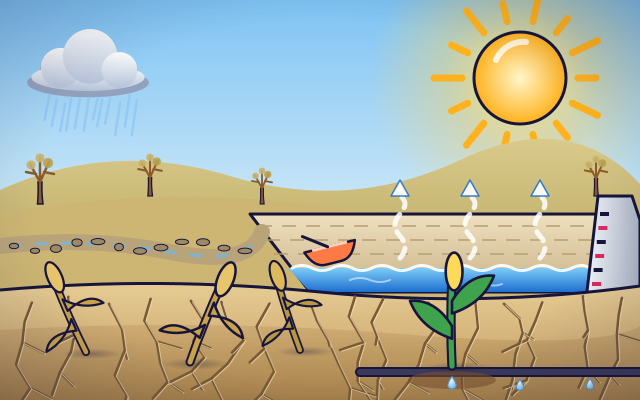
Follow rainfall, evaporation, soil moisture, and stored water through a dry period.
#458
Earth & weather
How do droughts develop?
Follow rainfall, evaporation, soil moisture, and stored water through a dry period.
 #459
Earth & weather
How do ocean currents move water?
Explore wind, temperature, salinity, and Earth's rotation in a simplified ocean model.
#459
Earth & weather
How do ocean currents move water?
Explore wind, temperature, salinity, and Earth's rotation in a simplified ocean model.
 #460
Earth & weather
How do ocean waves form and reach the shore?
Add wind and follow wave energy toward shallower water.
#460
Earth & weather
How do ocean waves form and reach the shore?
Add wind and follow wave energy toward shallower water.
Keep exploring
Games to play next
- Weather LabPredict the weather in a box, then run a fair test to find out why.
- River MysterySomething changed the river. Sample sites with a limited budget, follow the evidence and find where the change begins.
- Landform ExplorerMountains, valleys, peninsulas and deltas — learn the shapes of the land and find them on Earth.
Guide for grown-ups
- How to start homeschooling: a step-by-step guide for familiesA guide for parents · 7 min read
Science games by grade
Science worksheets by grade
- Preschool Science Worksheets
- Pre-K Science Worksheets
- Kindergarten Science Worksheets
- 1st Grade Science Worksheets
- 2nd Grade Science Worksheets
- 3rd Grade Science Worksheets
- 4th Grade Science Worksheets
- 5th Grade Science Worksheets
- 6th Grade Science Worksheets
- 7th Grade Science Worksheets
- 8th Grade Science Worksheets