How do LCD screens make pictures?
Open and shut tiny light gates, mix red, green and blue, and build a picture one pixel at a time.
The big idea: A white light shines behind the screen all the time. Each pixel has three tiny windows: red, green and blue. Liquid crystals open or shut each window, and the mix of the three makes the pixel's color.
It's like a wall of tiny colored-glass windows with a lamp behind. Each window has a blind you can open a little or a lot. Together the windows make a picture.
The interactive parts didn't load. The explanations below still work; try reloading the page.
How a screen builds a picture
- Tablets, laptops and many TVs use LCD screens. The picture looks smooth, but it is built from tiny pieces. Let's zoom in and find them.
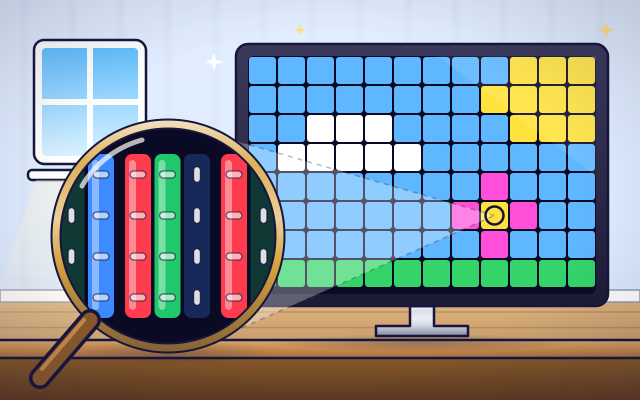
- Zoom in and you see tiny squares called pixels. Zoom in more: each pixel has three stripes, one red, one green and one blue. These are called subpixels.
- An LCD is a sandwich. At the back, a white light shines all the time. In front are two special filters with a layer of liquid crystal between them, and then the color stripes.
- The liquid crystals are tiny rods. Resting, they twist the light so it slips through the front filter: bright. Electricity makes the rods line up, so the light is blocked: dark.
- Each subpixel can be bright, dim or dark. Your eye blends the three together. Red and green look yellow. All three look white. With different amounts you can make millions of colors.
- The screen sets the color of every pixel, row by row, about sixty times each second. Millions of pixels switching together make pictures, words and moving video.
The layers of an LCD
Here the screen is pulled apart so you can see its layers. Light travels from left to right. Tap each layer.
- Backlight. A row of white LEDs lights the screen from behind, and a plastic sheet spreads their light evenly. The backlight stays on the whole time the screen is on.
- Back polarizer. Light waves wiggle in every direction. This filter works like a comb: it only lets through light that wiggles one way.
- Switch layer. A sheet of glass carries a tiny switch for every subpixel. Each switch turns the electricity for its own bit of crystal up or down.
- Liquid crystal. Liquid crystal flows like a liquid, but its rod-shaped molecules line up like a solid crystal. Resting, the rods form a twist that turns the light. Electricity straightens them out.
- Color filter. Each subpixel has a tiny colored window: red, green or blue. White light goes in, and only that color comes out.
- Front polarizer. The front filter is turned sideways compared with the back one. Only light that the crystals have twisted can get through it. Untwisted light is stopped, and the subpixel looks dark.
Open the shutters, paint the pixels
Tap the stripes or use the sliders to open each subpixel, and see what color they mix. Then tap squares on the screen to paint pixels.
Experiment: Which two subpixels do you need to open to make yellow?
- Close all three stripes. Now open red and green.
- Try red and blue, then green and blue.
- Open all three. What do you see?
What we found: Red and green light together look yellow. Red and blue make magenta, and green and blue make cyan. All three together look white. Mixing light is different from mixing paint!
Turn on JavaScript to try it yourself.
Paint the flower
Copy the little picture. Mix the color each ring shows, then tap that square to paint it.
How an LCD makes a picture
Look very closely at a screen and the smooth picture turns into a grid of tiny squares called pixels. A Full HD screen has about two million of them. Each pixel is split into three stripes, called subpixels: one red, one green and one blue.
An LCD does not make colored light. At the back of the screen, white lights shine all the time. In front of them is a sandwich of layers. For each subpixel there is a tiny blob of liquid crystal that works like a blind on a window. It can let all the light through, some of it, or almost none. Then a colored filter turns that light red, green or blue.
How does the blind work? Liquid crystal is made of tiny rods. Resting, the rods form a twist that turns the light, and turned light can slip through the front filter. When a tiny switch sends electricity to the rods, they straighten out. Now the light is not turned, and the front filter stops it. A little electricity gives a half-open blind.
Your eyes cannot see the three stripes from a normal distance, so they blend. Red and green light together look yellow. Red and blue look magenta, green and blue look cyan, and all three look white. By setting the three blinds to different amounts, one pixel can show millions of colors. The window blind is only a comparison: a real subpixel has no moving slats, just crystals that turn.
Key words
- Pixel
- One tiny square of a screen picture. The word is short for picture element.
- Subpixel
- One of the three colored parts of a pixel: red, green or blue.
- Liquid crystal
- A material that flows like a liquid but whose rod-shaped molecules line up in order. It can turn light.
- Backlight
- The white light at the back of an LCD. It shines through all the other layers.
- Polarizer
- A filter that only lets through light wiggling in one direction.
- Additive mixing
- Making new colors by adding colored lights together. Red, green and blue light together look white.
Check your thinking
-
What is a pixel made of?
Show the answer
Three subpixels: red, green and blue. Each pixel has a red, a green and a blue subpixel. Their mix makes the pixel's color.
-
Which two colors of light look yellow together?
Show the answer
Red and green. Red and green light add up to yellow. That is how a screen with no yellow subpixel shows a yellow banana.
-
What do you see when red, green and blue all shine together?
Show the answer
White. All three lights together look white. With all three shut, the pixel is black.
-
What job does the liquid crystal do?
Show the answer
It lets more or less light through each subpixel. The backlight makes the light and the filters color it. The liquid crystal is the blind that opens and shuts.
-
Where does the light of an LCD screen come from?
Show the answer
A white backlight behind the layers. The backlight shines all the time. The layers in front only block it or let it through.
-
Why does an LCD's black look slightly gray in a dark room?
Show the answer
The backlight is always on, and a little light leaks through the closed subpixels. An LCD can only block its backlight, and the block is never perfect. Screens whose pixels make their own light can switch a pixel fully off.
You're a Electricity & energy expert!
You watched, looked inside, tried it, solved the challenge and went deeper. Pick another question below, or switch the age at the top to see this topic another way.
More about electricity & energy
 #378
Electricity & energy
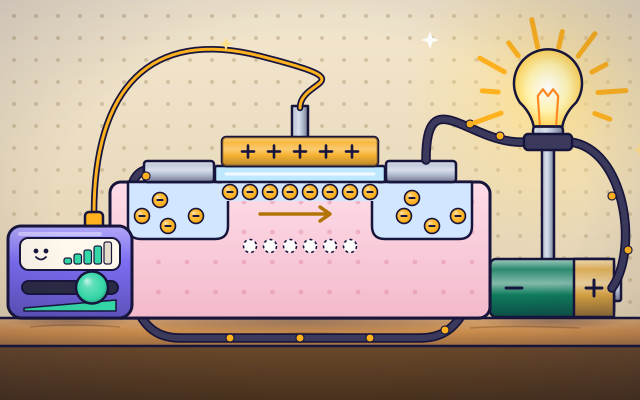
How do transistors act as electronic switches?
Use a small control signal to switch another current path in a model circuit.
#378
Electricity & energy
How do transistors act as electronic switches?
Use a small control signal to switch another current path in a model circuit.
 #379
Electricity & energy
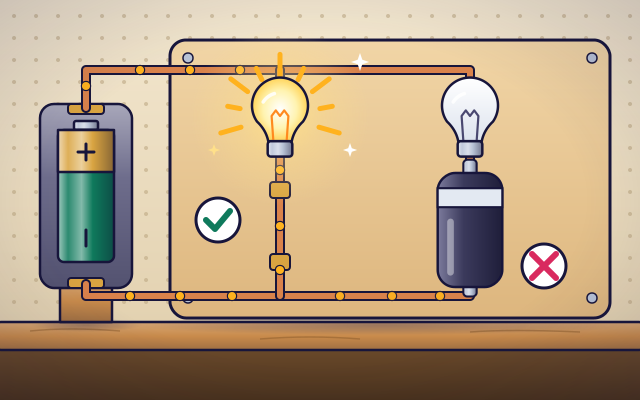
How do diodes guide electricity in one direction?
Reverse connections and compare current through a wire and a diode.
#379
Electricity & energy
How do diodes guide electricity in one direction?
Reverse connections and compare current through a wire and a diode.
 #380
Electricity & energy
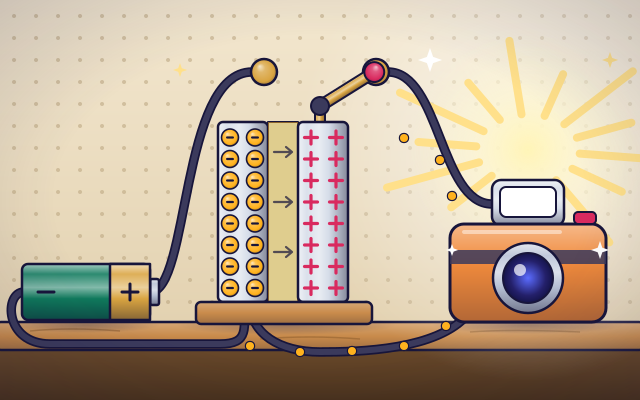
How do capacitors store and release energy?
Charge a virtual capacitor and use its stored energy for a brief action.
#380
Electricity & energy
How do capacitors store and release energy?
Charge a virtual capacitor and use its stored energy for a brief action.
 #381
Electricity & energy
How do resistors control current?
Change resistance and observe corresponding changes on a virtual current meter.
#381
Electricity & energy
How do resistors control current?
Change resistance and observe corresponding changes on a virtual current meter.
Keep exploring
Games to play next
- Circuit Workshop 3DWire up batteries, bulbs and switches on a 3D workbench.
- SwitchworksFlip switches to light the lamps in the target pattern — in as few presses as you can.
- Machine RepairFix levers, pulleys, gears and ramps so every contraption works.
Guide for grown-ups
- How to start homeschooling: a step-by-step guide for familiesA guide for parents · 7 min read
Science games by grade
Science worksheets by grade
- Preschool Science Worksheets
- Pre-K Science Worksheets
- Kindergarten Science Worksheets
- 1st Grade Science Worksheets
- 2nd Grade Science Worksheets
- 3rd Grade Science Worksheets
- 4th Grade Science Worksheets
- 5th Grade Science Worksheets
- 6th Grade Science Worksheets
- 7th Grade Science Worksheets
- 8th Grade Science Worksheets