How do transistors act as electronic switches?
Send a small signal to a transistor's gate and watch it switch on a much bigger current, with nothing moving but electrons.
The big idea: A transistor has three legs. A small signal on one leg, the gate, pulls electrons into a bridge between the other two. With the bridge in place, a much bigger current can flow. Take the signal away and the bridge is gone.
It's like a water tap: a small, easy turn of the handle controls a strong stream. A transistor's handle is a tiny electric signal on its gate.
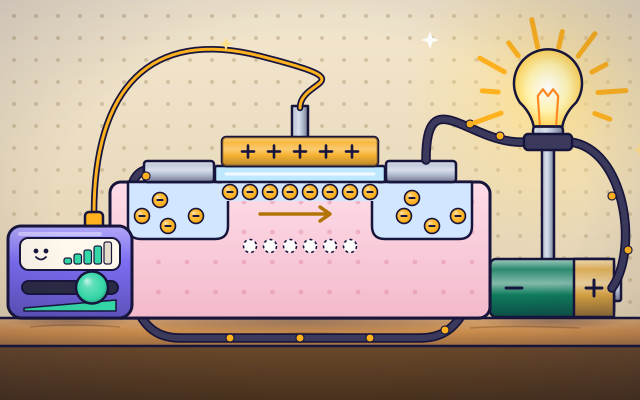
The interactive parts didn't load. The explanations below still work; try reloading the page.
A switch that electricity flips
- When you press a light switch, two pieces of metal touch and electricity flows to the lamp. But a computer needs billions of switches that flip millions of times a second. Fingers are far too slow!
- This is a transistor. It has three legs. Electricity wants to go in one leg and out another. The middle leg, called the gate, is in charge: it decides whether the path is open.
- Inside are two pools of electrons, the source and the drain, with a gap of different silicon between them. With no signal on the gate, electrons cannot cross the gap. The lamp stays off.
- Put a small positive signal on the gate. It pulls electrons up under the gate, where they form a thin bridge called the channel. Now current flows from source to drain, and the lamp lights.
- The gate signal is tiny, and almost no electricity flows into the gate. But it controls a much bigger current through the lamp. A weak signal can switch something strong, like a motor.
- One transistor's output can be the signal for the next. Chips link billions of them together. Each one is either on or off, a 1 or a 0, and patterns of ones and zeros do all of a computer's work.
Look inside a transistor
This is a giant model, sliced open. A real transistor in a chip is far too small to see. Tap each part.
- Gate. The gate is the control leg. A small positive signal on it pulls electrons into place below. Remove the signal and they drift away again.
- Insulating layer. A very thin layer of glass-like material sits between the gate and the silicon. Electricity cannot pass through it, so the gate can pull on the electrons without touching them.
- Source. The source is a pool of silicon with lots of spare electrons. It is where the electrons come in from the battery.
- Drain. The drain is a second pool on the other side of the gap. Electrons that cross the bridge leave through it and go on to the lamp.
- Channel. The channel is a thin bridge of electrons that forms just under the gate when the signal is on. With no signal there is no bridge, and no current.
- Silicon base. The body is a slice of silicon, the same element found in sand. It has been treated so that it has very few free electrons, which is what makes the gap.
A small signal, a big current
Drag the knob on the signal box to raise the gate signal, and find where the lamp switches on. Compare the tiny signal current with the lamp current. Then try switching the battery off.
Experiment: Almost no current flows into the gate. Can such a tiny signal still control a big current through the lamp?
- Start with the signal at zero. Is the lamp on?
- Slide the signal up slowly until the lamp lights.
- Read the signal current and the lamp current. Which is bigger?
What we found: Below about 1 volt nothing happens. Just above it, a bridge of electrons forms and the lamp lights. The signal current is almost zero, yet it controls hundreds of milliamps. That is what makes a transistor such a useful switch.
Turn on JavaScript to try it yourself.
Green on, red off
Choose which signals to switch on so the green lamp lights but the red lamp stays dark. Then press Power.
How a transistor switches
A transistor is a switch with no moving parts. An ordinary light switch needs a finger to push two pieces of metal together. A transistor is switched by electricity itself, so it can flip on and off billions of times a second, and it can be made unbelievably small.
The transistor in our model has three legs. Two of them, the source and the drain, are like the two ends of a broken road. They are pools of silicon with plenty of spare electrons, but between them is a gap with almost none, so no current can cross. The third leg, the gate, sits above the gap, separated from it by a very thin insulating layer.
When a small positive signal reaches the gate, it pulls electrons up toward it. They gather just under the insulating layer and form a thin bridge called the channel. Now electrons can travel from the source, across the bridge, to the drain, and on through the lamp. Take the signal away and the bridge disappears.
The clever part is that almost no electricity flows into the gate, because of the insulating layer. A tiny signal controls a much bigger current, a bit like a small tap handle controlling a strong stream of water. The comparison is not perfect: nothing turns inside a transistor, and the signal is a voltage, not a hand. Because one transistor can switch another, engineers connect billions of them on a chip. Each is on or off, a 1 or a 0, and those patterns do everything a computer does.
Key words
- Transistor
- An electronic switch with no moving parts. A small signal controls a larger current.
- Gate
- The control leg of a transistor. A signal here opens or closes the path.
- Source and drain
- The two legs the main current flows between: in at the source, out at the drain.
- Channel
- The thin bridge of electrons that forms under the gate when the signal is on.
- Threshold voltage
- The smallest gate signal that switches the transistor on.
- Logic gate
- A small group of transistors that makes a yes-or-no decision, such as AND (both) or OR (either).
Check your thinking
-
What does the gate of a transistor do?
Show the answer
It controls whether current can flow between the other two legs. A signal on the gate builds the bridge between source and drain. No signal, no bridge.
-
Why can a transistor switch much faster than a light switch?
Show the answer
It has no moving parts; only electrons move. Electrons are extremely light and only have to move a tiny distance, so a transistor can flip billions of times a second.
-
How many transistors are in a computer chip?
Show the answer
Billions. A chip in a phone or computer holds billions of tiny transistors.
-
How big is the signal current into the gate, compared with the lamp current?
Show the answer
Much smaller: almost zero. The insulating layer stops current flowing into the gate, yet the gate still controls the big current.
-
Two transistors are connected in a row, one after the other. When does the lamp light?
Show the answer
Only when both are on. The current has to pass through both. If either one is off, the path is broken.
-
Two transistors in parallel connect a lamp to the battery. Which logic do they give?
Show the answer
OR: the lamp lights if either gate is on. Each transistor offers its own path, so one open gate is enough.
You're a Electricity & energy expert!
You watched, looked inside, tried it, solved the challenge and went deeper. Pick another question below, or switch the age at the top to see this topic another way.
More about electricity & energy
 #379
Electricity & energy
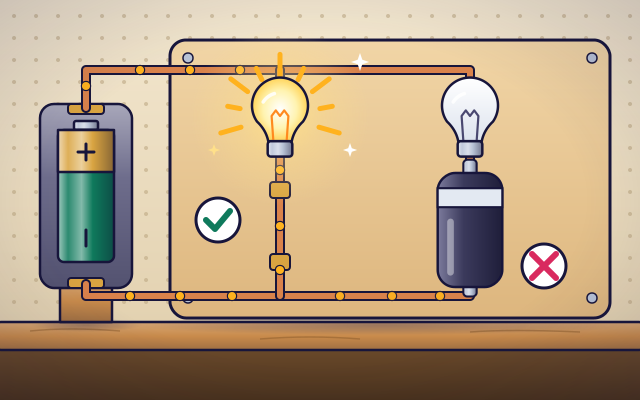
How do diodes guide electricity in one direction?
Reverse connections and compare current through a wire and a diode.
#379
Electricity & energy
How do diodes guide electricity in one direction?
Reverse connections and compare current through a wire and a diode.
 #380
Electricity & energy
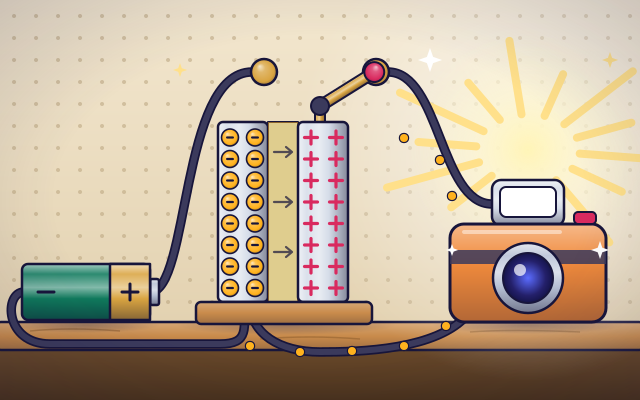
How do capacitors store and release energy?
Charge a virtual capacitor and use its stored energy for a brief action.
#380
Electricity & energy
How do capacitors store and release energy?
Charge a virtual capacitor and use its stored energy for a brief action.
 #381
Electricity & energy
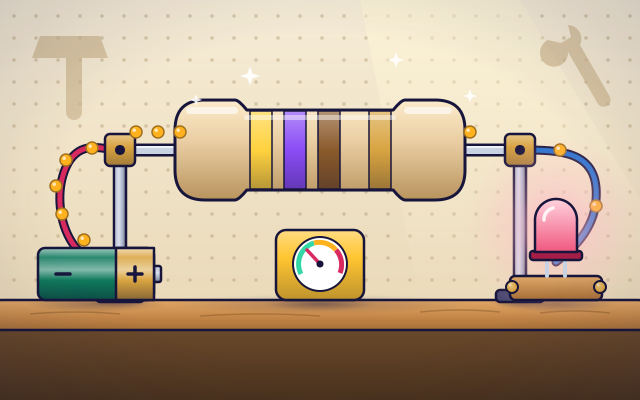
How do resistors control current?
Change resistance and observe corresponding changes on a virtual current meter.
#381
Electricity & energy
How do resistors control current?
Change resistance and observe corresponding changes on a virtual current meter.
 #382
Electricity & energy
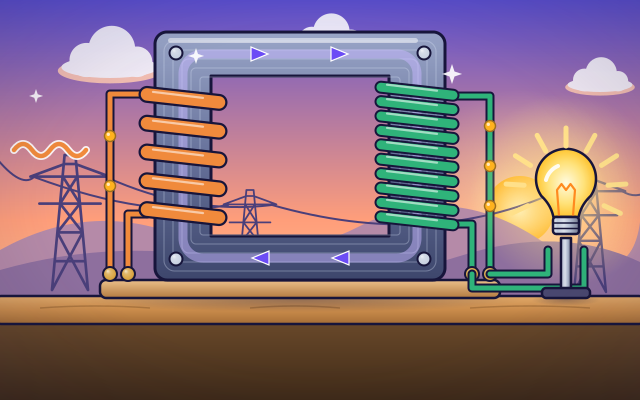
How do transformers change voltage?
Adjust turns in model coils and compare input and output voltages.
#382
Electricity & energy
How do transformers change voltage?
Adjust turns in model coils and compare input and output voltages.
Keep exploring
Games to play next
- SwitchworksFlip switches to light the lamps in the target pattern — in as few presses as you can.
- Circuit Workshop 3DWire up batteries, bulbs and switches on a 3D workbench.
- Machine RepairFix levers, pulleys, gears and ramps so every contraption works.
Guide for grown-ups
- How to start homeschooling: a step-by-step guide for familiesA guide for parents · 7 min read
Science games by grade
Science worksheets by grade
- Preschool Science Worksheets
- Pre-K Science Worksheets
- Kindergarten Science Worksheets
- 1st Grade Science Worksheets
- 2nd Grade Science Worksheets
- 3rd Grade Science Worksheets
- 4th Grade Science Worksheets
- 5th Grade Science Worksheets
- 6th Grade Science Worksheets
- 7th Grade Science Worksheets
- 8th Grade Science Worksheets