How do tornadoes form?
Winds that change with height make the air roll. A storm's rising air tips the roll upright, and the whole storm starts to spin.
The big idea: Wind that is slow near the ground and fast higher up makes a rolling tube of air. A strong updraft tips it upright, so the storm spins. Sometimes the spin gets tight and reaches the ground as a tornado.
It's like
The interactive parts didn't load. The explanations below still work; try reloading the page.
From rolling air to a tornado
- Tornadoes start with a special kind of thunderstorm. It needs warm, moist air near the ground, cooler air above it, and winds that change with height.
- Near the ground the wind is slow. Higher up it blows faster. The air in between starts to roll over, like a rolling pin on a table.
- The thunderstorm's strong updraft lifts the middle of the rolling tube and tips it upright. Now the rising air inside the storm spins too.
- The spinning air stretches and gets narrower, so it spins faster, like a skater pulling in their arms. A funnel reaches down. When it touches the ground, it is a tornado.
- A tornado travels across the land along with its storm, usually for just a few minutes. Then it gets thin like a rope and fades away.
- Weather scientists watch storms with radar and send warnings. If there is a tornado warning, go to a basement or a small room in the middle of the house, away from windows, and cover your head.
Inside a supercell thunderstorm
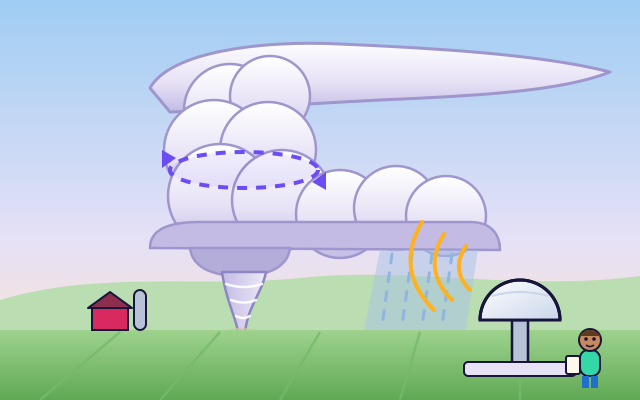
This is a simplified cutaway of a rotating thunderstorm. Tap each part to see what it does.
- Warm, moist inflow. Warm, moist air near the ground flows into the storm. The storm runs on the energy in this air.
- Updraft. The updraft is a column of rising air. In a supercell it can rise faster than a car on a highway, building a tall cloud.
- Mesocyclone. In a supercell the whole updraft slowly spins. This spinning part, a few kilometers wide, is called a mesocyclone.
- Anvil top. The rising air can't go higher than the top of the lower atmosphere, so it spreads out sideways into a flat anvil shape.
- Rain and hail. Heavy rain and sometimes hail fall in the front part of the storm, blown away from the updraft by the winds.
- Downdraft. Rain cools the air and drags it down. This cool, sinking air is a downdraft. It spreads out when it hits the ground.
- Wall cloud. Under the updraft, part of the cloud base hangs lower. This wall cloud often slowly turns. Storm spotters watch it closely.
- Tornado. A tornado is a narrow column of fast-spinning air reaching from the storm to the ground. We see it because of cloud droplets and dust swirling inside it.
- Wind shear. The wind is slow near the ground and fast high up. This change in the wind with height is called wind shear. It makes the air roll.
Spin up a storm: shear and updraft
Change the wind shear and the updraft. Watch the rolling tube of air and the storm. What makes the storm spin?
Experiment: What does a thunderstorm need to start spinning?
- Set the wind shear to none and the updraft to strong. Does the storm spin?
- Now make the wind shear strong.
- Try strong shear with a weak updraft too.
What we found: A storm needs both. Wind shear makes the air roll, but only a strong updraft can tip that roll upright. Strong rising air alone makes an ordinary thunderstorm that does not spin. Together they make a spinning supercell.
Turn on JavaScript to try it yourself.
Storm spotter
Tornadoes move with their storm. Look at the storm's track and the steering wind, then warn every place in its path before it arrives. Try not to warn places that are safe.
How a storm starts to spin
Most thunderstorms never spin. They need warm, moist air near the ground that wants to rise, and something to start lifting it. But for a storm to spin, it also needs wind shear: wind that is slow near the ground and much faster high up, and often blowing from a different direction too.
Wind shear makes the air between the slow and fast winds roll over, like a pencil rolling between your hands. This rolling tube of air lies flat along the ground. When a strong thunderstorm's updraft sucks air upward, it lifts the tube and tips it upright, and now the storm's rising air spins. A storm like this is called a supercell.
Inside a supercell the spinning air can stretch and get narrower. Like a skater pulling in their arms, it spins faster as it gets thinner. Sometimes a narrow, fast-spinning column reaches all the way to the ground: a tornado. Even so, most supercells never make a tornado, and scientists are still working out exactly why some do.
Weather scientists use radar to see storms spinning and send out warnings, often several minutes before a tornado arrives. Knowing your safe place, a basement or a small inside room on the lowest floor, away from windows, keeps families safe.
Key words
- Wind shear
- A change in wind speed or direction with height.
- Updraft
- A current of rising air inside a cloud.
- Supercell
- A big thunderstorm with a spinning updraft.
- Mesocyclone
- The spinning part of a supercell, a few kilometers wide.
- Vorticity
- How much the air is spinning.
- Tornado warning
- A message that a tornado is happening or may happen very soon nearby, so it is time to go to a safe place.
Check your thinking
-
Where should you go during a tornado warning?
Show the answer
A basement or small inside room on the lowest floor. Low, inside rooms put the most walls between you and the wind, and keep you away from flying glass.
-
What is wind shear?
Show the answer
Wind that changes speed or direction with height. Wind shear means the wind is different at different heights, which makes the air roll.
-
What tips the rolling tube of air upright?
Show the answer
The storm's updraft. Rising air lifts the middle of the roll and stands it up, so the storm spins.
-
Why does the spin get faster when the spinning air gets narrower?
Show the answer
Like a skater pulling in their arms, it speeds up. Pulling the spin in close makes it go faster, just like a twirling skater.
-
What is the difference between a tornado watch and a tornado warning?
Show the answer
A watch means conditions are favorable; a warning means take shelter now. During a watch, stay alert. During a warning, go to your safe place right away.
-
Who watches the storms to help keep us safe?
Show the answer
Weather scientists with radar. Weather scientists watch storms day and night and send warnings.
You're a Earth & weather expert!
You watched, looked inside, tried it, solved the challenge and went deeper. Pick another question below, or switch the age at the top to see this topic another way.
More about earth & weather
 #76
Earth & weather
How do rivers shape the land?
Guide flowing water across a landscape and watch erosion, sediment transport, and deposition. Change slope and flow to create bends, channels, and deltas.
#76
Earth & weather
How do rivers shape the land?
Guide flowing water across a landscape and watch erosion, sediment transport, and deposition. Change slope and flow to create bends, channels, and deltas.
 #77
Earth & weather
Why do ocean tides rise and fall?
Explore the Moon's and Sun's influence on a simplified ocean model. Move them into different positions and compare patterns of tidal change.
#77
Earth & weather
Why do ocean tides rise and fall?
Explore the Moon's and Sun's influence on a simplified ocean model. Move them into different positions and compare patterns of tidal change.
 #446
Earth & weather
How do snowflakes form?
Grow virtual ice crystals under different conditions and compare their branching patterns.
#446
Earth & weather
How do snowflakes form?
Grow virtual ice crystals under different conditions and compare their branching patterns.
 #447
Earth & weather
How do hailstones grow?
Follow an ice particle through a storm and watch additional layers accumulate.
#447
Earth & weather
How do hailstones grow?
Follow an ice particle through a storm and watch additional layers accumulate.
Keep exploring
Games to play next
- Weather LabPredict the weather in a box, then run a fair test to find out why.
- River MysterySomething changed the river. Sample sites with a limited budget, follow the evidence and find where the change begins.
- Seasons and SkiesFrom days of the week to Earth's tilt: dress for the weather, read the sky and discover why seasons happen.
Guide for grown-ups
- How to start homeschooling: a step-by-step guide for familiesA guide for parents · 7 min read
Science games by grade
Science worksheets by grade
- Preschool Science Worksheets
- Pre-K Science Worksheets
- Kindergarten Science Worksheets
- 1st Grade Science Worksheets
- 2nd Grade Science Worksheets
- 3rd Grade Science Worksheets
- 4th Grade Science Worksheets
- 5th Grade Science Worksheets
- 6th Grade Science Worksheets
- 7th Grade Science Worksheets
- 8th Grade Science Worksheets