How does the lymphatic system move fluid?
A second set of tubes gathers fluid that leaks out of your blood, cleans it and returns it, pushed along by your moving muscles.
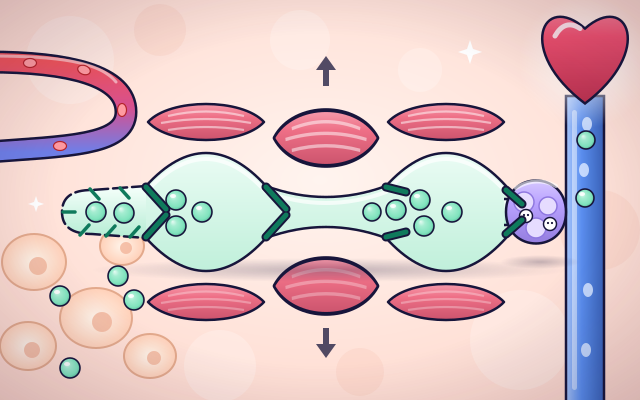
The big idea: Fluid that leaks out of blood is collected by lymph vessels. Muscles squeeze the vessels, and one-way valves stop the fluid from sliding back, so it travels toward the heart.
It's like a turnstile at a stadium: the crowd can push through in one direction, but the gate will not turn backward.
The interactive parts didn't load. The explanations below still work; try reloading the page.
Your second set of tubes
- Kai has blood vessels all through his body. He also has a second set of tubes, shown here in green: lymph vessels. What are they for?
- Zoom in on Kai's arm. The thinnest blood vessels, capillaries, leak a little watery fluid. It bathes the cells and brings them what they need.
- Lymph capillaries collect the leftover fluid. Their walls are made of overlapping flaps: fluid can push its way in, but it cannot get back out. Now it is called lymph.
- There is no heart to pump lymph. When Kai moves, his muscles squeeze the vessel. The valve ahead opens, and the valve behind snaps shut, so lymph can only move forward.
- The lymph passes through bean-shaped lymph nodes. Inside, guard cells check the fluid and catch germs. That is why nodes in your neck can swell when you have a cold.
- At last the vessels join big veins near the collarbones, and the clean fluid is back in the blood. Every time you move, you help it along.
From tissue back to blood
Tap each part to trace the fluid from the blood, through the lymph vessels and back again.
- Blood capillary. Capillaries are the thinnest blood vessels. A little watery fluid leaks through their walls to reach the cells.
- Tissue fluid. The leaked fluid surrounds every cell. It carries food and oxygen to the cells and takes wastes away.
- Lymph capillary. A lymph capillary is a tiny tube closed at one end. Flaps in its wall let fluid in but not out.
- Lymph vessel. Lymph vessels look like strings of beads. Each bead is a little chamber between two valves.
- One-way valve. Each valve has two flaps. Lymph moving forward pushes them open. Lymph trying to slide back pushes them shut.
- Muscle. Lymph vessels run between muscles. Each time a muscle tightens, it squeezes the vessel and pushes the lymph along.
- Lymph node. Lymph nodes are filters. Guard cells inside catch germs and bits of rubbish before the fluid goes back to the blood.
- Vein to the heart. The biggest lymph vessels empty into large veins near the collarbones. The fluid is blood again.
Muscles, valves and lymph
Tap the muscles to squeeze the vessel. Then switch the valves off and try again. What changes?
Experiment: The valves are switched off and the arm hangs down. You squeeze a muscle. What happens to the lymph?
- Tap the three muscles one after another, from the hand end toward the heart.
- Watch the drops reach the vein.
- Switch off Valves working and tap the muscles again.
What we found: A squeeze pushes lymph in both directions. With valves, the way back is shut, so every squeeze moves the lymph forward. Without valves, it just sloshes and gravity pulls it back down.
Turn on JavaScript to try it yourself.
Drain the puffy hand
After a long car ride, Kai's hand is a little puffy. Send all 10 drops back to the vein. You only have 14 squeezes, so do not waste any.
How lymph gets home
Your blood travels in tubes, but the thinnest ones, the capillaries, are a little leaky on purpose. Watery fluid seeps out and washes around your cells, bringing them food and oxygen. Most of that fluid goes straight back into the blood. A few liters every day are left over.
The leftover fluid is collected by lymph capillaries, tiny tubes that are closed at one end. Flaps in their walls let fluid in and keep it in. From there it flows into bigger lymph vessels that look like strings of beads, because they are full of one-way valves.
Blood has the heart to pump it, but lymph has no pump of its own. It is pushed by squeezing: your muscles when you move, your chest when you breathe, and the gentle squeezing of the vessel walls themselves. Each squeeze pushes lymph forward past a valve, and the valve shuts so it cannot slide back.
On the way, the lymph passes through lymph nodes, where guard cells catch germs. Finally it pours into big veins near your collarbones. The toothpaste and turnstile comparisons are not perfect: a turnstile lets through one person at a time, but a valve is opened and closed just by the push of the fluid, with no one in charge.
Key words
- Lymph
- The watery fluid inside lymph vessels.
- Capillary
- The thinnest kind of vessel. Blood capillaries leak fluid; lymph capillaries collect it.
- Valve
- A pair of flaps that lets fluid through in one direction only.
- Lymph node
- A small bean-shaped filter where guard cells catch germs.
- Tissue fluid
- The fluid in the spaces between the body's cells.
Check your thinking
-
What pushes lymph along its vessels?
Show the answer
Squeezing by muscles when you move. Lymph has no heart of its own. Muscles, breathing and the vessel walls squeeze it along.
-
What would happen if a lymph vessel in your leg had no valves?
Show the answer
The lymph would slosh and slide back down. A squeeze pushes in both directions. Only the valves stop the lymph from going back.
-
Why might the nodes in your neck swell when you have a sore throat?
Show the answer
Guard cells inside are busy catching germs. Nodes are filters. When there are germs to catch, the guard cells multiply and the node gets bigger for a while.
-
Where does lymph finally go?
Show the answer
Into big veins near the collarbones. The biggest lymph vessels join veins near the collarbones, so the fluid becomes part of the blood again.
-
After a long flight, a passenger's ankles are slightly puffy. Which explanation fits best?
Show the answer
Sitting still meant few muscle squeezes, so tissue fluid drained slowly against gravity. Lymph flow depends on movement. With little muscle pumping, fluid builds up in the lowest parts of the body until the person walks again.
You're a Human body expert!
You watched, looked inside, tried it, solved the challenge and went deeper. Pick another question below, or switch the age at the top to see this topic another way.
More about human body
 #273
Human body
How do cells release energy from food?
Follow a simplified cellular-respiration pathway and connect energy release to cell activities.
#273
Human body
How do cells release energy from food?
Follow a simplified cellular-respiration pathway and connect energy release to cell activities.
 #274
Human body
How do cells build proteins?
Follow a message from DNA to a ribosome and assemble an amino-acid chain.
#274
Human body
How do cells build proteins?
Follow a message from DNA to a ribosome and assemble an amino-acid chain.
 #275
Human body
How does skin make its pigment?
Explore pigment-producing cells and follow melanin into surrounding skin cells.
#275
Human body
How does skin make its pigment?
Explore pigment-producing cells and follow melanin into surrounding skin cells.
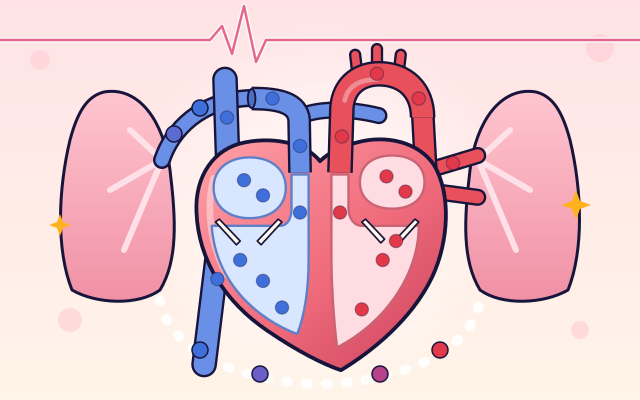 #84
Human body
How does the heart pump blood?
Follow blood through the heart, lungs, and body. Explore chambers and valves, and compare a resting heartbeat with one during exercise.
#84
Human body
How does the heart pump blood?
Follow blood through the heart, lungs, and body. Explore chambers and valves, and compare a resting heartbeat with one during exercise.
Keep exploring
Games to play next
- Body ExplorerTap, match and label your way around the amazing human body.
- Label LabPut the right labels on beautiful science diagrams, from bean plants to heart chambers.
- Science QuizzesOlly's Science Quiz Show: plants, animals, the body, weather, space and more, for every grade.
Guide for grown-ups
- How to start homeschooling: a step-by-step guide for familiesA guide for parents · 7 min read
Science games by grade
Science worksheets by grade
- Preschool Science Worksheets
- Pre-K Science Worksheets
- Kindergarten Science Worksheets
- 1st Grade Science Worksheets
- 2nd Grade Science Worksheets
- 3rd Grade Science Worksheets
- 4th Grade Science Worksheets
- 5th Grade Science Worksheets
- 6th Grade Science Worksheets
- 7th Grade Science Worksheets
- 8th Grade Science Worksheets