How does a magnifying glass enlarge things?
A magnifying glass is a lens that is fat in the middle. It bends light so small things look bigger.
The big idea: A lens that bulges in the middle bends light rays inward. Hold it close to something and the bent rays seem to come from a bigger thing farther back.
It's like a round drop of water on a page: the curved drop bends the light, so the letter under it looks bigger. A lens is a drop made of glass.
The interactive parts didn't load. The explanations below still work; try reloading the page.
How a magnifying glass works
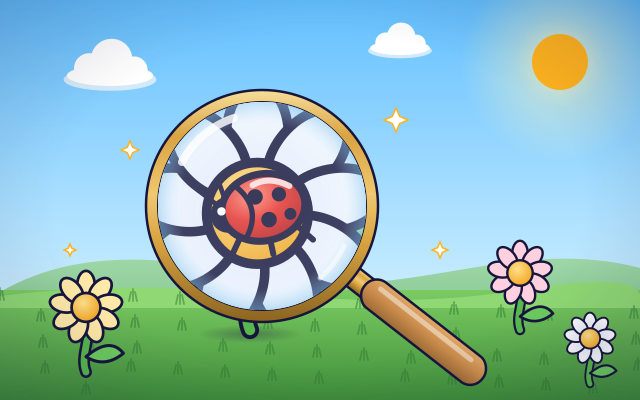
- A ladybug is too small to see its spots clearly. Look through a magnifying glass and it seems to grow. But the ladybug has not changed at all.
- From the side, the secret shows. The glass is thick in the middle and thin at the edge. A piece of glass with this shape is called a lens.
- Light bends as it goes into glass and bends again as it comes out. The curved lens bends every ray inward, so they meet at one spot: the focus.
- Hold the lens close to a flower. The rays bend, then reach your eye. Your brain follows them straight back, and they seem to come from a much bigger flower.
- Now move the lens away. Near the focus everything blurs. Farther still, the rays cross over before they reach you, so the picture is upside down.
- So a magnifying glass is a fat lens held close. It bends light inward, and your brain sees a bigger picture. Never look at the Sun through it!
Look inside the light path
Here is a magnifying glass seen from the side, with a flower in front of it. Tap each part to see what it does.
- Lens. A piece of clear glass or plastic that bulges on both sides. Its curved surfaces bend light inward.
- Rim. The rim holds the lens by its thin edge and protects it from knocks.
- Handle. The handle lets you hold the lens at just the right distance, without leaving fingerprints on the glass.
- The real flower. The real flower. Light bounces off it in every direction, and some of that light goes through the lens.
- Focus points. A lens has a focus on each side. Light that arrives straight and level is bent to pass through the focus on the far side.
- Bent rays. Two of the many rays that leave the ladybug. The lens bends both of them inward, toward your eye, but they are still spreading apart when they arrive.
- The big picture. Follow the bent rays straight back and they meet here. This is the bigger flower your brain sees. It is the right way up.
Lens bench: near and far
Drag the lens, or the flower, along the rail. Watch the round window to see what your eye would see. What happens near the focus, and beyond it?
Experiment: What happens to the picture as you pull the lens farther and farther from the flower?
- Start with the lens close to the flower. How big is the picture?
- Slide the lens slowly away until it reaches the orange focus dot.
- Keep going. What has happened to the flower?
What we found: Close to the flower, the lens makes it look a bit bigger. Farther away it looks bigger still, until the flower sits at the focus and everything blurs. Beyond the focus the rays cross over, so the picture is upside down, and it shrinks as the lens moves away.
Turn on JavaScript to try it yourself.
Photo detective
Take two photos through the lens. First: the flower 3 times bigger, the right way up. Then: upside down, the same size as the real flower.
How a lens makes things look bigger
Light travels in straight lines through air. But when it goes from air into glass at a slant, it changes direction. It bends again on the way out. This bending is called refraction, and it is why a straw looks broken in a glass of water.
A magnifying glass is a lens: a piece of glass that is fat in the middle and thin at the edge. Because its surfaces are curved, it bends each ray by a different amount. Rays near the edge are bent the most, and all of them lean in toward the middle. Rays that arrive straight and level meet at one spot called the focus.
Hold the lens close to a flower, closer than the focus. Light from the flower spreads out, goes through the lens and is bent inward a little, but the rays are still spreading when they reach your eye. Your brain always assumes light came in a straight line, so it follows the rays back, and they seem to come from a bigger flower farther away.
Move the lens away and the picture grows, then turns to a blur when the flower sits at the focus. Beyond that, the rays cross before they reach you, and the picture is upside down. The water drop comparison only goes so far: a drop is a wobbly, fat lens, so its picture is small and smeary. And one rule matters more than any other: never look at the Sun through a lens, and never leave one lying in sunshine.
Key words
- Lens
- A curved piece of glass or plastic that bends light.
- Refraction
- The bending of light when it goes from one clear material into another.
- Focus
- The spot where a lens brings level rays of light together.
- Focal length
- The distance from the middle of a lens to its focus. Fatter lenses have shorter focal lengths.
- Magnification
- How many times bigger the picture looks than the real thing.
- Virtual image
- A picture your eye sees where no light really meets, like the big flower behind a magnifying glass.
Check your thinking
-
What does a magnifying glass do to the light that passes through it?
Show the answer
It bends the rays inward. The lens bends the rays inward. The object itself never changes.
-
To make a stamp look bigger and the right way up, where should the lens be?
Show the answer
Close to the stamp, nearer than the focus. Inside the focus the picture is bigger and upright. Past the focus it flips upside down.
-
You hold a magnifying glass at arm's length and look at a tree far away. What do you see?
Show the answer
A small, upside-down tree. The tree is far beyond the focus, so the rays cross over and the picture is upside down and small.
-
Two lenses are the same width, but one is much fatter in the middle. What is different about the fat one?
Show the answer
It bends light more, so its focus is closer. A fatter lens has steeper curves, so it bends the rays more and they meet sooner.
-
Why must you never look at the Sun through a magnifying glass?
Show the answer
The lens gathers the sunlight into one tiny, very hot, very bright spot. All the sunlight that hits the lens is squeezed into one spot. That can badly hurt eyes and can start fires.
You're a Light & sound expert!
You watched, looked inside, tried it, solved the challenge and went deeper. Pick another question below, or switch the age at the top to see this topic another way.
More about light & sound
 #428
Light & sound
How does a prism separate colors?
Guide white light through a prism and follow different colors' paths.
#428
Light & sound
How does a prism separate colors?
Guide white light through a prism and follow different colors' paths.
 #429
Light & sound
How do shadows change size and shape?
Move a light and object and compare the resulting shadow.
#429
Light & sound
How do shadows change size and shape?
Move a light and object and compare the resulting shadow.
 #430
Light & sound
How do periscopes let us see over obstacles?
Arrange mirrors inside a tube and trace the reflected view.
#430
Light & sound
How do periscopes let us see over obstacles?
Arrange mirrors inside a tube and trace the reflected view.
 #431
Light & sound
How do polarized sunglasses reduce glare?
Rotate virtual polarizing filters and compare reflected light passing through them.
#431
Light & sound
How do polarized sunglasses reduce glare?
Rotate virtual polarizing filters and compare reflected light passing through them.
Keep exploring
Games to play next
- Mirror MazeBend a beam of light with mirrors to light up every crystal — in the right order.
- Shadow SculptorStack cubes under three lamps until every shadow matches the outline.
- Listen and FindOlly whispers a clue or plays a sound. Can you find it in the picture?
Guide for grown-ups
- How to start homeschooling: a step-by-step guide for familiesA guide for parents · 7 min read
Science games by grade
Science worksheets by grade
- Preschool Science Worksheets
- Pre-K Science Worksheets
- Kindergarten Science Worksheets
- 1st Grade Science Worksheets
- 2nd Grade Science Worksheets
- 3rd Grade Science Worksheets
- 4th Grade Science Worksheets
- 5th Grade Science Worksheets
- 6th Grade Science Worksheets
- 7th Grade Science Worksheets
- 8th Grade Science Worksheets