How do periscopes let us see over obstacles?
Two tilted mirrors in a tube bounce light down to your eye, so you can see over walls and around corners.
The big idea: Light travels in straight lines, so it cannot bend over a wall. A periscope turns it with two mirrors, each tilted halfway: one sends the light down the tube, the other sends it out to your eye.
It's like a ball bounced off two walls to get around a corner: one bounce turns it, the second bounce turns it again and sends it to you.
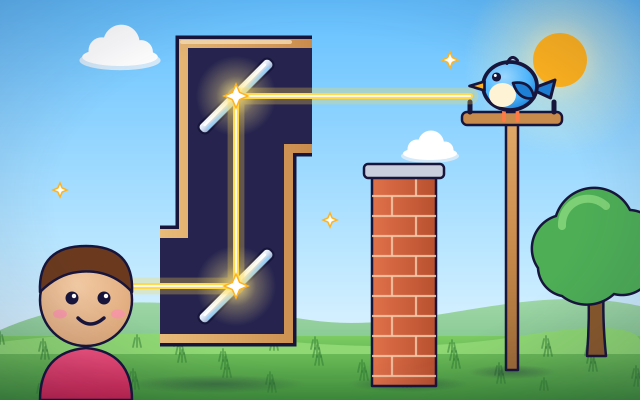
The interactive parts didn't load. The explanations below still work; try reloading the page.
How a periscope sees over a wall
- Mia can hear a bird on the other side of the wall, but the wall is taller than she is. Light from the bird travels straight, right over her head.
- A periscope is a tall tube with a window at the top, a window at the bottom, and a mirror behind each one. Both mirrors are tilted the same way.
- Light from the bird goes in the top window and hits the top mirror. Because the mirror is tilted halfway, the light makes a square turn and heads straight down.
- At the bottom the light hits the second mirror and makes another square turn, out through the window and into Mia's eye. She sees the bird!
- One mirror on its own flips the picture. But a periscope has two, and the second flips it back again, so Mia sees the bird the right way up.
- Submarines use the same idea. The periscope pokes up above the waves while the crew stays hidden below, and two bounces carry the view down to them.
Look inside a periscope
The front of this periscope has been cut away. Tap each part to see what it does.
- Top window. The opening at the top. It sits higher than the wall, so light from the bird can get in.
- Top mirror. A flat mirror tilted halfway between level and upright. It turns the light from sideways to straight down.
- Tube. The tube holds the two mirrors exactly in line. It is dark inside, so stray light does not spoil the view.
- Bottom mirror. A second mirror, tilted the same way as the top one. It turns the light from straight down to sideways again.
- Eyepiece. The opening at the bottom, where you put your eye. The light comes out here.
- Path of the light. The light's whole trip: in through the top, a square turn at each mirror, and out at the bottom. It looks like a letter Z.
Build a periscope: set the mirrors
Turn each mirror and trace where the light goes. Which tilts send it down the tube and out to the eye?
Experiment: How should the two mirrors be tilted so that the light reaches the eye?
- Turn the top mirror until the light goes straight down the middle of the tube.
- Turn the bottom mirror until the light comes out level, toward the eye.
- Now spoil one mirror a little. What does Mia see?
What we found: The light only reaches the eye when both mirrors are tilted halfway, at 45 degrees, facing each other. Then each one turns the light through a square corner: sideways to down, and down to sideways.
Turn on JavaScript to try it yourself.
The bendy tube
This tube has four corners. Tap each mirror to set its tilt, then press Look! Get the light to Mia's eye in as few looks as you can.
How a periscope turns light
You see things when light from them reaches your eyes. Light travels in straight lines, so if a wall is in the way, the light from the other side sails over your head and you see nothing but wall.
A periscope fixes that with two flat mirrors in a tube. A mirror bounces light so that it leaves at the same slant it arrived. If you tilt a mirror exactly halfway between level and upright, at 45 degrees, light coming in sideways bounces straight down. That is a square turn.
At the bottom of the tube a second mirror, tilted the same way, gives the light another square turn, back to sideways and out to your eye. The light has made a Z shape. Now you can look straight ahead and see what is happening high above you.
One mirror alone would show the picture flipped over. The second mirror flips it back, so everything looks the right way up. Submarines have used periscopes to look above the waves while staying hidden, and people use them to see over crowds. The bouncing ball comparison is not perfect: a ball slows down and drops, but light keeps going straight and fast, however long the tube.
Key words
- Periscope
- A tube with mirrors or prisms that lets you see over or around something that is in the way.
- Reflection
- Light bouncing off a surface.
- Right angle
- A square corner, like the corner of a book: 90 degrees.
- Parallel
- Tilted exactly the same way, like the two rails of a railway track.
- Normal
- A line sticking straight out of a mirror, at a right angle to it.
- Field of view
- How much of the scene you can see at once.
Check your thinking
-
Why can't you see over a tall wall without a periscope?
Show the answer
Light travels in straight lines, so it cannot bend down over the wall to your eyes. Light goes straight. The light from behind the wall passes over your head.
-
How must each mirror in a periscope be tilted?
Show the answer
Halfway between flat and upright, so the light makes a square turn. A mirror tilted halfway (45 degrees) turns the light through a square corner.
-
The bottom mirror gets knocked so it lies flat. What does Mia see now?
Show the answer
Nothing: the light bounces back up the tube. A flat mirror sends the light straight back the way it came, so none comes out to the eye.
-
Why does a periscope show things the right way up?
Show the answer
The first mirror flips the picture and the second flips it back. Two flips bring the picture back to the way it started.
-
You make a periscope twice as long with the same mirrors. What changes?
Show the answer
You can see over taller things, but less of the scene fits in view. A longer tube reaches higher, but it is like looking down a longer straw: you see a smaller patch.
You're a Light & sound expert!
You watched, looked inside, tried it, solved the challenge and went deeper. Pick another question below, or switch the age at the top to see this topic another way.
More about light & sound
 #431
Light & sound
How do polarized sunglasses reduce glare?
Rotate virtual polarizing filters and compare reflected light passing through them.
#431
Light & sound
How do polarized sunglasses reduce glare?
Rotate virtual polarizing filters and compare reflected light passing through them.
 #432
Light & sound
Why is the sky blue and a sunset red?
Follow sunlight through different atmospheric paths and explore scattering.
#432
Light & sound
Why is the sky blue and a sunset red?
Follow sunlight through different atmospheric paths and explore scattering.
 #433
Light & sound
How do colored lights combine?
Overlap red, green, and blue beams to create different colors.
#433
Light & sound
How do colored lights combine?
Overlap red, green, and blue beams to create different colors.
 #434
Light & sound
How do color filters change what we see?
Place filters over lights and objects and compare transmitted colors.
#434
Light & sound
How do color filters change what we see?
Place filters over lights and objects and compare transmitted colors.
Keep exploring
Games to play next
- Mirror MazeBend a beam of light with mirrors to light up every crystal — in the right order.
- Shadow SculptorStack cubes under three lamps until every shadow matches the outline.
- Listen and FindOlly whispers a clue or plays a sound. Can you find it in the picture?
Guide for grown-ups
- How to start homeschooling: a step-by-step guide for familiesA guide for parents · 7 min read
Science games by grade
Science worksheets by grade
- Preschool Science Worksheets
- Pre-K Science Worksheets
- Kindergarten Science Worksheets
- 1st Grade Science Worksheets
- 2nd Grade Science Worksheets
- 3rd Grade Science Worksheets
- 4th Grade Science Worksheets
- 5th Grade Science Worksheets
- 6th Grade Science Worksheets
- 7th Grade Science Worksheets
- 8th Grade Science Worksheets