How does a prism separate colors?
White light is all the colors mixed together. A prism bends each color by a different amount and spreads them out.
The big idea: Glass bends light. It bends violet light a little more than red light, so a prism spreads white light into a band of colors.
It's like a toy cart rolling at a slant from smooth floor onto thick carpet: one wheel slows first, so the cart turns. Each color of light turns a different amount.
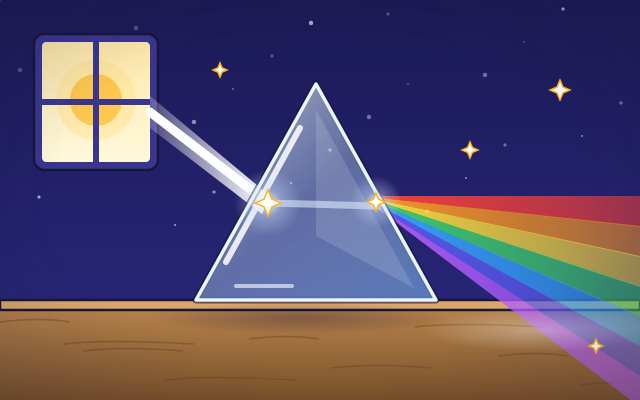
The interactive parts didn't load. The explanations below still work; try reloading the page.
How a prism makes a rainbow
- A beam of sunlight shines through a glass prism on the windowsill, and a band of colors appears on the wall. Where did the colors come from?
- White light is really many colors travelling together. Red, orange, yellow, green, blue and violet all mixed up look white to your eyes.
- Roll a cart at a slant onto carpet. One wheel slows first, so the cart turns. Light slows down in glass, so it turns in just the same way.
- Here is the trick. Glass slows violet light a bit more than red light. So violet bends the most, red bends the least, and the colors fan out.
- On a screen, the colors line up in order: red, orange, yellow, green, blue, indigo and violet. This band of colors is called a spectrum.
- A rainbow in the sky is made the same way. Sunlight goes into each raindrop, bends, bounces off the back, and bends again on the way out, spread into colors.
Look inside the light path
A lamp sends a thin beam of white light through a prism onto a screen. Tap each part to see what happens there.
- Lamp with a slit. A lamp in a box with a narrow slit. Only a thin beam of white light gets out, so its path is easy to follow.
- White beam. The white beam. All the colors travel together along the same path, so you cannot tell them apart yet.
- Prism. A solid block of clear glass shaped like a triangle. Its slanted faces are what make it special.
- Way in. The beam enters the glass at a slant. It slows down and bends. The colors begin to part, but only a tiny bit.
- Way out. Leaving the glass, the light speeds up and bends again, the same way as before. The colors spread farther apart.
- Red light. Red light is slowed the least by glass, so it bends the least. It always lands at one end of the rainbow.
- Violet light. Violet light is slowed the most, so it bends the most. It always lands at the opposite end from red.
- Screen. A white card catches the colors. The farther it is from the prism, the wider the rainbow.
Light table: turn the prism
Turn the prism and watch the colors move. Then send just one color through and follow its path.
Experiment: Which color of light does a prism bend the most?
- Turn the prism until all the colors land on the screen.
- Pick the red light, then the violet light. Which one is turned farther from the straight path?
- Go back to white light. Where on the screen do red and violet land?
What we found: Violet light bends the most and red the least, with the other colors in order in between. That is why a prism always makes the colors in the same order.
Turn on JavaScript to try it yourself.
Light the three lanterns
Each lantern glows only in its own color. Turn the prism and slide the lantern rack until red, green and violet all glow. Then press Lock it in.
Why a prism makes colors
Sunlight and lamp light look white, but white light is really a mixture. Long ago, a scientist named Isaac Newton let a thin beam of sunlight into a dark room and through a glass prism. A band of colors appeared on the wall. He then used a second prism to squeeze the colors back together, and the light turned white again.
The colors separate because of bending. Light travels a little more slowly in glass than in air. When a beam hits glass at a slant, it turns, the way a cart turns when one wheel rolls onto carpet before the other. This bending is called refraction.
Here is the key: glass slows each color by a slightly different amount. Violet light is slowed the most, so it bends the most. Red is slowed the least, so it bends the least. Orange, yellow, green and blue fall in order between them. That is why the colors of a spectrum always come in the same order.
A flat window does not make rainbows, because the light bends one way going in and bends straight back coming out. A prism's faces are tilted, so both bends go the same way and the colors keep spreading. Raindrops work in a similar way: sunlight bends going into the drop, bounces off the back and bends again coming out, and millions of drops together paint a rainbow. The cart comparison has a limit, though: it cannot explain why colors differ. For that you need to think of light as waves.
Key words
- Prism
- A block of clear glass or plastic with flat faces that are tilted toward each other.
- Refraction
- The bending of light when it passes from one clear material into another.
- Spectrum
- The band of colors you get when white light is spread out.
- Dispersion
- The spreading of white light into its colors.
- Refractive index
- A number that tells how much a material slows light. A bigger number means more bending.
- Deviation
- The angle a ray has been turned through, compared with the straight path it started on.
Check your thinking
-
Where do the colors come from when white light passes through a prism?
Show the answer
They were already in the white light, mixed together. White light is a mixture of colors. The prism only spreads them out.
-
Which color of light is bent the most by a prism, and which the least?
Show the answer
Violet the most, red the least. Glass slows violet light the most, so it turns the most. Red is slowed the least.
-
Why doesn't a flat window pane make a rainbow like a prism does?
Show the answer
The light bends going in and bends straight back coming out. With flat, parallel sides the two bends cancel out. A prism's tilted sides bend the light the same way twice.
-
You move the screen farther away from the prism. What happens to the rainbow on it?
Show the answer
It gets wider. The colors leave the prism in slightly different directions, so the farther they travel, the farther apart they get.
-
What plays the part of the prism when a rainbow appears in the sky?
Show the answer
Millions of raindrops. Each raindrop bends the sunlight and spreads its colors, just like a tiny prism.
You're a Light & sound expert!
You watched, looked inside, tried it, solved the challenge and went deeper. Pick another question below, or switch the age at the top to see this topic another way.
More about light & sound
 #429
Light & sound
How do shadows change size and shape?
Move a light and object and compare the resulting shadow.
#429
Light & sound
How do shadows change size and shape?
Move a light and object and compare the resulting shadow.
 #430
Light & sound
How do periscopes let us see over obstacles?
Arrange mirrors inside a tube and trace the reflected view.
#430
Light & sound
How do periscopes let us see over obstacles?
Arrange mirrors inside a tube and trace the reflected view.
 #431
Light & sound
How do polarized sunglasses reduce glare?
Rotate virtual polarizing filters and compare reflected light passing through them.
#431
Light & sound
How do polarized sunglasses reduce glare?
Rotate virtual polarizing filters and compare reflected light passing through them.
 #432
Light & sound
Why is the sky blue and a sunset red?
Follow sunlight through different atmospheric paths and explore scattering.
#432
Light & sound
Why is the sky blue and a sunset red?
Follow sunlight through different atmospheric paths and explore scattering.
Keep exploring
Games to play next
- Mirror MazeBend a beam of light with mirrors to light up every crystal — in the right order.
- Shadow SculptorStack cubes under three lamps until every shadow matches the outline.
- Listen and FindOlly whispers a clue or plays a sound. Can you find it in the picture?
Guide for grown-ups
- How to start homeschooling: a step-by-step guide for familiesA guide for parents · 7 min read
Science games by grade
Science worksheets by grade
- Preschool Science Worksheets
- Pre-K Science Worksheets
- Kindergarten Science Worksheets
- 1st Grade Science Worksheets
- 2nd Grade Science Worksheets
- 3rd Grade Science Worksheets
- 4th Grade Science Worksheets
- 5th Grade Science Worksheets
- 6th Grade Science Worksheets
- 7th Grade Science Worksheets
- 8th Grade Science Worksheets