How do shadows change size and shape?
Light travels in straight lines. When something gets in its way, a dark shadow appears behind it.
The big idea: Light travels in straight lines and cannot bend around a solid thing. The place the light cannot reach is the shadow. Move the thing closer to the lamp and its shadow grows.
It's like an umbrella in the rain: rain falls straight and cannot get through, so the ground under it stays dry. A shadow is a patch that light cannot reach.
The interactive parts didn't load. The explanations below still work; try reloading the page.
How shadows are made
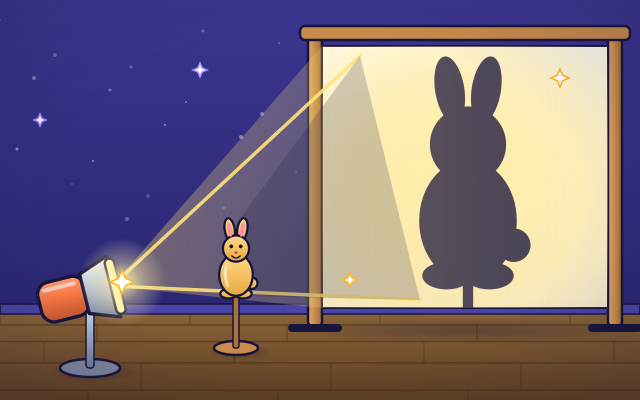
- In a dim room, a lamp shines on a paper bunny. On the screen behind it is a dark bunny shape. That is the puppet's shadow. Where does it come from?
- Light leaves a lamp in every direction, and each bit of it travels in a perfectly straight line. It does not curve or turn corners.
- The paper bunny is solid, so the rays that hit it stop. The rays that miss carry on to the screen. Behind the bunny is a space with no light: a shadow.
- Close to the lamp, the bunny blocks a wide slice of the light, so its shadow is huge. Close to the screen, it blocks a narrow slice and the shadow is nearly its own size.
- Outside, the Sun is your lamp. When it is low in the sky, its light comes in at a slant and shadows stretch out long. At midday it is high, and shadows are short.
- A tiny lamp makes a shadow with a crisp edge. A big lamp makes a fuzzy edge, because near the edge only part of the lamp is hidden.
Look inside a shadow
Here is a shadow theater: a lamp, a puppet and a screen. Tap each part to see what it does.
- Lamp. The light source. Every shadow needs one. Light streams out of it in straight lines.
- Light rays. These two rays just skim the top and bottom of the puppet. They show where the edge of the shadow will be.
- Puppet. The puppet is cut from thick card. No light gets through it, so we call it opaque. Clear things like glass make hardly any shadow.
- Dark space. A shadow is not only on the screen. The whole space behind the puppet is dark. Put your hand in it and your hand goes dark too.
- Shadow. Where the dark space meets the screen, you see the shadow. It has the puppet's shape, only bigger.
- Fuzzy edge. Look closely at the edge. It is slightly blurred, because the lamp is not a single tiny point of light.
- Screen. A white sheet that catches the light. Where light lands it looks bright. Where none lands you see the shadow.
Shadow theater: move the puppet and the lamp
Drag the puppet and the lamp. Turn the puppet. How do the size and the shape of the shadow change?
Experiment: What happens to the shadow when the puppet moves closer to the lamp?
- Put the puppet close to the screen. Compare the shadow with the dotted outline of the puppet's real size.
- Slide the puppet toward the lamp and watch the shadow.
- Now turn the puppet sideways. What happens to the shape?
What we found: The closer the puppet is to the lamp, the bigger its shadow, because it blocks a wider slice of the spreading light. Turning the puppet changes the shadow's shape: edge-on, it is just a thin line.
Turn on JavaScript to try it yourself.
Shadow match
Make the shadow match the dotted outline: the right size and the right shape. Then press Check.
Why shadows change
Light travels in straight lines. You can see this when sunbeams shine through gaps in clouds or dusty air. Because light cannot bend around a solid thing, anything that is not see-through leaves a dark space behind it. That dark space is a shadow.
A shadow has the same outline as the thing that makes it, as seen from the lamp. Turn a paper plate to face the lamp and its shadow is a circle. Turn it sideways and the shadow is a thin line, because now it blocks only a thin strip of light.
The light from a lamp spreads out as it travels. If you hold your hand close to the lamp, it blocks a wide slice of that spreading light, so the shadow on the wall is huge. Hold your hand near the wall and the shadow is hardly bigger than your hand.
Outside, the Sun is the lamp, and it is so far away that its rays arrive side by side. In the morning and evening the Sun is low, the light comes in at a slant, and shadows are long. At midday the Sun is high and shadows are short. People once told the time this way, with sundials. The umbrella comparison has one limit: rain can blow sideways and drip around, but light really does keep to straight lines. And remember: never look straight at the Sun.
Key words
- Shadow
- A dark area where light is blocked by something.
- Opaque
- Not letting light through. Wood, card and you are opaque.
- Transparent
- Letting light through clearly, like window glass. Transparent things make very faint shadows.
- Ray
- A straight line showing the path that light takes.
- Umbra
- The darkest, middle part of a shadow.
- Penumbra
- The paler, fuzzy edge of a shadow.
Check your thinking
-
Why is there a shadow behind you on a sunny day?
Show the answer
Light travels in straight lines and cannot go through you or bend around you. Light goes straight. You are in the way, so no light reaches the patch behind you.
-
You want a HUGE hand shadow on the wall. Where should you hold your hand?
Show the answer
Close to the lamp. Near the lamp your hand blocks a wide slice of the spreading light, so the shadow is big.
-
At what time of day is your shadow outside the shortest?
Show the answer
Around midday, when the Sun is highest. A high Sun shines almost straight down, so shadows are short.
-
You turn a flat paper plate so its edge points at the lamp. What does its shadow look like?
Show the answer
A thin line. Edge-on, the plate blocks only a thin strip of light.
-
Which of these makes almost no shadow?
Show the answer
A clear glass window. Glass is transparent: it lets nearly all the light through.
You're a Light & sound expert!
You watched, looked inside, tried it, solved the challenge and went deeper. Pick another question below, or switch the age at the top to see this topic another way.
More about light & sound
 #430
Light & sound
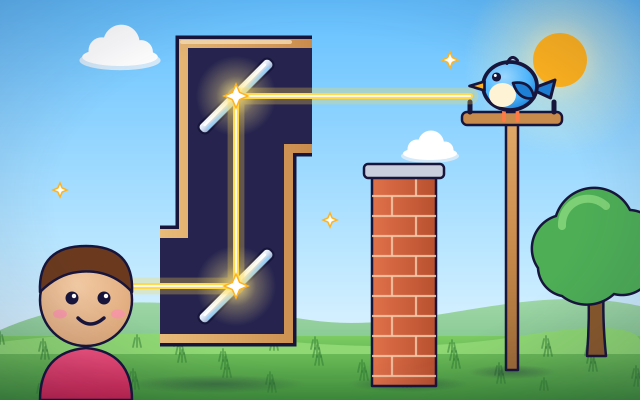
How do periscopes let us see over obstacles?
Arrange mirrors inside a tube and trace the reflected view.
#430
Light & sound
How do periscopes let us see over obstacles?
Arrange mirrors inside a tube and trace the reflected view.
 #431
Light & sound
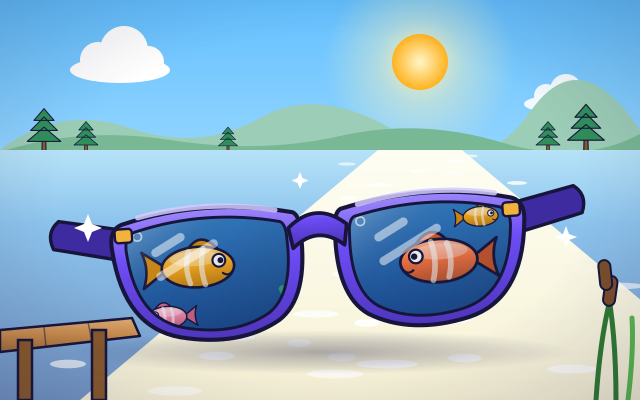
How do polarized sunglasses reduce glare?
Rotate virtual polarizing filters and compare reflected light passing through them.
#431
Light & sound
How do polarized sunglasses reduce glare?
Rotate virtual polarizing filters and compare reflected light passing through them.
 #432
Light & sound
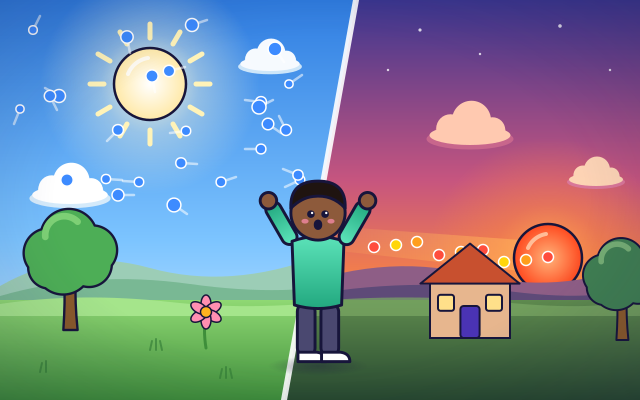
Why is the sky blue and a sunset red?
Follow sunlight through different atmospheric paths and explore scattering.
#432
Light & sound
Why is the sky blue and a sunset red?
Follow sunlight through different atmospheric paths and explore scattering.
 #433
Light & sound
How do colored lights combine?
Overlap red, green, and blue beams to create different colors.
#433
Light & sound
How do colored lights combine?
Overlap red, green, and blue beams to create different colors.
Keep exploring
Games to play next
- Shadow SculptorStack cubes under three lamps until every shadow matches the outline.
- Mirror MazeBend a beam of light with mirrors to light up every crystal — in the right order.
- Listen and FindOlly whispers a clue or plays a sound. Can you find it in the picture?
Guide for grown-ups
- How to start homeschooling: a step-by-step guide for familiesA guide for parents · 7 min read
Science games by grade
Science worksheets by grade
- Preschool Science Worksheets
- Pre-K Science Worksheets
- Kindergarten Science Worksheets
- 1st Grade Science Worksheets
- 2nd Grade Science Worksheets
- 3rd Grade Science Worksheets
- 4th Grade Science Worksheets
- 5th Grade Science Worksheets
- 6th Grade Science Worksheets
- 7th Grade Science Worksheets
- 8th Grade Science Worksheets