How do polarized sunglasses reduce glare?
Light bouncing off water wiggles mostly one way. Polarized lenses block that wiggle, so the glare fades and you can see below.
The big idea: Light is a wave that wiggles in every direction. When it bounces off flat water it wiggles mostly side to side. Polarized lenses block side-to-side wiggles, so the glare is stopped.
It's like a picket fence: a rope wiggled up and down passes between the slats, but a rope wiggled side to side is stopped by them.
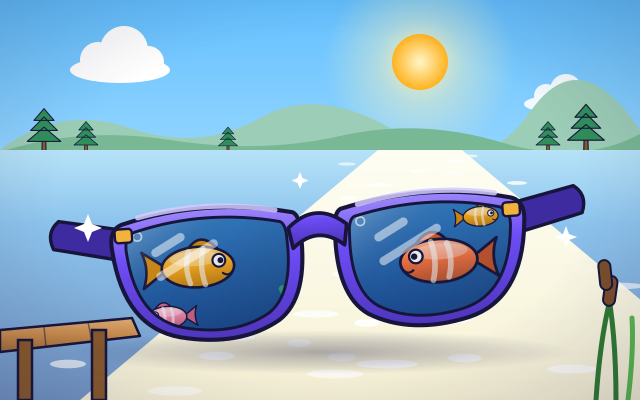
The interactive parts didn't load. The explanations below still work; try reloading the page.
Beating the glare
- It is a sunny day at the lake. Sunlight bounces off the water straight into Mia's eyes. That bright shine is called glare, and it hides the fish.
- Light travels as a wave, and waves wiggle. Sunlight is a mix of waves wiggling in every direction: up and down, side to side and everything in between.
- When the light bounces off the flat water, something changes. The side-to-side wiggles bounce best, so the glare wiggles mostly side to side.
- A polarized lens works like a tiny fence for light. Up-and-down wiggles get through the gaps. Side-to-side wiggles, like the glare, are stopped.
- Mia puts on polarized sunglasses. The side-to-side glare is blocked, but light from the fish still gets through. Now she can see under the water!
- Here is the proof. Turn a lens a quarter turn and its gaps lie flat, so the glare gets through again. Turn it back and the glare disappears.
Look inside a polarized lens
Tap each part of the sunglasses and the light. Watch what moves!
- Frame. The frame holds both lenses upright. That matters: a polarized lens only blocks glare when it is the right way around.
- Lens. The lens is a sandwich: tough clear layers outside and a very thin special film in the middle. A dark tint dims all the light a little.
- Polarizing film. The film is made of long, thin chains that were stretched until they all lined up. The chains soak up light that wiggles along them, which is the side-to-side glare.
- Pass direction. Every polarized lens has a pass direction. In sunglasses it points up and down, so up-and-down wiggles get through.
- Glare from the water. Glare from flat water wiggles side to side. That is across the pass direction, so the lens soaks it up and turns it into a tiny bit of warmth.
- Light from the fish. Light from the fish wiggles every way. The up-and-down part gets through the lens, so you still see the fish, only a little dimmer.
Turn the filter, watch the glare
Turn the filter by dragging its knob or using the slider. Compare the water inside the filter with the water outside. When is the glare weakest?
Experiment: The filter's arrow lies flat and the glare shines through. What happens when you give the filter a quarter turn?
- Start with the green arrow lying flat. Look at the water inside the filter.
- Slowly turn the filter until the arrow stands upright.
- Press Record at a few angles to compare.
What we found: The glare wiggles side to side. When the filter's arrow lies flat, the glare gets through. When the arrow stands upright, the glare is blocked and you can see the fish. In between, some of it gets through.
Turn on JavaScript to try it yourself.
Glare-free photos
You are a nature photographer. For each of the three photos, turn the filter until the glare is gone, then take the picture.
How polarized lenses work
Light travels as a wave. Like a wave on a rope, it wiggles as it goes. Light from the Sun or a lamp is a mix of waves that wiggle in every direction: up and down, side to side and every slant in between.
When this light bounces off something flat and shiny, such as a lake, a wet road or a window, the mix changes. Wiggles that run along the surface bounce off best. So the glare from flat water wiggles mostly side to side. Scientists say the light has become polarized, which means its wiggles are lined up.
A polarized lens contains a very thin film that lets through only one direction of wiggle. In sunglasses, that direction is up and down. The side-to-side glare is soaked up by the film, while about half of the ordinary light from everything else still gets through. That is why the glare disappears and you can suddenly see fish under the water.
The picket fence is a helpful picture, but it is not exactly how the film works. The real film is made of long chains that soak up light wiggling along them. So the real chains lie flat, across the direction that gets through. Also, polarized lenses cannot remove all glare: light bouncing off metal, or glare from an upright window, is not lined up the same way.
Key words
- Glare
- Very bright light bouncing off a shiny surface into your eyes.
- Polarized light
- Light whose wiggles are all lined up in one direction.
- Polarizing filter
- A sheet that lets through only one direction of wiggle.
- Transmission axis
- The direction of wiggle that a polarizing filter lets through.
- Malus's law
- The brightness that passes a polarizer equals the incoming brightness times the cosine squared of the angle between the light's vibration and the filter's axis.
- Brewster's angle
- The angle at which light reflected from a surface is completely polarized.
Check your thinking
-
Which light do polarized sunglasses block best?
Show the answer
Glare that wiggles side to side. Glare from flat water wiggles side to side, across the lens's pass direction, so it is blocked.
-
You hold polarized sunglasses in front of a lake and turn them a quarter turn. What happens?
Show the answer
The glare gets through again. After a quarter turn the pass direction lies flat, the same way the glare wiggles, so the glare passes.
-
Why can you still see the fish through polarized sunglasses?
Show the answer
Their light wiggles every way, so part of it gets through. Light from the fish is a mix of all wiggles. The up-and-down part passes the lens.
-
Polarized glare hits a filter whose axis is at 60 degrees to the glare's vibration. How much gets through?
Show the answer
One quarter. The cosine of 60 degrees is one half, and one half squared is one quarter.
-
Sunlight shines off an upright shop window. Which way does that glare mostly wiggle?
Show the answer
Up and down, along the window. Glare wiggles along the surface it bounced off. An upright window makes up-and-down glare, which normal polarized sunglasses let through.
-
You put one polarized lens on top of another and turn the top one a quarter turn. What do you see?
Show the answer
It goes dark, because almost no light passes both. The first lens lets through only one wiggle. The second lens, turned a quarter turn, blocks exactly that wiggle.
You're a Light & sound expert!
You watched, looked inside, tried it, solved the challenge and went deeper. Pick another question below, or switch the age at the top to see this topic another way.
More about light & sound
 #432
Light & sound
Why is the sky blue and a sunset red?
Follow sunlight through different atmospheric paths and explore scattering.
#432
Light & sound
Why is the sky blue and a sunset red?
Follow sunlight through different atmospheric paths and explore scattering.
 #433
Light & sound
How do colored lights combine?
Overlap red, green, and blue beams to create different colors.
#433
Light & sound
How do colored lights combine?
Overlap red, green, and blue beams to create different colors.
 #434
Light & sound
How do color filters change what we see?
Place filters over lights and objects and compare transmitted colors.
#434
Light & sound
How do color filters change what we see?
Place filters over lights and objects and compare transmitted colors.
 #435
Light & sound
How do glow-in-the-dark materials work?
Charge a model material with light and follow its delayed light emission.
#435
Light & sound
How do glow-in-the-dark materials work?
Charge a model material with light and follow its delayed light emission.
Keep exploring
Games to play next
- Mirror MazeBend a beam of light with mirrors to light up every crystal — in the right order.
- Shadow SculptorStack cubes under three lamps until every shadow matches the outline.
- Listen and FindOlly whispers a clue or plays a sound. Can you find it in the picture?
Guide for grown-ups
- How to start homeschooling: a step-by-step guide for familiesA guide for parents · 7 min read
Science games by grade
Science worksheets by grade
- Preschool Science Worksheets
- Pre-K Science Worksheets
- Kindergarten Science Worksheets
- 1st Grade Science Worksheets
- 2nd Grade Science Worksheets
- 3rd Grade Science Worksheets
- 4th Grade Science Worksheets
- 5th Grade Science Worksheets
- 6th Grade Science Worksheets
- 7th Grade Science Worksheets
- 8th Grade Science Worksheets