How does a micrometer measure tiny differences?
A micrometer uses a very fine screw to turn a big twist of your fingers into a tiny, exact movement you can read.
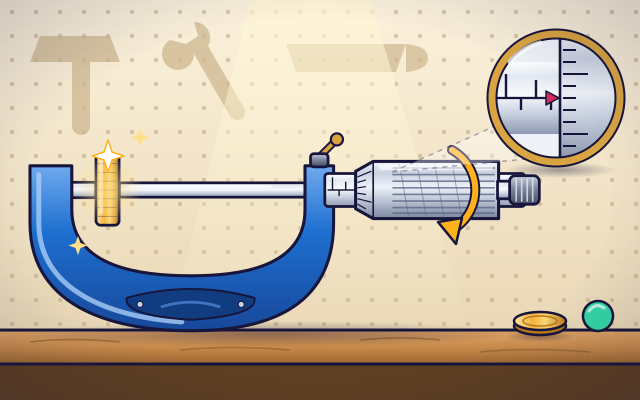
The big idea: One full turn of the fine screw moves the tip only half a millimeter. Marks around the handle split that turn into fifty smaller steps.
It's like a jar lid: a whole turn of your hand moves the lid down only a little. A micrometer's screw is the same, but far finer.
The interactive parts didn't load. The explanations below still work; try reloading the page.
Measuring what a ruler cannot
- How thick is a coin? On a ruler, its edge lands between two millimeter lines. We can only guess the last little bit.
- A micrometer holds the coin between a fixed tip, called the anvil, and a sliding tip, called the spindle. Turning the handle closes the gap.
- Inside the handle hides a very fine screw. One whole turn moves the spindle only half a millimeter, because the ridges are so close together.
- Fifty marks go around the handle, which is called the thimble. Turning by one mark moves the spindle one hundredth of a millimeter.
- First read the lines on the sleeve: 1 and a half millimeters. Then add the thimble mark at the line: 25 hundredths. The coin is 1.75 millimeters thick.
- The knob on the end clicks and slips when the tips touch. That way everyone squeezes the same gentle amount and gets the same answer.
Look inside a micrometer
Tap each part. The handle is see-through here so you can spot the hidden screw.
- Frame. The stiff C-shaped frame holds the two tips exactly in line. It must not bend, or the measurement would be wrong.
- Anvil. The anvil is the fixed tip. Its face is very flat and very hard, so it does not wear down.
- Spindle. The spindle is the moving tip. It slides toward the anvil as you turn the handle, until it touches the object.
- Fine screw. The hidden screw has ridges only half a millimeter apart. Each full turn moves the spindle by exactly that much.
- Sleeve scale. The sleeve has a line for every millimeter, and a line for every half millimeter. The edge of the handle uncovers them as it backs away.
- Thimble. You turn the thimble with your fingers. Fifty marks around its edge show how much of a turn you have made.
- Ratchet stop. Turn the micrometer by this small knob. When the tips touch, it clicks and slips so you cannot squeeze too hard.
- Lock. Flip the lock and the spindle cannot move. Now you can lift the micrometer away and still read it.
Turn the screw, read the scale
Turn the thimble and watch how far the spindle moves. Close it on an object and read the two scales in the round window.
Experiment: How far does the spindle move when you turn the thimble one full turn?
- Press One full turn in and watch the gap.
- Keep turning until the spindle touches the object.
- Read the sleeve lines, then the thimble mark, in the round window.
What we found: One whole turn moves the spindle only half a millimeter. Because a big twist makes such a small move, and the thimble marks split each turn into fifty parts, you can measure a hundredth of a millimeter.
Turn on JavaScript to try it yourself.
Find the worn washer
Four washers look the same, but one is worn thin. Measure them and pick the thin one.
How a screw makes tiny steps
A ruler is great for measuring a book or a pencil, but its lines are a whole millimeter apart. Many things need a closer look. A sheet of paper is about a tenth of a millimeter thick, and a hair is even thinner. To measure those, we need steps much smaller than the lines on a ruler.
A micrometer gets its tiny steps from a screw. When you turn a screw once, it moves forward by the distance between two of its ridges. The micrometer's screw has ridges only half a millimeter apart, so one whole turn of your fingers moves the tip just half a millimeter. A big, easy movement becomes a tiny, exact one.
Then the turn itself is cut into pieces. Fifty marks run around the thimble, so each mark is one fiftieth of a turn. Half a millimeter split into fifty parts is one hundredth of a millimeter. To read the tool, you look at the lines on the sleeve first, and then add the thimble mark that sits on the long line.
A good measurer is also gentle. If you squeeze hard, you squash the object a little and get a number that is too small. That is why you turn the clicking knob: it slips when the tips touch. The jar lid idea helps, but it is not perfect: a jar lid's thread is rough and loose, while a micrometer's screw is made very carefully so there is no wobble.
Key words
- Micrometer
- A tool that uses a fine screw to measure very small sizes.
- Pitch
- How far apart the ridges of a screw are, and how far it moves in one turn.
- Thimble
- The part you turn. It has marks all around its edge.
- Resolution
- The smallest step a measuring tool can show.
- Ratchet stop
- A knob that clicks and slips so the squeeze is always the same.
Check your thinking
-
Why does one big turn of the thimble move the spindle only a tiny bit?
Show the answer
The screw's ridges are very close together. A screw moves one ridge-gap per turn. Close ridges mean a tiny move for each turn.
-
Why do you turn a micrometer by the clicking knob on the end?
Show the answer
So everyone squeezes the same gentle amount. A harder squeeze squashes the object and changes the answer. The click keeps the squeeze the same.
-
The sleeve shows 3 millimeters and the thimble mark at the line is 20. How thick is the object?
Show the answer
3.20 millimeters. Each thimble mark is one hundredth of a millimeter, so 20 marks add 0.20 to the 3.
-
What would happen if the screw's ridges were farther apart?
Show the answer
Each turn would move the tip more, so the steps would be bigger. A screw moves one ridge-gap each turn. Wider gaps mean bigger, less careful steps.
-
Which of these needs a micrometer instead of a ruler?
Show the answer
The thickness of a sheet of paper. Paper is about a tenth of a millimeter thick, far smaller than a ruler's one-millimeter lines.
You're a Measuring & instruments expert!
You watched, looked inside, tried it, solved the challenge and went deeper. Pick another question below, or switch the age at the top to see this topic another way.
More about measuring & instruments
 #177
Measuring & instruments
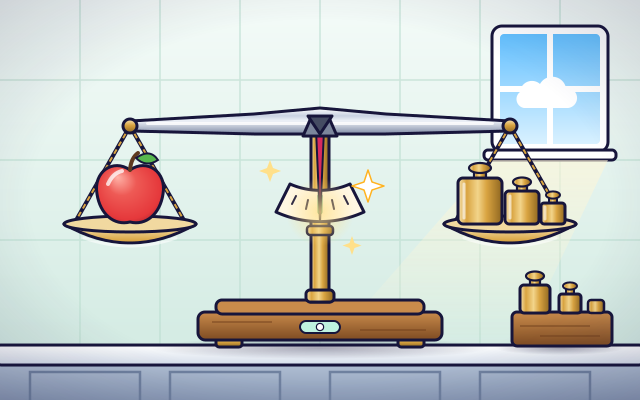
How do balance scales compare masses?
Add known masses to two pans and find combinations that balance the beam.
#177
Measuring & instruments
How do balance scales compare masses?
Add known masses to two pans and find combinations that balance the beam.
 #180
Measuring & instruments
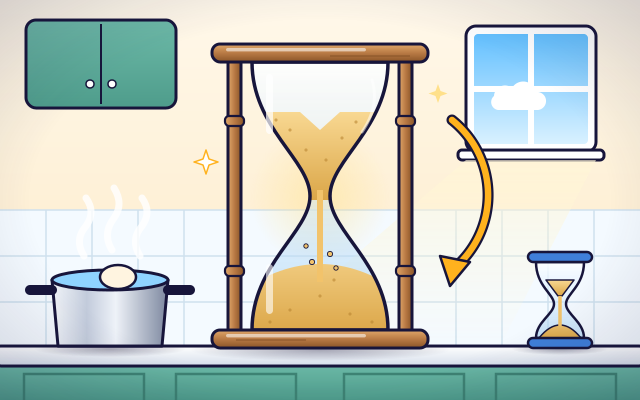
How does an hourglass measure time?
Change opening size and sand quantity and compare the time needed to empty.
#180
Measuring & instruments
How does an hourglass measure time?
Change opening size and sand quantity and compare the time needed to empty.
 #182
Measuring & instruments
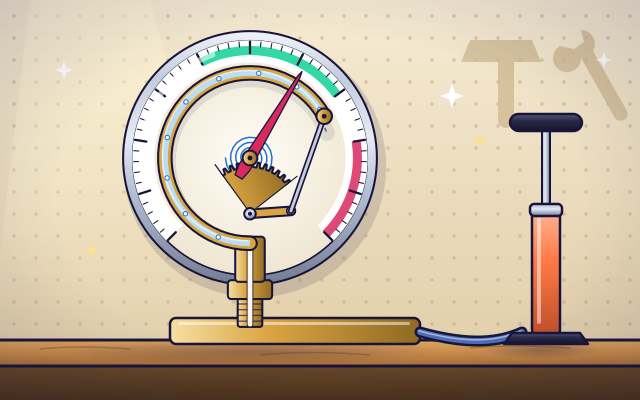
How does a mechanical pressure gauge work?
Change pressure and watch a flexible sensing element move the dial's pointer.
#182
Measuring & instruments
How does a mechanical pressure gauge work?
Change pressure and watch a flexible sensing element move the dial's pointer.
 #391
Measuring & instruments
How do microscopes reveal tiny details?
Position a sample and adjust focus and magnification to reveal structures.
#391
Measuring & instruments
How do microscopes reveal tiny details?
Position a sample and adjust focus and magnification to reveal structures.
Keep exploring
Games to play next
- Data DetectiveRead the clues hidden in graphs — and build your own.
- Clock TowerKeep the town on time: set the tower clock's hands just right.
- Mapmaker QuestFollow directions to make a map, then read its legend, compass rose and scale.
Guide for grown-ups
- How to start homeschooling: a step-by-step guide for familiesA guide for parents · 7 min read
Science games by grade
Science worksheets by grade
- Preschool Science Worksheets
- Pre-K Science Worksheets
- Kindergarten Science Worksheets
- 1st Grade Science Worksheets
- 2nd Grade Science Worksheets
- 3rd Grade Science Worksheets
- 4th Grade Science Worksheets
- 5th Grade Science Worksheets
- 6th Grade Science Worksheets
- 7th Grade Science Worksheets
- 8th Grade Science Worksheets