How do balance scales compare masses?
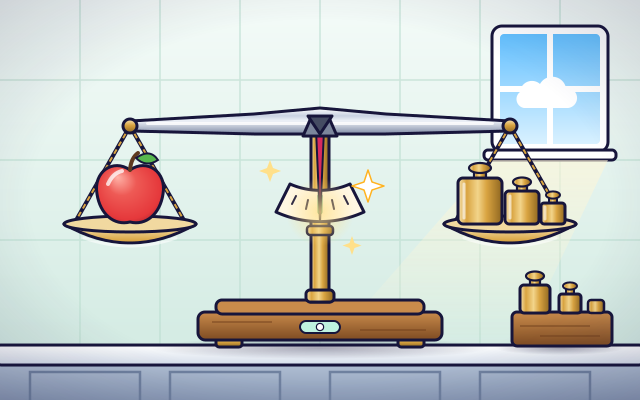
A balance compares an unknown object with known masses. When the beam is level, both sides are equal.
The big idea: A balance is a seesaw with equal arms. Add known masses to one pan until the beam is level, and they add up to the mass of the object.
It's like a seesaw: the heavier side sinks. When both sides weigh the same and sit the same distance out, it stays level.
The interactive parts didn't load. The explanations below still work; try reloading the page.
Weighing with a balance
- At a market stall, an apple goes onto one pan of a balance. That side sinks. But how much apple is there?
- The beam rests on a sharp point in the middle, called the pivot. Both arms are the same length, so the heavier side always goes down.
- On the other pan we add metal masses. Each one is marked with how much it is. The beam tips less and less as they add up.
- One more mass and the beam swings level. The pointer rests in the middle. Now add up the masses: the apple is 170 grams.
- On the Moon everything weighs less. But both pans get lighter by the same amount, so the balance still says 170 grams.
Look closely at a balance
Tap each part of the balance. Watch how it moves!
- Beam. The beam is the long bar across the top. It tips toward the heavier pan and stays level when both sides match.
- Pivot. The beam rocks on a sharp edge in the middle. A sharp edge rubs very little, so even a tiny difference can tip the beam.
- Pans. The object goes in one pan and the known masses go in the other. The two pans are made to be exactly as heavy as each other.
- Hangers. Chains let each pan hang straight down from the tip of the beam, even when the beam is tilted.
- Pointer. The pointer is fixed to the beam. It makes a small tilt easy to see, because its tip moves a long way.
- Scale plate. Lines behind the pointer show how far the beam is tilted. The middle line means the beam is level.
- Known masses. A set of metal masses, each marked in grams. You add them up to find the mass of the object.
- Base and feet. A heavy base keeps the balance steady. Feet that screw up and down make it stand perfectly level.
Weigh it with known masses
Tap the masses to add them to the right pan. Tap one on the pan to take it off. Make the beam level to find the object's mass.
Experiment: What will the beam do when the masses on the right add up to exactly the mass of the object?
- Add the biggest mass first. Is it too much or not enough?
- Keep adding smaller masses until the pointer is in the middle.
- Add up the masses on the pan.
What we found: When the masses add up to the same as the object, the beam is level and the pointer rests in the middle. Too little and the object's side stays down. Too much and the mass side goes down.
Turn on JavaScript to try it yourself.
Weigh the mystery box
Find the mass of the mystery box. Make the beam level using as few moves as you can.
Why level means equal
A balance is one of the oldest measuring tools in the world. People have used it for thousands of years to weigh grain, gold and spices. It has no batteries and no springs. It simply compares two things: the object you want to measure and a set of masses you already know.
It works like a seesaw. The beam rests on a sharp point in the middle, and the two arms are exactly the same length. Gravity pulls down on both pans. If one pan holds more, it pulls harder and that side sinks. If both pans hold the same amount, neither side wins, and the beam stays level.
To weigh something, put it on one pan and add known masses to the other. A smart way is to start with the biggest mass. If it is too much, take it off. If it is not enough, leave it on. Then try the next smaller one, and keep going. When the beam is level, add up the masses on the pan.
Here is something surprising: a balance gives the same answer on the Moon. Everything weighs less there, but both pans get lighter together, so the beam still stays level. That is because a balance measures mass, which is how much stuff is in an object. A seesaw is a good picture of a balance, but a real seesaw is not as fair: people can slide closer to the middle, and that changes everything.
Key words
- Mass
- How much stuff is in an object. It is measured in grams and kilograms.
- Weight
- How hard gravity pulls on an object.
- Pivot
- The point a beam turns on. It is also called a fulcrum.
- Torque
- A turning push: how hard something tries to tip the beam.
- Standard mass
- A piece of metal made to have an exactly known mass.
Check your thinking
-
The beam is level and the pointer is in the middle. What does that tell you?
Show the answer
Both pans hold the same mass. With equal arms, the beam stays level only when both sides pull down equally.
-
You put 100 grams on the right and the left pan stays down. What should you do?
Show the answer
Add more mass to the right pan. The left side is still heavier, so the right pan needs more mass.
-
You take a balance and an apple to the Moon. What does the balance say?
Show the answer
The same number of grams as on Earth. Both pans get lighter together, so the same masses still balance the apple.
-
The right pan hangs at half the distance from the pivot. How much mass on it balances 60 grams on the full-length left arm?
Show the answer
120 grams. Torque is weight times distance. Half the distance needs twice the mass: 120 times one half equals 60 times one.
-
Why does a balance rock on a sharp edge instead of a fat, round bar?
Show the answer
A sharp edge rubs very little, so tiny differences can tip the beam. Less rubbing means the beam can move for even a very small difference.
You're a Measuring & instruments expert!
You watched, looked inside, tried it, solved the challenge and went deeper. Pick another question below, or switch the age at the top to see this topic another way.
More about measuring & instruments
 #180
Measuring & instruments
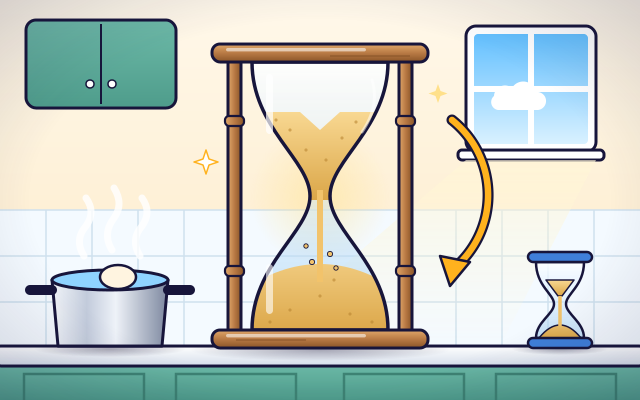
How does an hourglass measure time?
Change opening size and sand quantity and compare the time needed to empty.
#180
Measuring & instruments
How does an hourglass measure time?
Change opening size and sand quantity and compare the time needed to empty.
 #182
Measuring & instruments
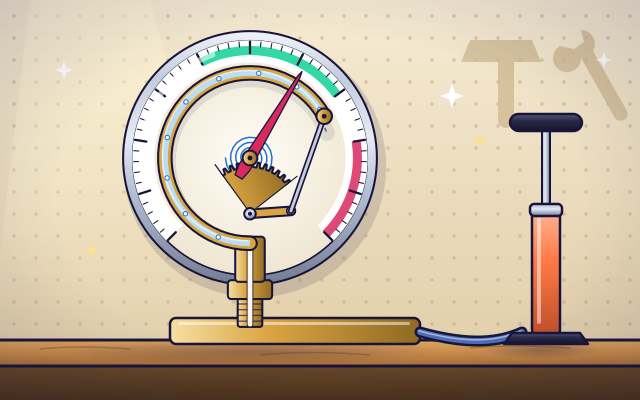
How does a mechanical pressure gauge work?
Change pressure and watch a flexible sensing element move the dial's pointer.
#182
Measuring & instruments
How does a mechanical pressure gauge work?
Change pressure and watch a flexible sensing element move the dial's pointer.
 #391
Measuring & instruments
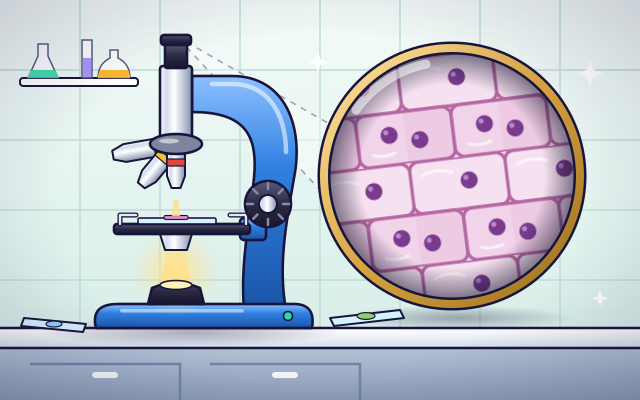
How do microscopes reveal tiny details?
Position a sample and adjust focus and magnification to reveal structures.
#391
Measuring & instruments
How do microscopes reveal tiny details?
Position a sample and adjust focus and magnification to reveal structures.
 #392
Measuring & instruments
How do thermal cameras show heat patterns?
Compare familiar objects in visible-light and simulated infrared images.
#392
Measuring & instruments
How do thermal cameras show heat patterns?
Compare familiar objects in visible-light and simulated infrared images.
Keep exploring
Games to play next
- Algebra BalanceKeep the scale level and the equation true, step by step.
- Data DetectiveRead the clues hidden in graphs — and build your own.
- Clock TowerKeep the town on time: set the tower clock's hands just right.
Guide for grown-ups
- How to start homeschooling: a step-by-step guide for familiesA guide for parents · 7 min read
Science games by grade
Science worksheets by grade
- Preschool Science Worksheets
- Pre-K Science Worksheets
- Kindergarten Science Worksheets
- 1st Grade Science Worksheets
- 2nd Grade Science Worksheets
- 3rd Grade Science Worksheets
- 4th Grade Science Worksheets
- 5th Grade Science Worksheets
- 6th Grade Science Worksheets
- 7th Grade Science Worksheets
- 8th Grade Science Worksheets