How do mirrors form reflections?
A mirror is so smooth and shiny that light bounces off it in perfect order, and that makes a reflection.
The big idea: Light bounces off a mirror at the same slant it arrived. Because the mirror is so smooth, every ray stays in order, so you see a clear picture.
It's like a ball bounced off a smooth floor: it leaves at the same slant it came in. Light does that on a mirror, and every ray stays in order.
The interactive parts didn't load. The explanations below still work; try reloading the page.
How a mirror makes a reflection
- You wave, and your reflection waves back at exactly the same moment. Nobody is inside the mirror. So how does it copy you?
- Throw a ball at a slant and it bounces away at the same slant. Light does the same thing on a mirror: the slant in matches the slant out.
- A mirror is very smooth, so rays that arrive side by side leave side by side. Paper is bumpy up close, so it scatters light every which way.
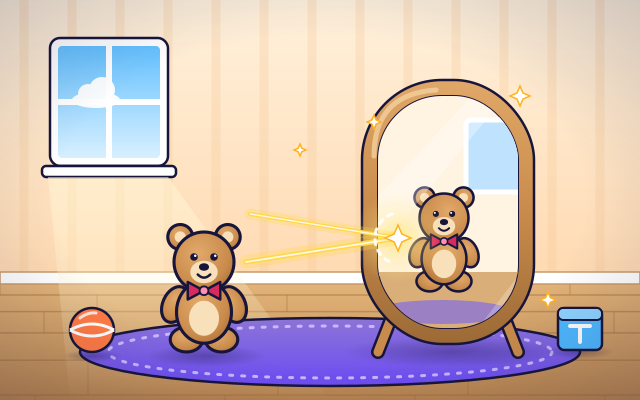
- Light from the teddy bounces off the mirror into your eye. Your brain thinks light always travels straight, so it sees a teddy behind the glass.
- Curve the mirror and the picture changes. A mirror that bulges out spreads the rays, so things look small. One that curves in can make things look big up close.
- So a reflection is your own light coming back. It leaves you, bounces off the mirror at the same slant, and returns to your eyes in perfect order.
Look inside a mirror
This mirror has been sliced open and made much thicker so you can see its layers. Tap each part.
- Glass. The front of a mirror is a sheet of clear, very flat glass. Light passes through it. The glass keeps the shiny layer smooth and safe.
- Shiny metal layer. On the back of the glass is a coat of shiny metal, usually silver or aluminum. It is far thinner than a hair, and it is what bounces the light back.
- Protective paint. A coat of tough paint covers the metal so it cannot be scratched off or spoiled by damp air.
- Frame. The frame holds the glass, protects its edges and lets you hang the mirror flat on a wall.
- Light going in. Light bounces off the teddy in every direction. Some of those rays travel to the mirror. This one is on its way in.
- Light bouncing out. The ray bounces off the metal at the same slant it came in, and travels to the child's eye.
- The picture you see. Your brain follows the ray straight back, so the teddy appears behind the mirror, just as far back as the real teddy is in front.
Light table: bounce a beam
Drag the flashlight along the track and watch where the beam bounces. Then swap the flat mirror for a curved one.
Experiment: A beam hits a flat mirror at a slant. Which way does it bounce?
- Put the flashlight right over the middle of the mirror. Where does the beam go?
- Drag the flashlight to one side and watch the bounce.
- Switch to a bulging mirror, then a caved-in one. What happens to the rays?
What we found: The beam always bounces off to the other side at the same slant it came in. A flat mirror keeps the rays side by side. A bulging mirror spreads them out, and a caved-in mirror brings them together until they cross.
Turn on JavaScript to try it yourself.
Bounce shot
Turn the mirror, then press Shine! Bounce the beam onto the gem in as few tries as you can.
Why a mirror shows a picture
You can only see something when light from it reaches your eyes. Light from a lamp or the Sun lands on you and bounces off in all directions. Some of that light travels to the mirror.
A mirror is a sheet of glass with a thin coat of shiny metal on the back. The metal bounces light like a floor bounces a ball: the light leaves at the same slant it arrived. Scientists say the angle in equals the angle out.
Lots of things bounce light. A white wall bounces plenty! But a wall is bumpy when you look very closely, so it scatters the light in a jumble. A mirror is so smooth that rays that arrive side by side leave side by side. The pattern of light stays in order, and that pattern is the picture.
Your brain expects light to travel in straight lines, so it traces the bounced rays straight back. They seem to come from behind the glass, and that is where you see your reflection. Bend the mirror and the rays spread out or squeeze together, which is why a spoon makes your face look so funny. The ball comparison is not perfect, though: a ball slows down and curves as it falls, while light keeps going straight at the same speed.
Key words
- Reflection
- Light bouncing off a surface.
- Ray
- A straight line that shows the path light travels along.
- Normal
- A line that sticks straight out of a mirror, like a flagpole on flat ground.
- Image
- The picture you see in a mirror.
- Convex mirror
- A mirror that bulges out toward you. It spreads rays apart and shows a small, wide view.
- Concave mirror
- A mirror that curves in, like the bowl of a spoon. It brings rays together and can magnify.
Check your thinking
-
A beam of light hits a flat mirror at a slant. What happens?
Show the answer
It bounces off at the same slant, on the other side. The slant going out always matches the slant coming in.
-
A white wall bounces lots of light. Why can't you see your face in it?
Show the answer
The wall is bumpy up close, so it scatters the light in a jumble. A picture needs the rays to stay in order. Only a very smooth surface does that.
-
You stand two steps in front of a flat mirror. How far away from you does your reflection seem to be?
Show the answer
Four steps. The picture is as far behind the mirror as you are in front: two steps plus two steps.
-
Why are the mirrors at tricky road corners made to bulge outward?
Show the answer
They spread the rays, so they show a wide view (but smaller). A bulging mirror gathers light from a wide area and squeezes it into a small picture.
-
Parallel rays hit a concave mirror straight on. What do the reflected rays do?
Show the answer
They come together near a focus, then cross and spread out. The normals of a concave mirror tilt inward, so the rays converge to a focus about half the radius of curvature from the mirror.
You're a Light & sound expert!
You watched, looked inside, tried it, solved the challenge and went deeper. Pick another question below, or switch the age at the top to see this topic another way.
More about light & sound
 #427
Light & sound
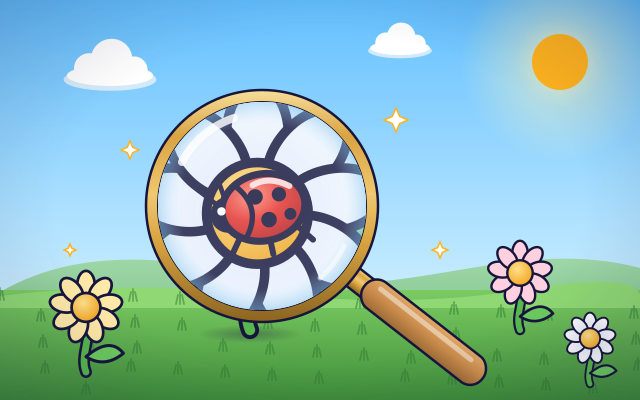
How does a magnifying glass enlarge things?
Move an object and lens and compare image size and focus.
#427
Light & sound
How does a magnifying glass enlarge things?
Move an object and lens and compare image size and focus.
 #428
Light & sound
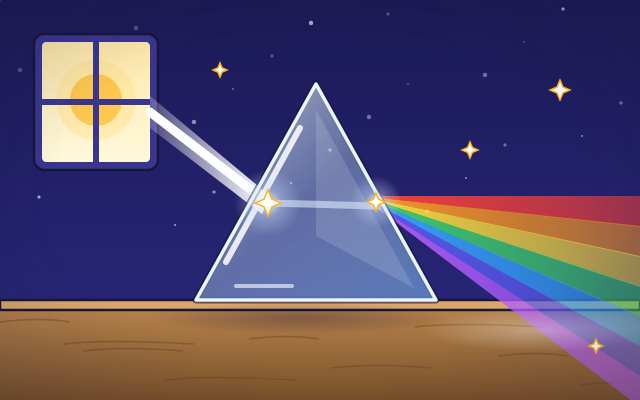
How does a prism separate colors?
Guide white light through a prism and follow different colors' paths.
#428
Light & sound
How does a prism separate colors?
Guide white light through a prism and follow different colors' paths.
 #429
Light & sound
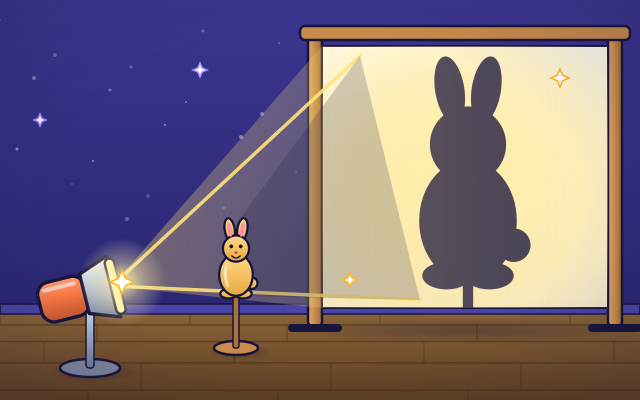
How do shadows change size and shape?
Move a light and object and compare the resulting shadow.
#429
Light & sound
How do shadows change size and shape?
Move a light and object and compare the resulting shadow.
 #430
Light & sound
How do periscopes let us see over obstacles?
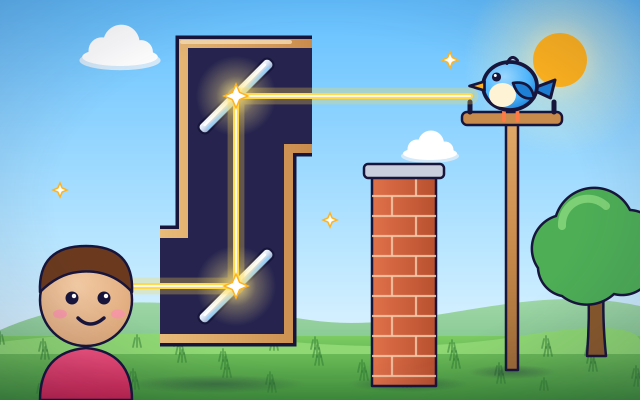
Arrange mirrors inside a tube and trace the reflected view.
#430
Light & sound
How do periscopes let us see over obstacles?
Arrange mirrors inside a tube and trace the reflected view.
Keep exploring
Games to play next
- Mirror MazeBend a beam of light with mirrors to light up every crystal — in the right order.
- Shadow SculptorStack cubes under three lamps until every shadow matches the outline.
- Listen and FindOlly whispers a clue or plays a sound. Can you find it in the picture?
Guide for grown-ups
- How to start homeschooling: a step-by-step guide for familiesA guide for parents · 7 min read
Science games by grade
Science worksheets by grade
- Preschool Science Worksheets
- Pre-K Science Worksheets
- Kindergarten Science Worksheets
- 1st Grade Science Worksheets
- 2nd Grade Science Worksheets
- 3rd Grade Science Worksheets
- 4th Grade Science Worksheets
- 5th Grade Science Worksheets
- 6th Grade Science Worksheets
- 7th Grade Science Worksheets
- 8th Grade Science Worksheets