How do sponges soak up water?
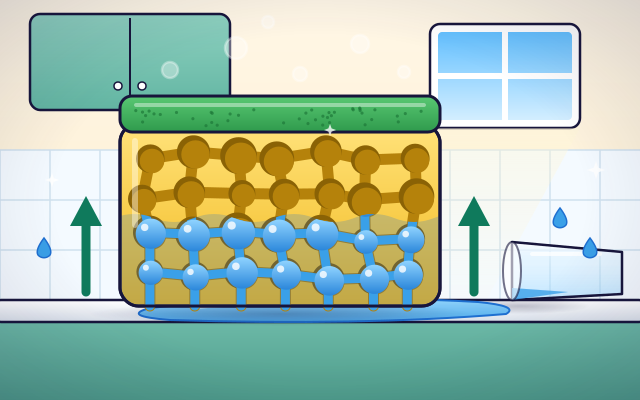
A sponge is full of holes that join up. Water clings to their walls and creeps from hole to hole.
The big idea: A sponge soaks up water because its holes are joined together and water clings to their walls. The water pulls itself in, hole after hole.
It's like a paper towel dipped in a spill: the water creeps up into it by itself, because it clings to the paper and pulls more water behind it.
The interactive parts didn't load. The explanations below still work; try reloading the page.
How a sponge drinks a spill
- A glass tips over and water spreads across the counter. One wipe with a sponge and the puddle is gone. The water did not vanish. It is inside the sponge. How did it get in?
- Look closely at a sponge. It is mostly holes. The holes are called pores, and a kitchen sponge has thousands of them. The soft walls between them are only a small part of the sponge.
- The holes are not separate. Each one opens into its neighbors, like rooms joined by doorways. That makes paths that lead from the outside of the sponge deep into the middle.
- Water clings to the sponge's walls. It also clings to itself. So the water at the front creeps along the walls and pulls more water behind it. It even climbs upward. The air that was in the holes is pushed out.
- Soon every hole is full of water. Lift the sponge and it feels much heavier. Most of the water stays put, held in the holes by that same clinging. A few drops fall from the biggest holes.
- Squeeze the sponge and you squash the holes flat. There is no room left for the water, so it runs out. Let go and the springy walls pop back. The holes open and are ready to soak up more.
Look inside a kitchen sponge
The sponge is cut open, and the lens shows two of its holes very close up. Tap each part.
- Scrub pad. The rough green layer on top. Its tough, scratchy fibers rub stuck food off plates. It does not soak up much water.
- Soft walls. The soft, springy material between the holes. Many kitchen sponges are made of cellulose, which comes from wood. Water clings to it strongly.
- Pore. A hole in the sponge. Pores are where the water is stored. A sponge has thousands of them, in many sizes.
- Tunnel. An opening that joins one pore to the next. Tunnels are the paths the water follows into the middle of the sponge.
- Creeping water. Water clings to the walls and to itself, so it creeps into the pores and even climbs upward. Tap here to watch it fill the sponge.
Which sponge soaks up water?
Dip each sponge in the tray and watch how far the water climbs. Try tiny holes, big holes and closed bubbles.
Experiment: A foam mat is full of bubbles too, but its bubbles are closed. Will it soak up water?
- Dip the sponge with tiny holes. Then try the one with big holes.
- Now choose Closed bubbles and dip it.
What we found: Water can only soak in if the holes are joined together. In the foam, every bubble is sealed, so the water stays outside. With joined holes, tiny ones lift the water higher than big ones.
Turn on JavaScript to try it yourself.
Water the thirsty plant
Choose a wick that carries water from the dish up to the plant, 10 centimeters above. For 3 stars, find the one that gets it there fastest.
The science of soaking
Put the corner of a dry sponge in a puddle and the water moves into it by itself. Nothing pushes it. To understand why, you need to know two things about water. First, water clings to many materials. That is why a wet finger stays wet. Second, water clings to itself. That is why it makes round drops.
A sponge is full of holes called pores, with thin, soft walls between them. Water clings to the walls. So when water touches the sponge, it spreads along the walls of the nearest pore. As it spreads, it pulls more water along behind it, because water clings to water. Then it reaches the next pore and does the same again. This creeping is called capillary action. It can even lift water upward.
Capillary action only works if the pores are joined together. In a kitchen sponge they are, so the water can travel from pore to pore. In a foam mat or a pool noodle, each bubble is closed. The water has no path, so those foams stay dry inside. That is why they float so well.
The size of the pores matters too. Small pores pull harder, so they can lift water higher and hold on to it better. That is why a paper towel, with its very tiny gaps, sucks up a spill so well. Big pores fill quickly and hold a lot when you dunk them, but they drip when you lift the sponge. The comparison with rooms and doors breaks down here: people walk through a door, but water is pulled through by clinging.
Key words
- Pore
- A small hole or space inside a material.
- Capillary action
- The way water creeps into narrow spaces by itself, even upward.
- Absorb
- To take in and hold a liquid.
- Hydrophilic
- Water-loving: water spreads out on it and clings to it.
- Open-cell and closed-cell
- Open-cell foams have holes that join up. Closed-cell foams have sealed bubbles.
Check your thinking
-
Where is the water stored in a wet sponge?
Show the answer
In its holes, called pores. A sponge is mostly holes, and the water fills them.
-
Why does squeezing a sponge push the water out?
Show the answer
It squashes the holes, so there is no room for the water. Squashed pores are smaller, so the water has to leave.
-
A pool noodle is full of bubbles. Why does it not soak up water?
Show the answer
Its bubbles are closed, so water cannot get from one to the next. Water needs joined-up holes to travel through. Sealed bubbles keep it out.
-
Two sponges stand in shallow water. One has pores half as wide as the other. How high does water climb in it?
Show the answer
About twice as high. Climb height is inversely proportional to pore radius: half the radius, twice the height.
-
A sponge is coated with wax, which repels water. Its pores are still connected. What happens when you dip it?
Show the answer
Water does not creep in, because it is not attracted to the walls. Capillary action needs adhesion. On a water-repelling wall the contact angle is above 90 degrees, so water is pushed out of narrow pores.
You're a Everyday chemistry & materials expert!
You watched, looked inside, tried it, solved the challenge and went deeper. Pick another question below, or switch the age at the top to see this topic another way.
More about everyday chemistry & materials
 #413
Everyday chemistry & materials
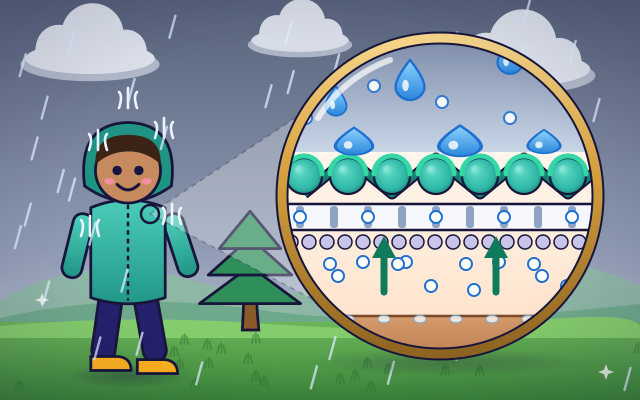
How can clothing be waterproof and breathable?
Compare liquid droplets and water vapor interacting with different fabric layers.
#413
Everyday chemistry & materials
How can clothing be waterproof and breathable?
Compare liquid droplets and water vapor interacting with different fabric layers.
 #414
Everyday chemistry & materials
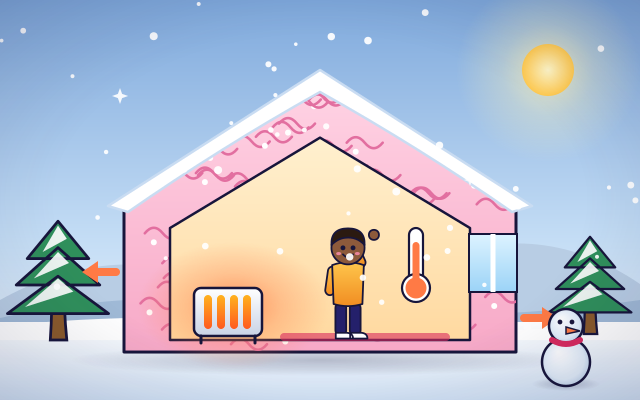
How does insulation slow heat loss?
Compare materials and trapped air around a model home or lunch container.
#414
Everyday chemistry & materials
How does insulation slow heat loss?
Compare materials and trapped air around a model home or lunch container.
 #415
Everyday chemistry & materials
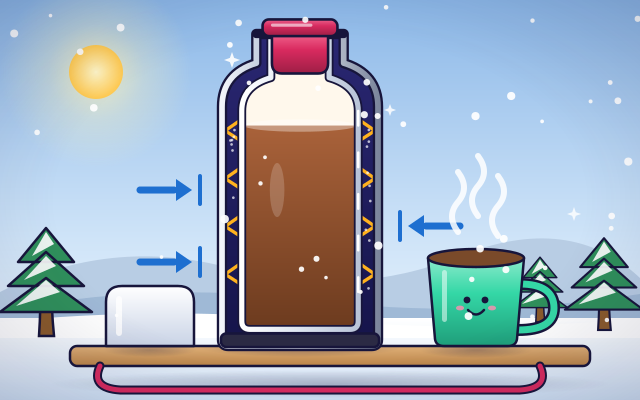
How does a vacuum flask keep drinks hot or cold?
Inspect the vacuum gap, reflective surfaces, and lid while tracking heat transfer.
#415
Everyday chemistry & materials
How does a vacuum flask keep drinks hot or cold?
Inspect the vacuum gap, reflective surfaces, and lid while tracking heat transfer.
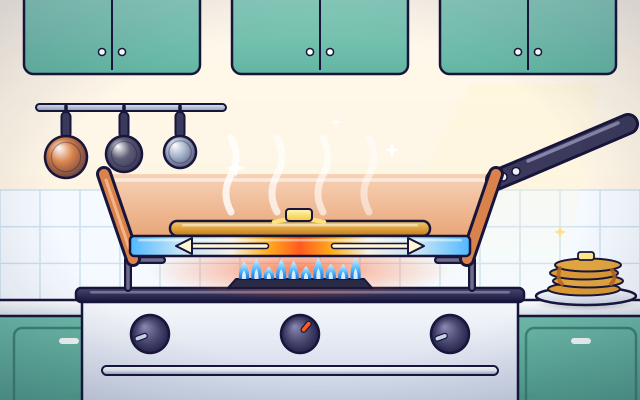 #416
Everyday chemistry & materials
How do cooking pans transfer heat?
Compare metal types and watch heat spread from a burner through a pan.
#416
Everyday chemistry & materials
How do cooking pans transfer heat?
Compare metal types and watch heat spread from a burner through a pan.
Keep exploring
Games to play next
- Weather LabPredict the weather in a box, then run a fair test to find out why.
- Science QuizzesOlly's Science Quiz Show: plants, animals, the body, weather, space and more, for every grade.
- Ratio KitchenScale recipes, fill ratio tables and find the better buy.
Guide for grown-ups
- How to start homeschooling: a step-by-step guide for familiesA guide for parents · 7 min read
Science games by grade
Science worksheets by grade
- Preschool Science Worksheets
- Pre-K Science Worksheets
- Kindergarten Science Worksheets
- 1st Grade Science Worksheets
- 2nd Grade Science Worksheets
- 3rd Grade Science Worksheets
- 4th Grade Science Worksheets
- 5th Grade Science Worksheets
- 6th Grade Science Worksheets
- 7th Grade Science Worksheets
- 8th Grade Science Worksheets