How does a pendulum clock keep time?
A swinging pendulum, a ticking escapement and a falling weight work together to keep a clock on time.
The big idea: Each swing of a pendulum takes the same time, so it is a steady beat. Longer pendulums swing more slowly. The escapement lets the gears move one tick for each swing, so the hands keep time.
It's like
The interactive parts didn't load. The explanations below still work; try reloading the page.
What makes a clock tick?
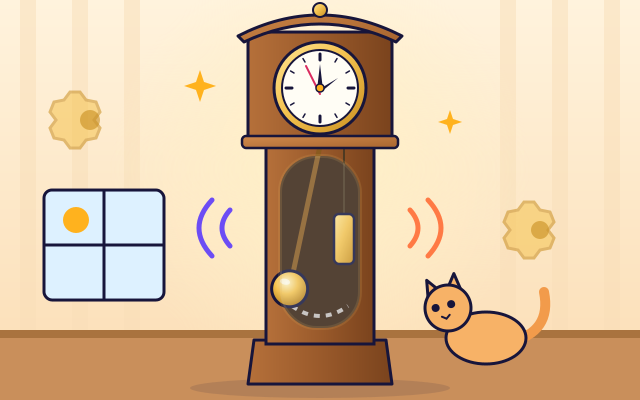
- This tall clock has kept time for years with no batteries at all. The secret is the pendulum swinging back and forth behind the glass.
- Here is something amazing. A pendulum swinging a lot and the same pendulum swinging a little take almost exactly the same time for each swing.
- Length is what matters. A short pendulum swings quickly, and a long pendulum swings slowly. A pendulum about one meter long takes one second for each swing.
- A heavy weight on a cord stores energy. If nothing stopped it, it would fall fast and spin the gears wildly. The clock lets it sink a tiny bit with every tick.
- The anchor rocks with the pendulum. Each swing it lets the toothed escape wheel slip forward a little, making the tick, and gives the pendulum a tiny push to keep it going.
- The ticking escape wheel turns a chain of gears. The gears are sized so the minute hand goes around once an hour and the hour hand once every twelve hours.
- A nut under the bob lets you adjust the clock. Lower the bob and the pendulum swings more slowly. Raise it and the clock speeds up.
Inside a pendulum clock
On the left is the whole clock. On the right is a close-up of the movement behind the dial. Tap each part to see it work.
- Pendulum. The pendulum is a long rod with a weight at the bottom. Each swing takes the same time, so it is the clock's steady beat.
- Bob and rating nut. The bob is the heavy disk at the bottom of the pendulum. Turning the nut under it moves it up or down to make the clock faster or slower.
- Anchor. The anchor is shaped a bit like a ship's anchor. It rocks with the pendulum, and its two hooks catch and release the escape wheel's teeth.
- Escape wheel. The escape wheel has slanted teeth. The weight tries to spin it, but the anchor lets it move only a tiny step with each swing.
- Gear train. A chain of big and small gears passes the motion along. The sizes are chosen so the hands move at exactly the right speeds.
- Driving weight. The heavy weight hangs on a cord wrapped around a drum. As it sinks, it turns the gears. Winding the clock lifts it back up.
- Crutch. The crutch is a thin arm that links the anchor to the pendulum, so they rock together.
- Dial and hands. The minute hand goes around once each hour, and the short hour hand once every twelve hours.
Pendulum lab: length and rhythm
Change the pendulum's length and the bob's weight. Watch the swing, the ticking clock and the swing trace. What changes the rhythm?
Experiment: What happens to the clock's ticking when you make the pendulum longer?
- Make the pendulum short and watch how fast it ticks.
- Make it long and watch again.
- Change the bob's weight. Does the rhythm change?
What we found: A longer pendulum swings more slowly, so the clock ticks more slowly. A heavier bob doesn't change the rhythm at all. Only the length (and gravity) matter.
Turn on JavaScript to try it yourself.
Keep the clock on time
Adjust the pendulum so your clock matches the helper clock after one hour. For 3 stars, be within 15 seconds.
The steady beat of a pendulum
A pendulum is a weight on a rod or string that can swing freely. Gravity pulls the weight back toward the middle, it overshoots, and gravity pulls it back again. Each swing takes the same amount of time, whether the swing is big or small. That makes a pendulum a steady beat, like a drummer that never speeds up.
The length of the pendulum sets the beat. Short pendulums swing quickly and long pendulums swing slowly. A heavier bob does not change the beat at all. A pendulum about one meter long takes one second to swing across, which is why many tall clocks are so tall.
A pendulum on its own would slowly stop, because air and friction take a little energy every swing. The clock's falling weight puts that energy back. The escapement lets the weight push the gears forward one tiny step each swing and gives the pendulum a small nudge at the same time.
The gears turn those steps into moving hands: one turn an hour for the minute hand and one turn every twelve hours for the hour hand. If the clock runs fast, you lower the bob to make the pendulum longer. If it runs slow, you raise the bob.
Key words
- Period
- The time a pendulum takes to swing there and back.
- Escapement
- The anchor and escape wheel that release the clock's energy one small step per swing.
- Bob
- The heavy weight at the bottom of a pendulum.
- Isochronism
- Taking the same time for every swing, big or small.
- Gear train
- A chain of gears that passes motion along and sets the speed of each hand.
- Potential energy
- Energy stored in something lifted up, like the clock's weight.
Check your thinking
-
Which pendulum ticks faster?
Show the answer
A short pendulum. A shorter pendulum has a shorter swing time, so it ticks faster.
-
Where does a pendulum clock get its energy?
Show the answer
From a falling weight. Winding lifts the weight. As it sinks, its stored energy turns the gears.
-
A clock runs too fast. What should you do?
Show the answer
Lower the bob to make the pendulum longer. A longer pendulum swings more slowly, so the clock slows down.
-
A pendulum is made four times longer. What happens to its period?
Show the answer
It doubles. T ∝ √L, and √4 = 2, so the period doubles.
-
What does the escapement do?
Show the answer
Lets the gears move a little with each swing and nudges the pendulum. It releases one small step per swing and gives the pendulum a tiny push to keep it swinging.
-
Does a heavier bob change how fast a pendulum swings?
Show the answer
No, only the length matters. The weight doesn't change the rhythm. Try it in the lab!
You're a Everyday machines expert!
You watched, looked inside, tried it, solved the challenge and went deeper. Pick another question below, or switch the age at the top to see this topic another way.
More about everyday machines
 #38
Everyday machines
How does a sewing machine make stitches?
Watch the needle, upper thread, and bobbin mechanism in slow motion. Join pieces of virtual fabric and compare stitch lengths and patterns.
#38
Everyday machines
How does a sewing machine make stitches?
Watch the needle, upper thread, and bobbin mechanism in slow motion. Join pieces of virtual fabric and compare stitch lengths and patterns.
 #39
Everyday machines
How does a dishwasher clean dishes?
Look inside during washing, rinsing, and drying. Follow water through rotating spray arms and arrange dishes so the spray can reach them.
#39
Everyday machines
How does a dishwasher clean dishes?
Look inside during washing, rinsing, and drying. Follow water through rotating spray arms and arrange dishes so the spray can reach them.
 #40
Everyday machines
How does a microwave heat food?
View a simplified animation of microwaves transferring energy to food. Explore uneven heating patterns and investigate how a rotating plate helps.
#40
Everyday machines
How does a microwave heat food?
View a simplified animation of microwaves transferring energy to food. Explore uneven heating patterns and investigate how a rotating plate helps.
 #143
Everyday machines
How does an air conditioner cool a room?
Follow heat moving outdoors while cooled air circulates inside a model room.
#143
Everyday machines
How does an air conditioner cool a room?
Follow heat moving outdoors while cooled air circulates inside a model room.
Keep exploring
Games to play next
- Clock TowerKeep the town on time: set the tower clock's hands just right.
- Machine RepairFix levers, pulleys, gears and ramps so every contraption works.
- Circuit Workshop 3DWire up batteries, bulbs and switches on a 3D workbench.
Guide for grown-ups
- How to start homeschooling: a step-by-step guide for familiesA guide for parents · 7 min read
Science games by grade
Science worksheets by grade
- Preschool Science Worksheets
- Pre-K Science Worksheets
- Kindergarten Science Worksheets
- 1st Grade Science Worksheets
- 2nd Grade Science Worksheets
- 3rd Grade Science Worksheets
- 4th Grade Science Worksheets
- 5th Grade Science Worksheets
- 6th Grade Science Worksheets
- 7th Grade Science Worksheets
- 8th Grade Science Worksheets