How does a sewing machine make stitches?
A sewing machine links a top thread and a bottom thread into stitches, hundreds of times a minute.
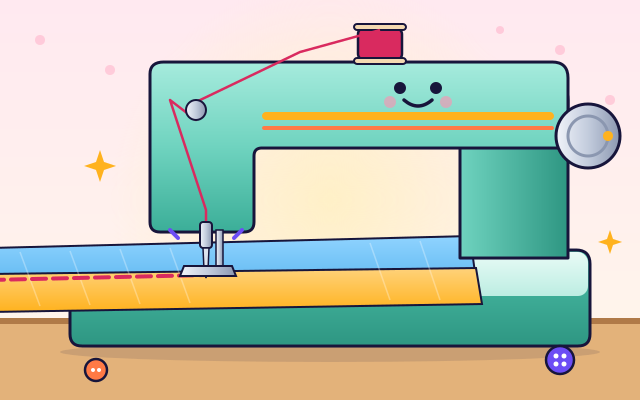
The big idea: A sewing machine uses two threads. The needle pushes the top thread through the fabric, a spinning hook loops it around the bottom thread from the bobbin, and then the top thread is pulled tight so the threads lock together in the middle of the fabric.
It's like
The interactive parts didn't load. The explanations below still work; try reloading the page.
How two threads make a stitch
- A sewing machine can make hundreds of stitches a minute. The needle flies up and down while the fabric slides along underneath it.
- Here's the surprise: a sewing machine uses two threads. The top thread comes from the spool, and the bottom thread is wound on a small bobbin hidden under the fabric.
- Let's slow it right down. The needle has its hole, called the eye, near the point. It carries the top thread down through both pieces of fabric.
- As the needle starts to rise, the thread rubs on the fabric and puffs out into a small loop. The point of a spinning hook slips into that loop.
- The hook keeps spinning and stretches the loop all the way around the bobbin case, so the bottom thread ends up inside the loop.
- Now the take-up lever pulls the top thread tight. The loop slips off the hook, and the two threads lock together in the middle of the fabric. Then little teeth push the fabric along for the next stitch.
- By changing how far the fabric moves, the machine makes short or long stitches. By swinging the needle side to side, it makes zigzag stitches that can stretch.
Parts of a sewing machine
The machine's base is cut open so you can see the parts under the fabric. Tap each part to watch it move.
- Spool of thread. The spool holds the top thread. The thread unwinds as the machine pulls it down to the needle.
- Tension discs. The thread passes between two discs that squeeze it. More squeeze makes the top thread pull tighter.
- Take-up lever. The take-up lever bobs up and down. It gives out thread to make the loop, then pulls it back to tighten each stitch.
- Needle. A machine needle's eye is near its point, not at the top like a hand-sewing needle. It carries the top thread down under the fabric.
- Presser foot. The presser foot presses the fabric down onto the little teeth below, so the fabric moves along smoothly.
- Feed dogs. The feed dogs are small metal teeth. They pop up, grab the fabric, move it back by one stitch, then drop down and return.
- Rotating hook. The hook spins under the fabric. Its sharp point catches the loop of top thread and carries it around the bobbin.
- Bobbin. The bobbin is a tiny spool for the bottom thread. It sits in a case inside the hook, and the top thread loops around it.
- Hand wheel and motor. The motor spins the hand wheel. One turn of the wheel makes one stitch. You can also turn it slowly by hand.
Stitch lab: length and pattern
Sew the two pieces together. Change the stitch length and the pattern, and turn on slow motion to see each stitch form. Which seam looks strongest?
Experiment: Short stitches or long stitches: which put more stitches into the seam?
- Set a long stitch and sew a little way.
- Set a short stitch and sew the same distance.
- Compare how many stitches each part of the seam has.
What we found: Short stitches fit many more stitches into the same seam, which makes it stronger, but it takes longer and uses more thread. Long stitches are quick and easy to pull out. Zigzag stitches can stretch.
Turn on JavaScript to try it yourself.
Sew the curvy seam
Join the two pieces along the curvy line. Steer the fabric so the stitches stay on the line. For 3 stars, keep 90% of them on it.
The clever lockstitch
When you sew by hand, one thread goes in and out of the fabric. A sewing machine can't do that, because its needle never lets go of the thread or goes all the way through. Instead it uses two threads: one from the spool on top and one from a little bobbin underneath.
The needle carries the top thread down through the fabric. As it starts to rise, a small loop of thread forms. A spinning hook catches the loop and carries it all the way around the bobbin, so the bottom thread ends up inside it. Then the take-up lever pulls the top thread tight, and the two threads lock together.
This is called a lockstitch. When the tension of both threads is balanced, the lock sits hidden in the middle of the fabric, and the stitches look the same on both sides. Then the feed dogs, little teeth under the fabric, push it along so the next stitch lands in a new place.
Changing how far the fabric moves makes short or long stitches. Short stitches make a stronger seam. Swinging the needle from side to side makes a zigzag, which can stretch without breaking, perfect for stretchy clothes.
Key words
- Lockstitch
- A stitch made of two threads that interlock inside the fabric.
- Bobbin
- A small spool under the fabric that holds the bottom thread.
- Feed dogs
- Little teeth under the presser foot that move the fabric along.
- Tension
- How tightly a thread is pulled.
- Stitch length
- How far the fabric moves between one stitch and the next.
- Take-up lever
- The arm that pulls the top thread tight after each stitch.
Check your thinking
-
How many threads make a machine lockstitch?
Show the answer
Two: a top thread and a bobbin thread. The top thread loops around the bobbin thread and they lock together.
-
What carries the loop of top thread around the bobbin?
Show the answer
The rotating hook. The hook's point slips into the loop and carries it all the way around.
-
Which makes a stronger seam?
Show the answer
Short stitches. Short stitches put more stitches into the seam, so it holds more firmly.
-
Which stitch is best for stretchy clothes?
Show the answer
Zigzag. A zigzag can stretch with the fabric instead of snapping.
-
Where should the two threads lock when the tension is right?
Show the answer
In the middle of the fabric. Balanced tension hides the lock inside the fabric.
You're a Everyday machines expert!
You watched, looked inside, tried it, solved the challenge and went deeper. Pick another question below, or switch the age at the top to see this topic another way.
More about everyday machines
 #39
Everyday machines
How does a dishwasher clean dishes?
Look inside during washing, rinsing, and drying. Follow water through rotating spray arms and arrange dishes so the spray can reach them.
#39
Everyday machines
How does a dishwasher clean dishes?
Look inside during washing, rinsing, and drying. Follow water through rotating spray arms and arrange dishes so the spray can reach them.
 #40
Everyday machines
How does a microwave heat food?
View a simplified animation of microwaves transferring energy to food. Explore uneven heating patterns and investigate how a rotating plate helps.
#40
Everyday machines
How does a microwave heat food?
View a simplified animation of microwaves transferring energy to food. Explore uneven heating patterns and investigate how a rotating plate helps.
 #143
Everyday machines
How does an air conditioner cool a room?
Follow heat moving outdoors while cooled air circulates inside a model room.
#143
Everyday machines
How does an air conditioner cool a room?
Follow heat moving outdoors while cooled air circulates inside a model room.
 #144
Everyday machines
How do ceiling fans help us feel cooler?
Change blade speed and follow airflow around a person in a room.
#144
Everyday machines
How do ceiling fans help us feel cooler?
Change blade speed and follow airflow around a person in a room.
Keep exploring
Games to play next
- Machine RepairFix levers, pulleys, gears and ramps so every contraption works.
- Circuit Workshop 3DWire up batteries, bulbs and switches on a 3D workbench.
- Clock TowerKeep the town on time: set the tower clock's hands just right.
Guide for grown-ups
- How to start homeschooling: a step-by-step guide for familiesA guide for parents · 7 min read
Science games by grade
Science worksheets by grade
- Preschool Science Worksheets
- Pre-K Science Worksheets
- Kindergarten Science Worksheets
- 1st Grade Science Worksheets
- 2nd Grade Science Worksheets
- 3rd Grade Science Worksheets
- 4th Grade Science Worksheets
- 5th Grade Science Worksheets
- 6th Grade Science Worksheets
- 7th Grade Science Worksheets
- 8th Grade Science Worksheets